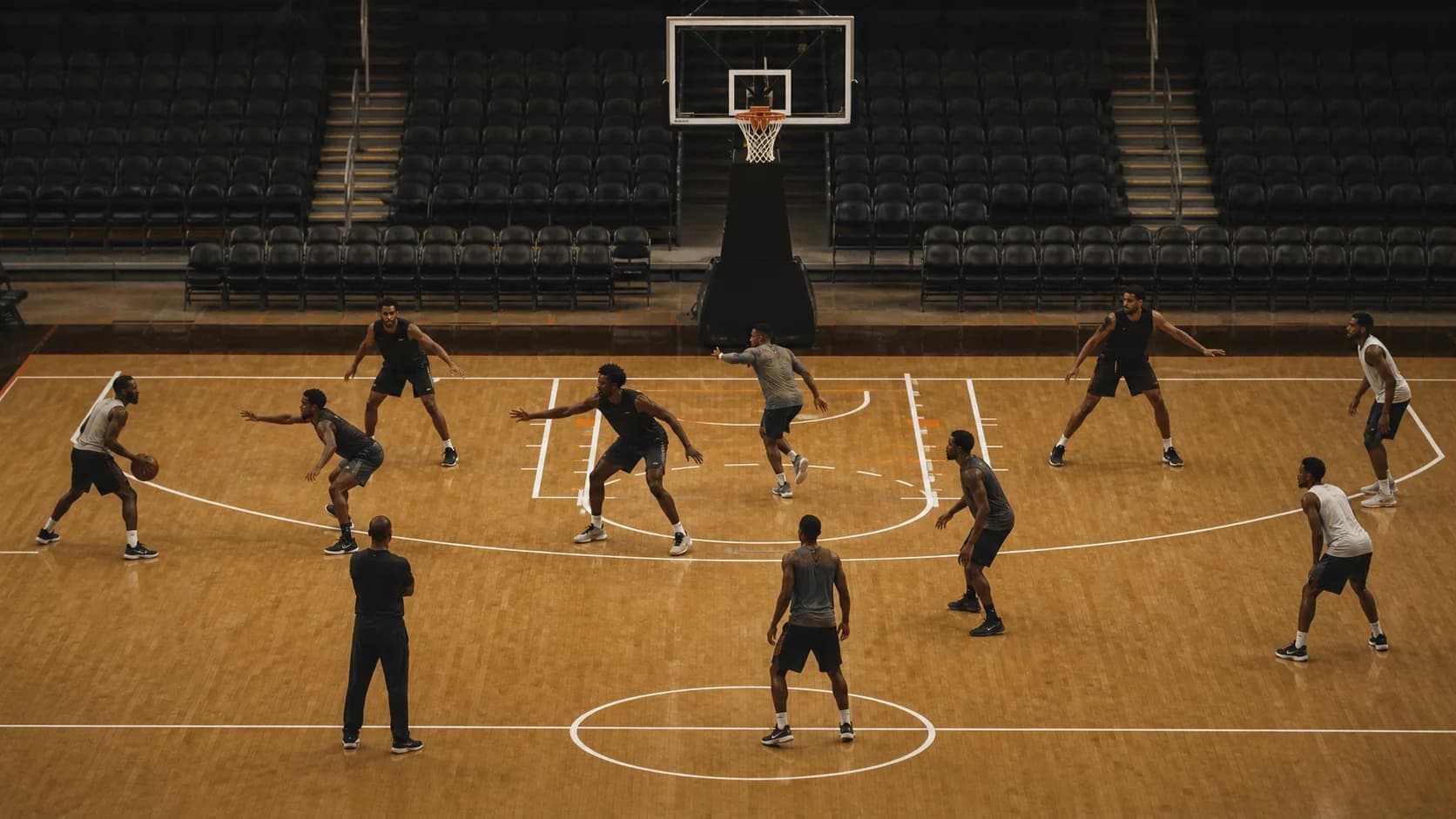
Most coaches plan practice the morning of. Sometimes the night before. They run the same warmup, the same scrimmage block, maybe a new emphasis depending on what felt off in the last game.
The coaches whose teams keep improving in February planned their full season in October. Different approach. Different results.
This is the template for that approach, the season plan, the weekly workflow, and the in-season adjustment cycles that actually produce February-better-than-November teams.
The Three-Layer Practice Plan
Every winning program plans at three layers:
Layer 1: The Season Plan
The 4-5 themes you want your team to be good at by the playoffs, mapped to months.
Example season plan for a high school program:
- October: transition defense + half-court switching scheme
- November: primary actions (Horns, Spain, Chicago) installed and rehearsed
- December: pick-and-roll coverages, drop, hedge, switch
- January: ATO and SLOB packages, late-game possessions
- February: playoff prep, situational scrimmages, opponent-specific scouting
Each month has ONE primary theme. Practices in that month build toward that theme. Themes layer, November's primary actions are practiced against December's coverages, etc.
Layer 2: The Weekly Plan
Each day of the week emphasizes a different aspect of the monthly theme. Typical weekly cadence:
- Monday: heavy contact + scrimmage day. Game-simulation intensity.
- Tuesday: film + skill day. Lighter physical load, higher cognitive load.
- Wednesday: team + situational. Specific scenarios from the monthly theme.
- Thursday: light prep + walk-through. Pre-game day.
- Friday/Saturday: games.
- Sunday: recovery + film review + scout for next opponent.
The rotation prevents practice from feeling repetitive while still building toward the monthly theme.
Layer 3: The Daily Plan
The specific 90-120 minutes. A typical daily structure:
- 0-10 min: dynamic warmup + ball-handling.
- 10-25 min: skill block (shooting, footwork, finishing).
- 25-50 min: team block (offense or defense install/rehearsal).
- 50-75 min: scrimmage with constraints (this month's theme).
- 75-90 min: situational (last 2 minutes, free throw scenarios, OT prep).
- 90-95 min: cooldown + announcements.
Most coaches do this layer well. The gap is whether the daily layer ladders up to a real season plan or just exists in isolation.
The Free Template
Here's the one-page season-plan template you can use today:
``` PROGRAM: [Team name] SEASON: [Year] ───────────────────────────────────────────────── SEASON THEMES (4-5): 1. [Theme], [Target month] 2. [Theme], [Target month] 3. [Theme], [Target month] 4. [Theme], [Target month] 5. [Theme], [Target month]
MONTHLY PRIORITIES: October: [Primary theme + 2 supporting drills] November: ... December: ... January: ... February: ...
WEEKLY CADENCE: Monday: [Heavy contact + scrimmage] Tuesday: [Film + skill] Wednesday: [Team + situational] Thursday: [Light prep + walk-through] Friday: [Game] Saturday: [Game / recovery] Sunday: [Film review + opponent scout]
PRACTICE BLOCK STRUCTURE (90-120 min): 0-10: Warmup + handling 10-25: Skill block 25-50: Team block 50-75: Scrimmage with constraints 75-90: Situational 90-95: Cooldown ───────────────────────────────────────────────── ```
Two pages total when filled in. Lives in a binder, gets referenced weekly, gets updated monthly.
The Weekly Adjustment Cycle
The single biggest in-season improvement lever. Every Sunday:
- Watch the weekend's game film. Not full game, the 5-7 possessions that decided it.
- Identify 1-2 specific tactical breakdowns. Not "we need to play better defense." Specific: "we missed the weak-side rotation 4 times in the second half, Tuesday's film session covers this."
- Update the upcoming week's practice plan to address those specific breakdowns.
- Send a 1-page weekly memo to the staff outlining the changes.
Most coaches do step 1 and skip steps 2-4. The result: practice doesn't actually adjust to what's breaking. The teams that improve in February are the ones whose Sunday → Monday adjustment cycle is reliable.
For the film-study workflow that drives this cycle, see how NBA coaches use film: the 6-hour daily workflow and how to write a basketball scouting report: template + workflow.
HoopBrief currently turns basketball and matchup questions into structured reports using public statistical and play-by-play context. It does not accept film uploads or provide possession-level video tagging.
The Monthly Re-Plan
The cycle most coaches skip entirely. On the last Sunday of each month:
- Review the original month's theme. Did the team actually get better at it?
- Pull the lineup net ratings for the month. Which units are working? Which aren't?
- Decide whether to accelerate, slow down, or pivot the next month's theme based on the trajectory.
- Update the season plan to reflect the new reality.
This is the layer that separates "had a season plan" from "actually executed a season plan." Programs that re-plan monthly compound their advantage; programs that lock the October plan in October usually find it doesn't match February reality.
The 3 Most-Common Practice Planning Mistakes
The 3 mistakes nearly every newer coach makes, and the fix for each:
Mistake 1: Planning Day-by-Day Only
Symptom: practice feels reactive. The team's strengths and weaknesses in February look almost identical to October.
Fix: add the monthly priority layer. Pick a theme for the month and let the daily plan ladder up to it.
Mistake 2: Over-Adjusting Weekly
Symptom: every Tuesday's practice is a complete pivot based on Friday's loss. Players never repeat enough to actually install anything.
Fix: allow 1-2 specific tactical adjustments per week MAX. Everything else stays on the monthly plan. The 1-2 adjustments compound over a season; the 10-per-week thrash doesn't.
Mistake 3: No Film Cycle
Symptom: practice adjustments are based on what the coach FELT during the game, not what actually happened on the possessions.
Fix: the Sunday film cycle above. 30-45 minutes max. The 5-7 possessions that decided the game, tagged for the specific breakdown.
For the broader matchup-prep workflow, see what coaches look for in matchup prep.
HoopBrief currently turns basketball and matchup questions into structured reports using public statistical and play-by-play context. It does not accept film uploads or provide possession-level video tagging.
Where to Go Next
Workflow companions: how to write a basketball scouting report, template + workflow, how NBA coaches use film: the 6-hour daily workflow, what coaches look for in matchup prep.
Foundation reading: how NBA coaches prepare for playoffs, the basketball film study guide.
Hub: Playoff Prep Hub.