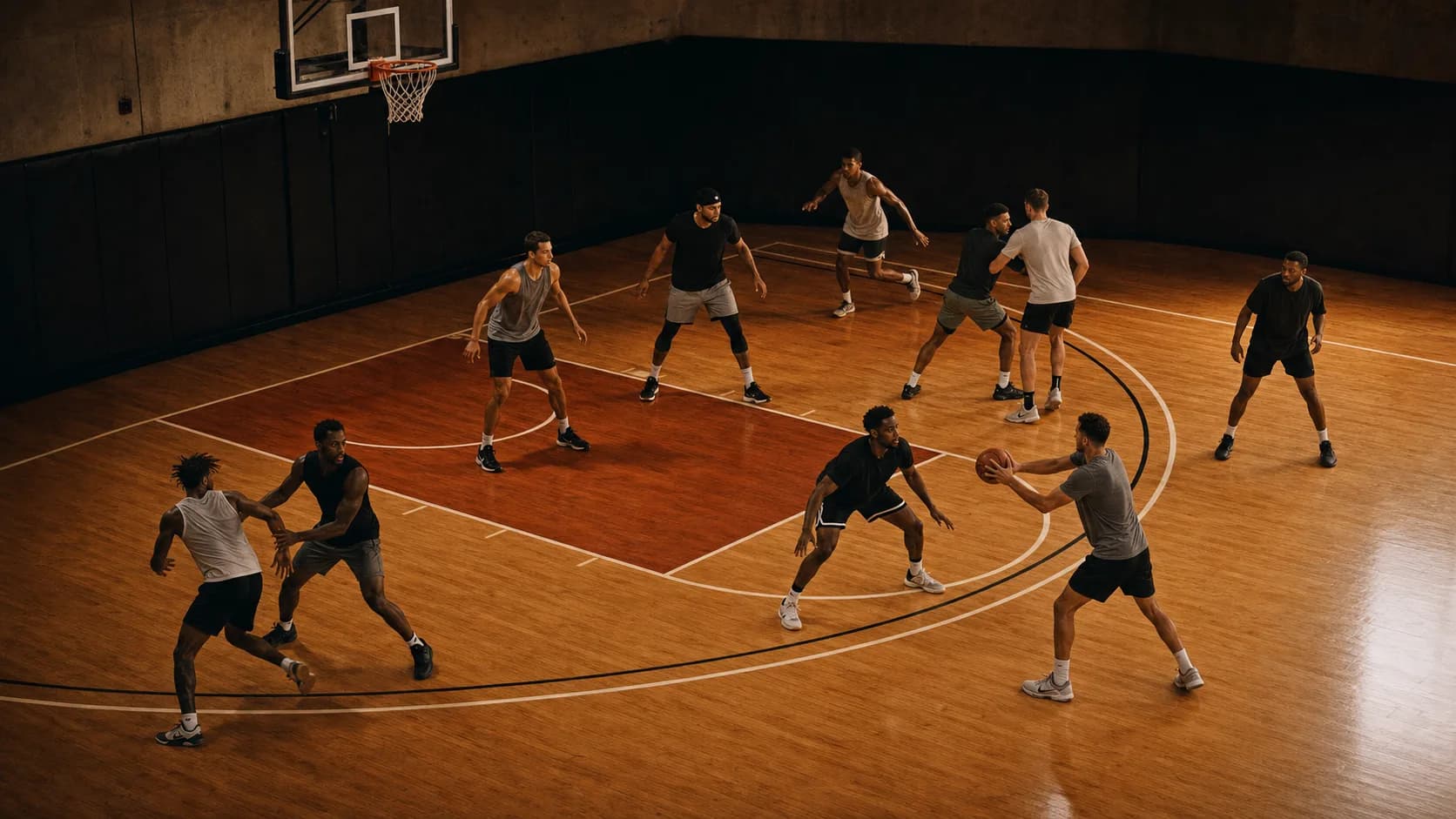
An NBA head coach spends more time watching film than running practice. A typical regular-season game day has 4-6 hours of film work spread across 3 windows; a playoff game day climbs to 8-12 hours across the full staff. Practice is where the decisions made in film get walked through, but the decisions themselves are made in the film room.
This is what that workflow actually looks like, who does what, and how the same structure scales down to high school and small-college staffs.
The Staff Division
A typical 5-coach NBA staff divides the film work like this:
- Head coach (2-3 hrs/day): coverage commits on opposing scorers, late-game packages, lineup decisions.
- Offensive coordinator (3-4 hrs/day): ATO and SLOB sets, flow-offense reads, screen-and-roll efficiency.
- Defensive coordinator (3-4 hrs/day): primary coverages, rotation patterns, weak-side help geometry.
- Advance scouts (4-6 hrs/day, 1-2 dedicated): 4-6 upcoming opponents at a time, on rolling 2-week cycles.
- Analytics coordinator (3-5 hrs/day): per-possession PPP, lineup math, shot quality, matchup math.
Total staff film hours per day: 18-24. That's why staffs are 5+ coaches, the film work alone is a full-time job for several people.
The Game-Day Workflow (Regular Season)
A typical 7 PM game day for an NBA head coach:
- 7:00-9:00 AM, wake up, gym, breakfast.
- 9:00-10:30 AM, pre-shootaround film: 30 min confirming yesterday's coverage decisions still apply against tonight's opponent, 30 min on new ATO installs, 30 min on opposing lead scorer's last 100 possessions.
- 10:30 AM-12:30 PM, shootaround (walk-throughs of what was decided in the film).
- 12:30-3:00 PM, meal + nap + family time + travel to arena.
- 3:00-5:00 PM, pre-game film at the arena: 60 min final confirm on tonight's plan, 30 min on the OPPOSING coach's late-game tendencies, 30 min on adjustments to be ready for halftime.
- 5:00-7:00 PM, coaches' meeting, walk-through with starters, pre-game prep.
- 7:00-10:00 PM, game + halftime adjustments + post-game.
- 10:30 PM-12:00 AM, post-game film: 60 min initial review of tonight's game (decisions that worked, decisions that didn't), set up tomorrow morning's prep.
Total film time on game day: ~4-5 hours, spread across 3 windows.
Non-game days have less context-switching but more total film, typically 6-8 hours doing advance scout on the next 3 opponents.
The Advance Scout Workflow
The single biggest time investment in the staff. Dedicated advance scouts cover 4-6 upcoming opponents at a time on rolling 2-week cycles. The per-opponent workflow:
- Day 1 (15-30 days out): Pull every game the opponent has played in the last 30 days. Watch full games at 1.5x speed.
- Day 2-4 (10-20 days out): Per-player breakdowns, for each opposing rotation player, the 6 questions a scouting report answers: dominant hand, preferred spots, primary action, defensive matchup, foul-rate, quiet edge.
- Day 5-7 (5-10 days out): ATO and SLOB packages, every set the opposing coach has called in late-game situations.
- Day 8 (final prep day): Game plan synthesis with the head coach. Coverage decisions, lineup engineering, late-game packages.
The advance scout produces a 4-8 page packet that lives in the head coach's binder. Then the in-arena pre-game prep is a CONFIRMATION pass on the packet, not a fresh build.
The Self-Scout Workflow
The most-undervalued film work on the staff. Most casual fans think coaches watch only opponents; they actually spend 1-2 hrs/week watching their OWN team's last 5-10 games.
The questions self-scout answers:
- What are WE tipping to opposing scouts?
- Which of our actions are still producing high PPP?
- Which actions are getting scouted out (PPP declining over time)?
- What are the score-state patterns in our late-game possessions?
The self-scout writes a 1-2 page weekly memo for the head coach. The memo drives offseason adjustments, in-season scheme tweaks, and the order of plays in the late-game playbook.
The Playoff Workflow Difference
Playoff prep is the same workflow at 3x the intensity:
- Regular season: 4-6 opponents per week (one game per opponent).
- Playoffs: 1 opponent per series, 4-7 games against them, 7-14 days of prep per series.
Per-opponent depth multiplies. Instead of "where do they want to score?" the playoff scout asks "where do they want to score against US specifically, based on our last meeting plus the matchup math?"
Our how NBA coaches prepare for playoffs piece walks through the playoff-specific version of the workflow.
Where the Time Is Actually Spent
If you broke down where the 4-6 hours of daily film time goes, it's:
- 25%, tagging possessions (the slow part).
- 35%, pattern-finding (what repeats? what's exploitable?).
- 20%, packet writing (turning patterns into game-plan-ready output).
- 15%, coverage decisions (the strategic part).
- 5%, coordinator meetings to align on the packet.
The 25% on tagging is the bottleneck. NBA staffs have 1-2 dedicated tagging analysts; high school staffs do it by hand. That gap is the entire reason most high school coaches can't replicate the NBA workflow at the same depth, they're spending all their time tagging possessions instead of finding patterns.
HoopBrief currently turns basketball and matchup questions into structured reports using public statistical and play-by-play context. It does not accept film uploads or provide possession-level video tagging.
How High School and Small-College Coaches Can Replicate the Structure
The NBA workflow doesn't fit a high school coach's calendar. The compressed version that does:
- 30-45 minutes of opponent advance scout per game (focus on lead scorer + 1-2 secondary scorers).
- 20 minutes of self-scout per week.
- 15 minutes of late-game package review (your own 2-minute drill possessions from the last 3 games).
- 45 minutes before each game on the bench-card distillation (the one-page scouting report).
Total per-game prep: ~2 hours. That's feasible for a coach who's also teaching three classes during the school day.
Our scouting report template piece covers the one-page output. Our matchup prep piece covers turning the scout into a game plan.
The Three-Job Weekly Workflow
An NBA staff splits film by role. A one-coach staff has to split it by job instead. Every week of film should cover exactly three, in this order:
1. Self-scout. Watch your own last game with two questions: what are our clear tendencies, and where did we break down. Thirty to forty minutes. The output is a short list, two or three tendencies to vary and one or two weaknesses to fix in practice. Do it first, because the opposing staff is already charting you. 2. Opponent prep. Sixty to ninety minutes across two or three games. Name their identity, rank their threats, chart the actions that actually score, and pick the pressure points. If time is short, this is the job to protect. A weak self-scout costs you slowly. A weak opponent scout costs you Friday. 3. Teaching clips. Three to five clips, no more, each making one point and each tied to something you will drill. A two-minute clip attached to a practice rep changes behavior. A thirty-minute film room overwhelms more than it teaches.
Put them on the calendar in that order, early week, midweek, then pre-game, and run the same rotation every week. By the fourth week it runs almost automatically, and each pass gets faster because you already know what you are looking for.
The instinct when a team struggles is to watch more film. Usually the answer is to watch better film with clearer questions. A coach who watches three focused games with a specific job for each learns more than one who watches ten with no plan.
The Mindset
The thing most coaches underestimate isn't the time, it's the discipline. The NBA workflow works because the same five people do the same routine every day for 9 months. The film time compounds; the patterns become legible because the staff has watched 200 games together by November.
A high school coach watching 30 minutes of opponent film per game in a discipline pattern beats a coach watching 90 minutes randomly. Structure is the multiplier.
Where to Go Next
Workflow companions: how NBA coaches prepare for playoffs, what coaches look for in matchup prep, how to write a basketball scouting report, template + workflow, the basketball film study guide.
Tactical context: conference finals adjustments by Game 3, pick-and-roll coverages explained.
Hub: Playoff Prep Hub.