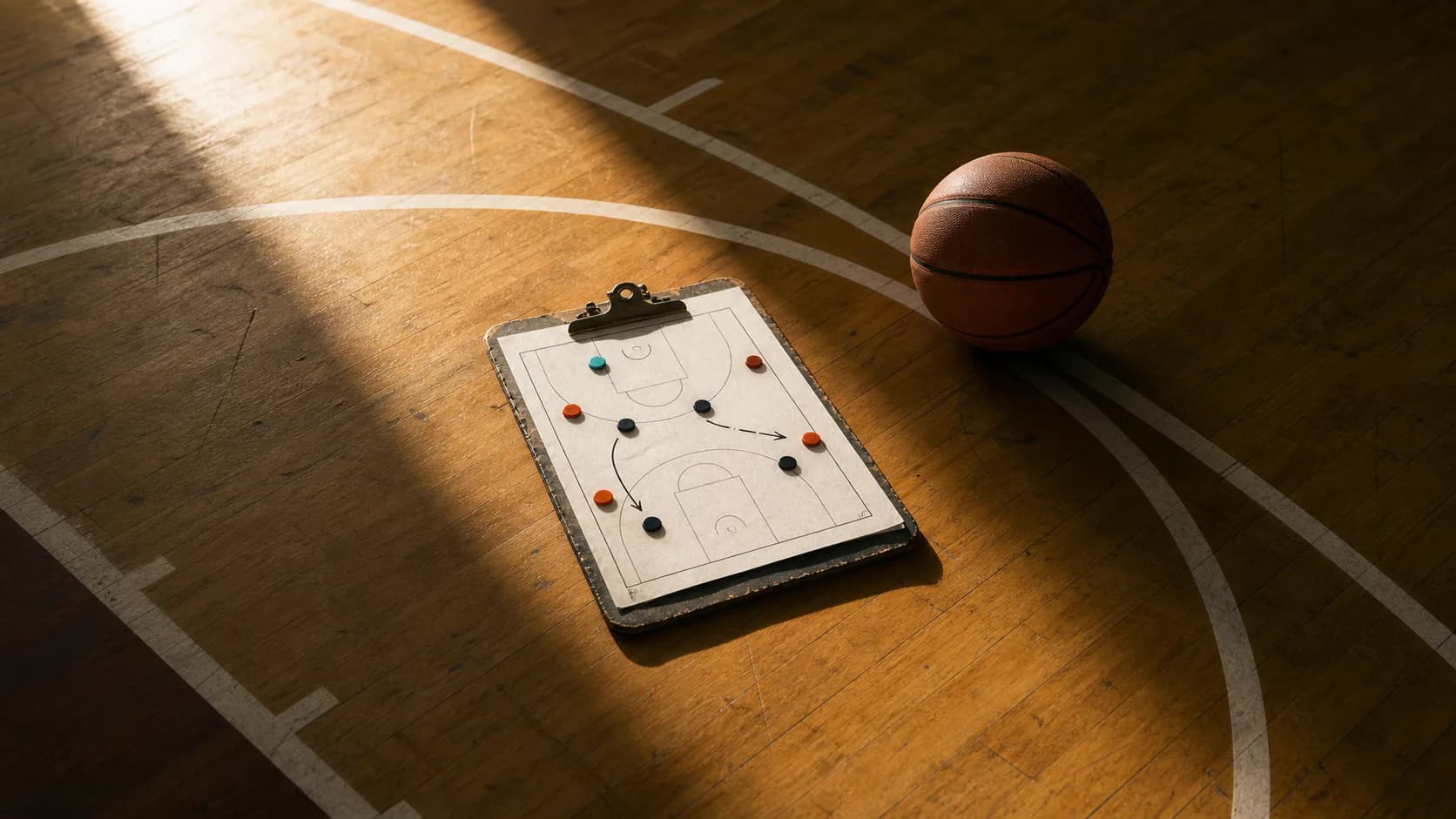
Most first-time youth coaches are parents who got volunteered. You do not need to have played college ball. You need a plan, a whistle, and a clear idea of what you are actually building.
Start every season with these five rules: - Plan practice around touches, not drills where six kids watch one kid go - Teach one fundamental and one IQ concept per session, never ten - Name good decisions out loud so kids learn what a good choice looks like - Keep it competitive and keep it short, because attention is your real budget - Measure the season by skills gained, not games won
A ten-year-old who learns to read a defender will still have that skill at sixteen. A ten-year-old who only learns to win this Saturday has nothing to carry forward.
How Do You Run a Youth Basketball Practice?
Run it in small groups with a ball in every kid's hands as often as possible. The enemy of youth practice is the line, where one player dribbles through cones while eleven others lose focus. Break into stations of three or four so nobody waits more than a few seconds for a rep.
Structure beats improvisation. Open with a movement warmup, move to a skill block, put that skill into a small-sided game, then finish with something fun and competitive. Keep water breaks short and keep the pace up. A practice that drags teaches kids that basketball is boring, which is the one lesson you cannot afford.
Use the whistle to reset, not to lecture. If you need to correct something, make it one sentence, show it, and get them moving again. For the skill blocks themselves, youth basketball drills that pair a fundamental with a decision are worth more than isolated form drills.
What Fundamentals Should You Teach First?
Teach the fundamentals that touch every possession: pivoting, catching in a stance, and a basic layup off the correct foot. Ball handling and passing come next. Shooting form matters, but a nine-year-old heaving from the arc is building a habit you will spend years undoing, so pull them in close to the rim.
Footwork is the fundamental nobody wants to coach and every kid needs. A player who can pivot without traveling and catch on balance is already ahead of most of the league at this age. Spend real time on the jump stop and the pivot before you spend a minute on crossovers.
Defense is a fundamental too, and it is mostly effort and stance early on. Teach a wide base, a flat back, and active feet. The finer points of where to stand come later, and how to improve your basketball defense breaks down the progression as kids get older.
How Do You Teach Basketball IQ to Young Kids?
Teach IQ by asking questions instead of giving answers. When a kid drives into three defenders, do not yell "pass." Ask "how many were there?" and let them find it. The habit you are building is seeing the floor, and you cannot install that by narrating every choice for them.
Start with two concepts: spacing and reading the defender. Spacing is simply "do not stand next to your teammate," and you can teach it with a rule as blunt as "stay in your area." Reading the defender is "if he backs off, shoot or drive; if he crowds you, go by him." That single if-then is the seed of real feel for the game.
These reads are the same ones advanced players refine for years, just simplified. Basketball IQ, what it actually means lays out the full idea, and how to improve basketball IQ has drills that scale down to a youth group. The point at every level is the same: a good decision beats a good athlete.
Should You Coach to Win or to Develop?
Coach to develop, and let winning be a byproduct. The scoreboard tempts you to hide your weakest kid, run one set for your best scorer, and press for cheap steals. All three win a Saturday and cost the kids everything that matters by age fifteen.
Development coaching means every kid plays real minutes, every kid brings the ball up sometimes, and every kid learns every spot. Your best player will get plenty good without you protecting their stat line. Your weakest player will quit if they only touch the ball during warmups.
Here is the honest tradeoff. You will lose games you could have won by playing your studs and hiding the rest. Sit with that. A youth season is a development window, not a resume, and the win column is the least durable thing you can build in it.
Here Is a Sample 60-Minute Practice Plan
A clean hour looks like this, and you can run it with one coach and a rack of balls.
- Minutes 0 to 8: dynamic warmup and form shooting close to the rim
- Minutes 8 to 23: skill stations, three groups, rotate every five minutes (ball handling, pivot and pass, layups off the correct foot)
- Minutes 23 to 38: small-sided game, three on three in a half court with one rule of the day, such as "you must pass before you shoot"
- Minutes 38 to 50: teach block, one IQ concept, spacing or reading the defender, walked through then played live
- Minutes 50 to 60: full-court competitive game with a fun constraint, then a one-minute huddle on what they learned
Notice the balance. Roughly half the hour is live play, because kids learn the game by playing the game, not by drilling pieces of it forever.
What Is the Most Common Youth Coaching Mistake?
The most common mistake is coaching youth basketball like a small version of the pros. Full-court presses, zone traps, and five set plays win at the ten-and-under level and teach nothing. The kids never learn to handle the ball under pressure or read a defense, they just exploit that the other team cannot inbound yet.
The second mistake is talking too much. A youth practice is not a film session, and a coach who lectures for three minutes has lost the group for five. Say less, demonstrate more, and let the reps do the teaching.
This approach is not for the coach whose only goal is a trophy this season. If you are measured by wins by your league or your own ego, development coaching will feel slow and frustrating. But if you want the kids still playing at sixteen, it is the only approach that gets them there.
The Bottom Line
Run fast practices with a ball in every hand, teach one fundamental and one read per session, and coach the decision, not the result. Development beats the scoreboard at this age, and the kids who have fun are the ones who keep playing. Fundamentals plus a little IQ is the whole job.
When you want to show a young player exactly how a defender's positioning tells them what to do, the HoopBrief Matchup Engine turns a real matchup into a plain read they can rep, and Starter is $9.99/mo.