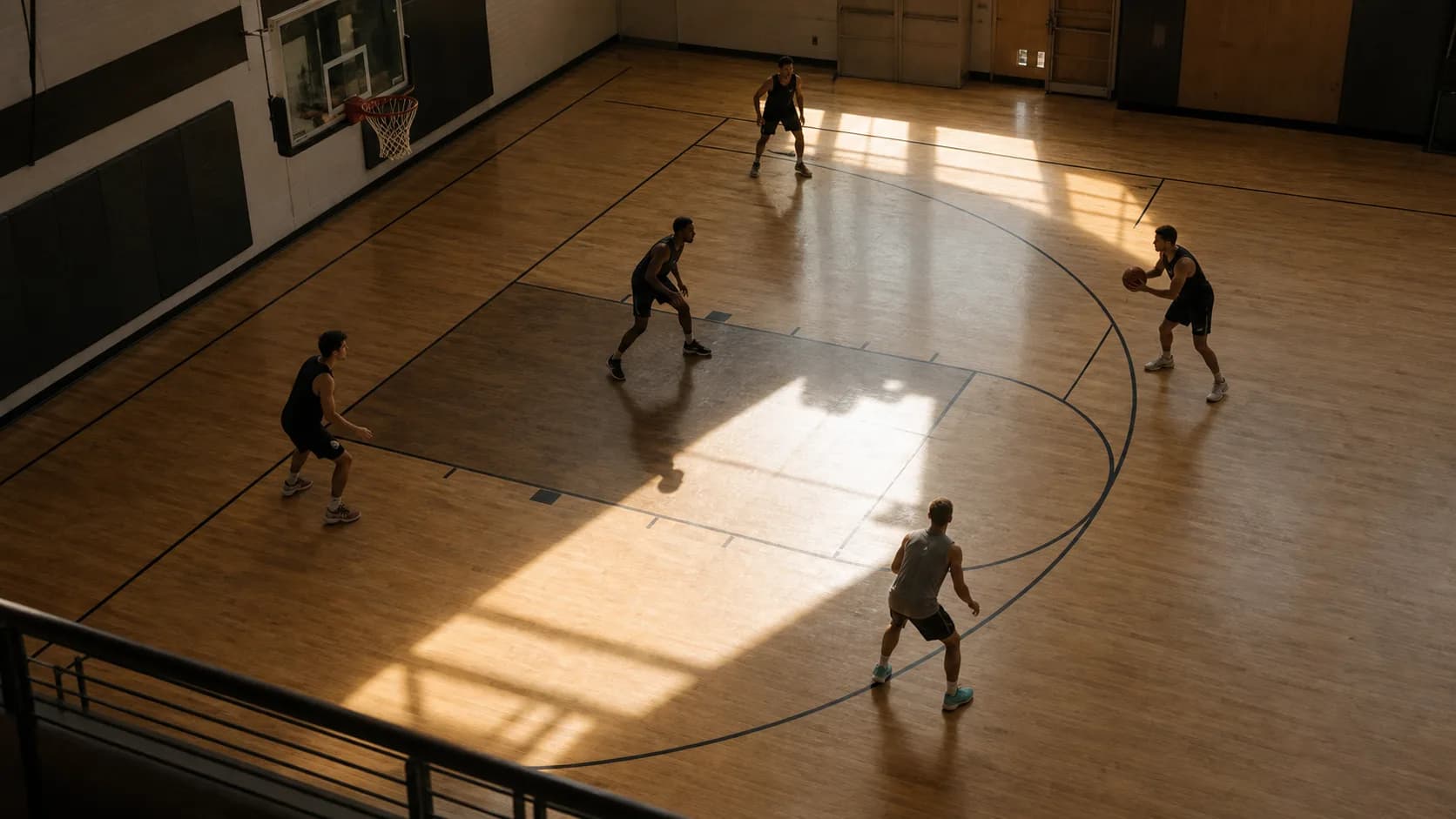
Defense is the most trainable skill in basketball. Unlike shooting - which requires a specific touch that takes years to develop - defense is primarily about effort, positioning, and habits. Anyone can become a good defender if they commit to it.
Step 1: Fix Your Stance
Everything starts with your stance. Your feet should be slightly wider than shoulder-width. Your weight is on the balls of your feet, not your heels. Your butt is down, your chest is up, and your hands are active.
Most young players stand too upright. When you're upright, you're slow to react. Get low and stay low.
Step 2: Move Your Feet
The number one defensive mistake is reaching. When a ball handler makes a move, your instinct is to reach for the ball. Resist it. Move your feet instead.
Slide, don't cross. Keep your feet wide. Stay between the ball handler and the basket. If you can move your feet well enough, you rarely need to reach.
Step 3: Understand Positioning
Where you stand before the action starts determines how the possession goes. If you're in the right position, defending is easy. If you're out of position, no amount of athleticism saves you.
Key positions to understand: top foot placement (which direction are you forcing?), gap distance (how much space between you and the ball handler?), and help positioning (where are you when the ball is two passes away?).
Step 4: Learn to Navigate Screens
Screens are the most common way defenses break down. Learning to navigate them - getting skinny, making early contact, recovering quickly - is essential.
The three keys: see the screen early, get skinny before it arrives, and fight over the top. Going under screens should be a deliberate choice against non-shooters, not a lazy default.
Step 5: Communicate
Great defense is loud. Call out screens before they arrive. Call out switches. Call out help. If your teammates can hear you, the entire defense improves.
Communication is free. It costs you nothing and adds enormous value. Start doing it today.
Step 6: Build Defensive Habits
Defense is about habits, not talent. Build these habits: - Sprint back on defense - every time. - Find your man before the ball crosses half court. - Keep your head on a swivel - see ball, see man. - Box out on every shot - not sometimes, every time. - Close out under control - not flying, controlled.
These habits, done consistently, will make you a significantly better defender within weeks. Not months - weeks. That's how quickly defensive improvement compounds.
The 4-Step Daily Defensive Routine
The drills above only compound if you do them daily. A structured 25-minute daily routine that produces visible improvement within 6 weeks:
- 5 minutes: Stance recovery ladder. Drop to stance, stand, drop again. Builds the stance-reset habit that decides whether you can defend a 7-second possession.
- 8 minutes: Lateral slide circuit. Cone-to-cone slides with hand-discipline checkpoints. Feet never cross.
- 6 minutes: Closeout reps. Sprint to a spot, break into choppy steps, contest vertically. The closeout footwork piece covers the mechanics.
- 6 minutes: Live one-on-one. Defend a partner attacking from the wing. Force a contested shot or pass-out.
The Most Common Defensive Mistakes at Every Level
Five recurring mistakes that show up across high school, college, and pro film:
1. Leading with hands. Defenders who reach before they slide foul at 3x the rate of defenders who lead with feet. The defending without fouling piece walks through the discipline. 2. High hips on a stance. Knees locked, weight on heels, gets crossed up on the first step. 3. Watching the ball, not the man. Off-ball defense decays when eyes track the ball instead of splitting between ball and man. The positioning IQ piece covers the eye-discipline framework. 4. Closing out at full speed. Sprinting all the way to the shooter = fly-by. Choppy steps break the closeout into two phases. 5. No verbal communication. Defense that runs in silence loses possessions to confusion every time.
Keep reading: defending without fouling, proper closeout technique, and defensive positioning IQ.