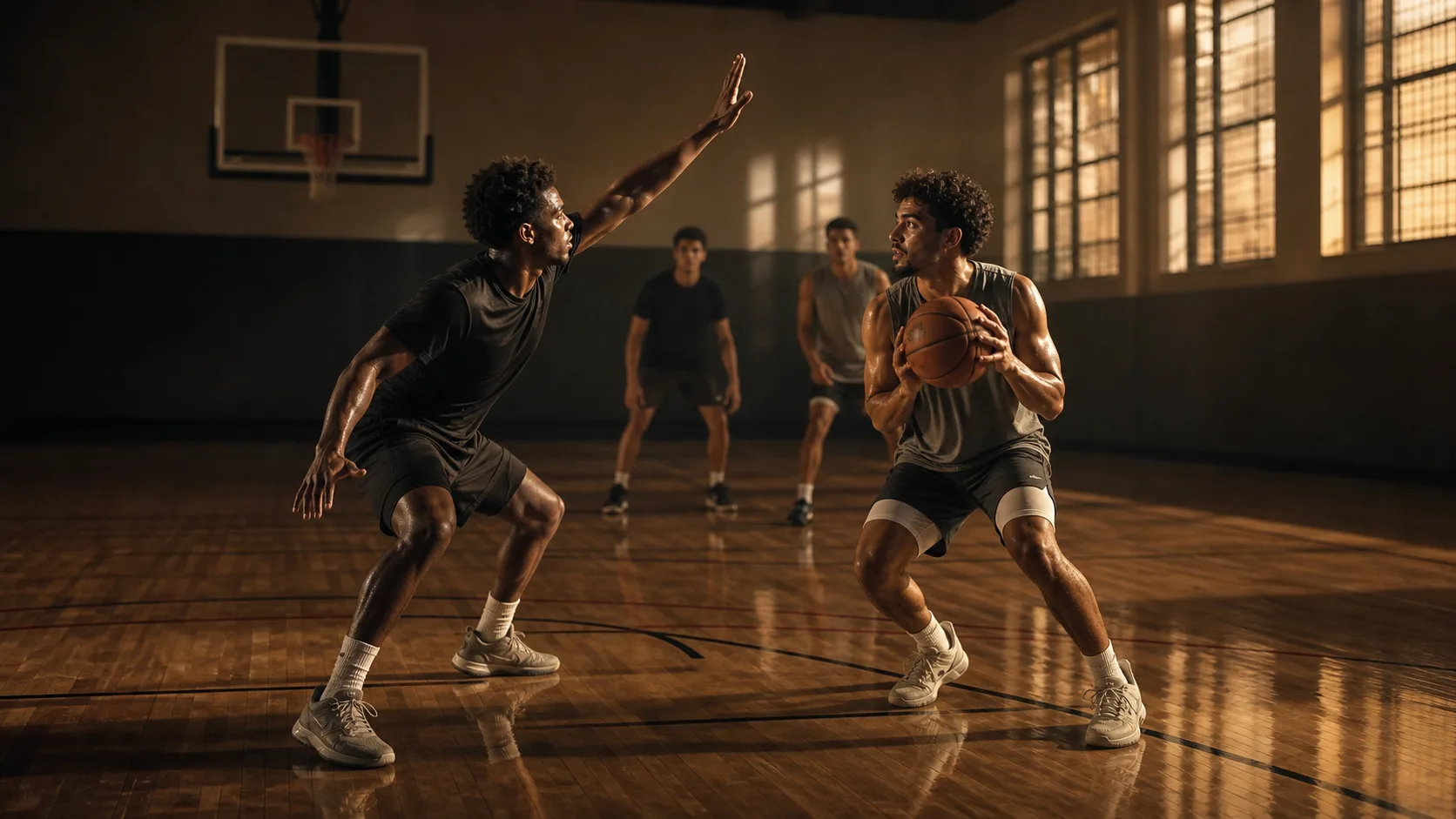
Watch any high school game and count the number of closeouts that end with the defender flying past the shooter, fouling, or giving up a one-dribble drive to the rim. That's the closeout problem. It's the most-coached fundamental nobody coaches well.
Why Most Closeouts Fail
The default move on a closeout is to sprint at the shooter. That's the problem. By the time you arrive, you have all the momentum going forward, and the ball-handler does one of three things:
1. He shoots a clean three because you're still 6 feet away. 2. You overcommit, fly past, and he drives by your shoulder. 3. You jump at the shot fake, and he goes around you for a layup.
Sprinting at a shooter is what bad defenders do. Good defenders run, stop, and contest. The whole technique is in the stop.
The Footwork: Sprint, Then Chop
The first half of the closeout is full sprint. You cover ground because the longer you stay 8 feet away, the longer he has to read you. But around the 8-foot mark, you switch to chop steps, short, controlled, low to the ground. Each step takes about a quarter of a normal stride. The reason: chop steps let you change direction. A normal sprint stride does not.
By the time you're 4 feet from the shooter, you're under control. Your weight is centered. You are not falling forward. From here you can react to anything he does.
High Hand, Mirror Hand
The hand on the side of the shooter's strong hand goes up. That's it, one hand, palm up, full extension. The other hand stays at your hip, mirroring his off-hand. If you put two hands up, you can't move. If you put no hand up, you don't contest.
The high hand has two jobs. The first is contesting the shot. The second, and this is the part nobody teaches, is making the shooter feel you. A hand at his eye line shrinks the rim in his vision. That's where contests actually do their work. You don't need to block the shot. You need to be in his face when his eye finds the rim.
When to Short-Closeout
Not every shooter gets the full closeout. The 90th-percentile defender knows who to closeout and who to invite into the shot.
Your team's scouting report should tell you the answer for every player. If a guy shoots 28% from three on the right wing, you closeout short. You stay in the gap, sit on the drive, and let him take the shot you're happy to live with. If he's a 40% shooter, full closeout, short steps, hand up, willing to give up the drive to take away the three.
The closeout is a judgment call disguised as a sprint. Players who can't read scouting reports always closeout the same way to everyone, which is why they always get scored on.
Closeout Without Fouling
Don't leave your feet. The shot fake is built to make you leave your feet. If you bite, he steps through, draws contact, and you've turned a three into three free throws. The simplest defensive rule in basketball: stay on the floor until the shooter is in his motion.
If he pump-fakes, you can lift your contest hand higher. You can shuffle back a step. You can do everything except leave your feet. Save the jump for the actual shot.
Closing Out to a Driver
Some guys aren't shooters at all, they're drivers waiting for a closeout. Against those players, the closeout is shorter, the stance is wider, and the hands are at chest height (not high). You're not contesting; you're cutting off the drive. Top foot to his strong hand. Influence him into help.
Treating a driver like a shooter is the most-common scouting failure for young defenders. They closeout hard, leap into the contest, and watch the ball-handler step through into a layup. The cure is simple: read the scouting report, and adjust the closeout for each individual.
Drill: The Three-Closeout
Coach is at the top of the key with the ball. Defender starts in help position at the nail. Coach passes to the wing. Defender sprints, chops, contests. Coach swings to the weak corner. Defender sprints back, sinks to help. Coach swings to the opposite wing. Defender sprints, chops, contests again.
The drill teaches the rhythm of help-to-contest-to-help. Three closeouts in eight seconds. Done correctly, the defender is exhausted in 30 seconds. That's the right exhaustion. Real games demand it.
The Quiet Edge
Great closeout defenders don't look like the fastest defenders. They look like the most-balanced. They never fly by, never bite the fake, never give up the drive. The fans don't see it. The shooters do.
Keep reading: the offensive side of the closeout, defending without fouling, and guarding shooters off screens.