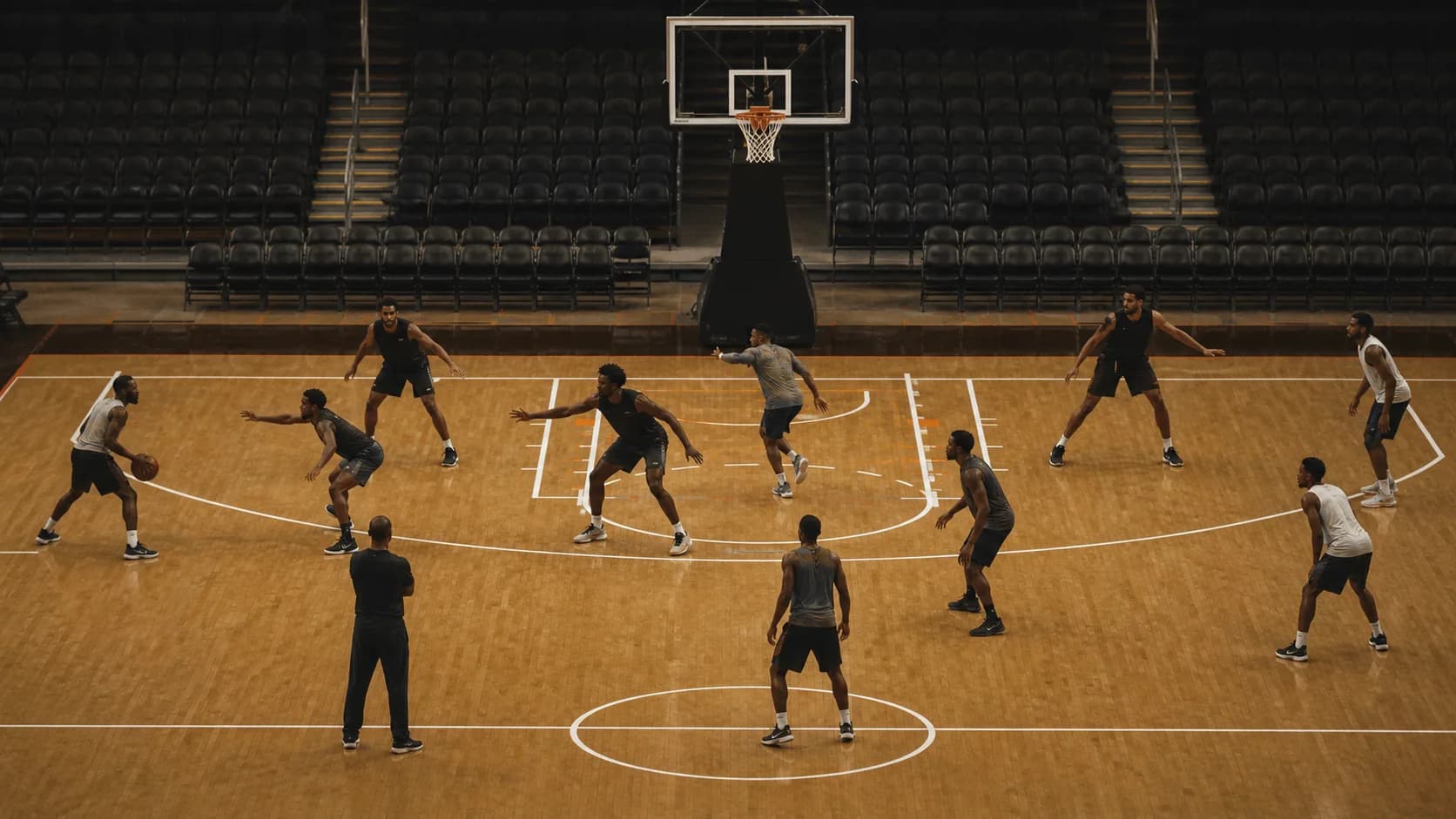
Walk into any NBA practice gym in 2026 and you'll hear the same word over and over: middle. As in: don't let them get to it.
The no-middle rule is the quiet revolution behind modern defense. It's not a coverage by itself, it's the principle that organizes every coverage above it. Drop, switch, ICE, weak: all of them now exist in service of the same goal. Push the ball away from the middle of the floor, where every read is open and every help defender is two steps too far.
Why Middle Is the Death Zone
The middle of the floor is geometric heaven for an offense. The ball-handler can see weak corner, weak wing, strong corner, both elbows, and the rim, all without turning his head. Every help defender has to choose between two equally good shooters, and every choice is wrong.
When the ball gets pushed to the sideline, that geometry collapses. Now there's a sideline (the best help defender in basketball), one short corner, and one wing. Skip passes have to travel further. Helpers can stunt without giving up easy reads.
The math is simple: middle penetration generates ~1.18 points per possession in the modern NBA. Sideline penetration generates ~0.94. That's the gap entire defensive identities are built on.
ICE: The Cleanest No-Middle Coverage
ICE (or "blue," depending on the staff) is no-middle made explicit. On a side ball-screen, the on-ball defender shades the screen-side hip and physically prevents the ball from going back middle. The screener's defender drops to the level of the rim. The result: the ball-handler can either reject the screen and drive baseline (where help is loaded), or pull up for a contested middy.
The play is to take away one read entirely. The middle PnR is the highest-EV action in basketball. ICE deletes it from the playbook for that possession.
How No-Middle Cascades
Once a defense commits to no-middle as a principle, every other rule gets organized around it:
- Weak-side help shifts strong. The low man is loaded one step higher. Why? Because no-middle pushes the ball baseline, and baseline drives need a tag at the rim, not a tag at the elbow.
- Closeouts become side-bias. Defenders close out with their high foot up so any drive goes baseline, not middle.
- Screen navigation stays top-side. Going under a ball-screen invites the ball middle. Modern defenses go over almost everything that isn't a non-shooter.
The whole shell tilts a few degrees off-center to keep the middle locked.
How Offenses Break No-Middle
The best offenses don't try to fight no-middle head-on. They use it.
Re-screens. The first ball-screen forces the ball wide. The defender follows. The screener flips, and now the second screen is going middle. By the time the defender registers it, the help has already decided the first action killed the play.
Spain action. The PnR ball-handler sees the no-middle force. He uses it. The screener slips, and a back-screen springs the cutter to the rim. No-middle pushed everyone toward the sideline; the cutter goes the other way into open space.
Ghost screens. A guard fakes a screen and immediately pops to the slot for a three. No-middle defenders are so trained to fight over screens that the fake disorients them. By the time they recover, the ball has been swung to a 45 with a half-second of cushion, the highest-quality three available.
Skip-back. When no-middle pushes the ball to a corner, the defense rotates one direction. A quick skip back across the floor catches the rotation overcommitted. The original side is now the open side.
The Trade-Off
No-middle defense isn't free. Forcing baseline puts more pressure on the rim protector, and corner threes become more available because the rotation distance is longer. A team without an elite low man (the help defender at the rim) shouldn't run no-middle as a principle, they'll get exposed at the rim and start hacking, which is how no-middle defenses end up at the line shooting free throws.
The teams that run it best, Boston, Minnesota, Cleveland, are the teams whose rim protectors can erase the few attempts that get through.
What This Means For You
If you're a guard: the next time a defender shades the screen-side hip and the big sits in drop, don't fight middle. Use the force. Reject the screen. Hit the open re-screen going opposite. Or pull-up early, the contest is real but the defender's body is leaning the wrong way.
If you're a defender: middle is the death zone. Top foot up, near shoulder a half-step ahead, force baseline, trust your help. The whole defense is built around making your job possible. Trust it.
Keep reading: pick-and-roll coverages, the drop-to-ICE switch, and Popovich system thinking.