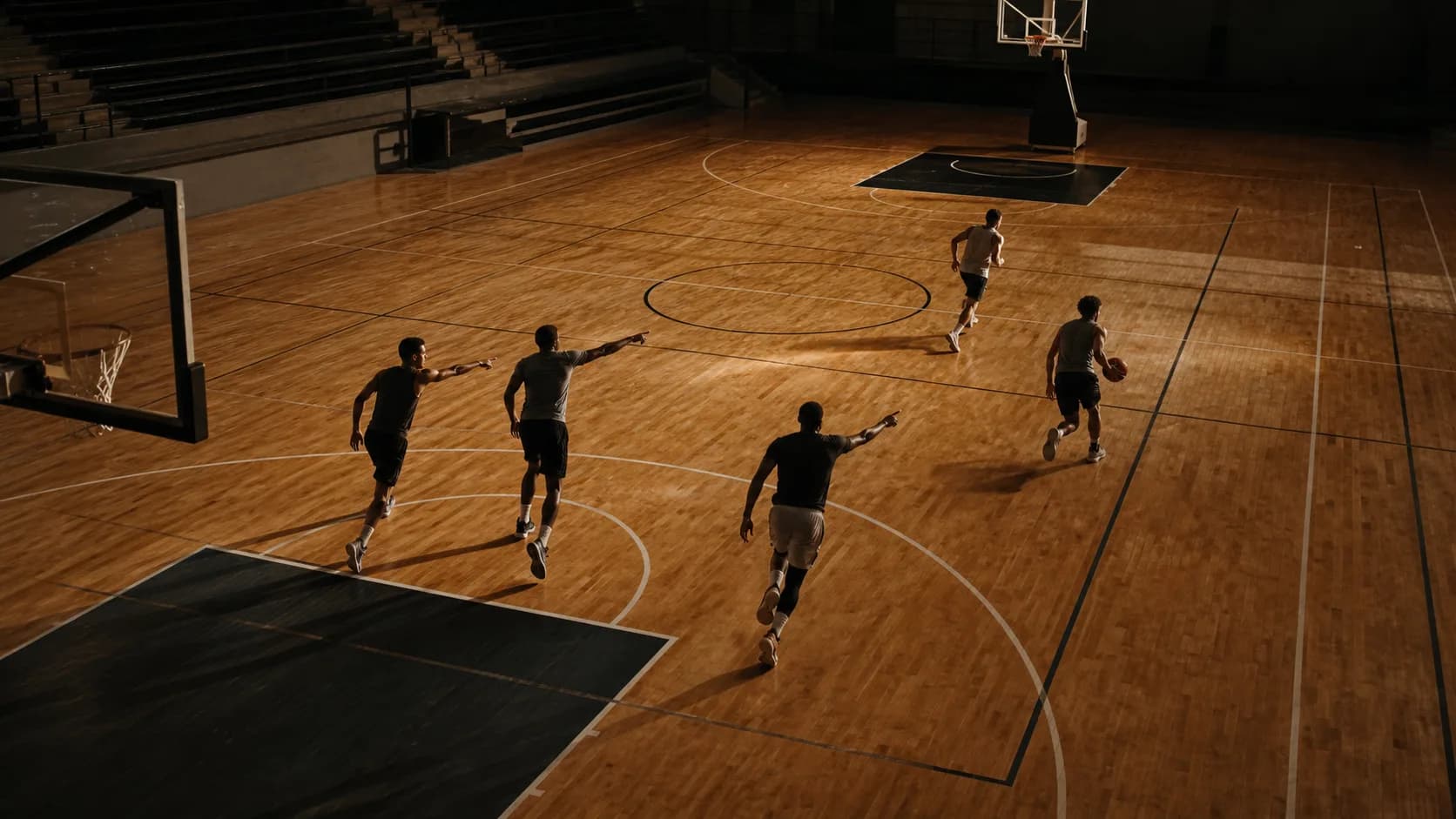
Every coach in the NBA has a transition-defense graphic on their iPad. It looks like a maze of arrows. It boils down to one rule: the first five seconds after the ball changes hands decide the next 14.
This piece is the pro-speed version. If you want the foundational principles every coach teaches at every level, start with the transition defense primer. What follows is the live-rep, communication-bound NBA version, what staffs actually drill against a full-speed opponent.
Why Transition Is Where Games Are Lost
Modern offenses score about 1.31 points per possession in transition versus 1.04 in the half-court. That gap, 0.27 points per possession, is the difference between a top-five offense and an average one. A team that gives up 12 transition possessions a game will lose to one that gives up six, even if the half-court defense is identical.
That's the math. The fix is structural.
Rule 1: Match Up First, Sort Out Later
The instinct after a missed shot is to find your man. That instinct is wrong. You don't have time. The right instinct: match up with the closest opponent, even if he's not your assignment. You can swap on the next dead ball.
Teams that try to find their assigned man in transition lose two possessions for every one they save. The crossing-traffic problem in the open court is too severe to fix on the fly. Pick up the closest man, get to a stop, and re-sort at the next whistle.
Rule 2: Stop the Ball
The first responsibility of the closest defender to the ball-handler is stopping the ball. Not slowing it down. Not influencing it. Stopping it. If the ball gets across half-court at full speed, your defense has lost the possession before the half-court even sets up.
Stopping the ball means getting your chest in front of the ball-handler at half-court, even if you have to give up a step laterally. Force him to make a decision, pass, pull-up, or stop. Once he stops, the rest of the defense catches up.
Rule 3: The First Big Gets the Rim
If you have a big and a guard sprinting back together, the big takes the rim. Always. Even if the guard is faster. The reason: the rim is the highest-value scoring spot in transition. A big in the paint deters a layup attempt, even from 8 feet away. A guard in the paint just gets bullied.
Bigs who are slow getting back lose teams playoff games. The rule has to be drilled until it's automatic: rim first, ball second.
Rule 4: Talk Loud, Talk Early
Transition defense is communication-bound. Every defender has to call out:
- "Ball!", meaning, I have the ball-handler.
- "Rim!", meaning, I have the basket protected.
- "Match!", meaning, I have a man and you find another.
- "Switch right!" or "Switch left!", meaning, we're trading on the fly.
A defense that talks is a defense that gets back. A defense that runs in silence loses possessions to confusion every time. The loudest voice in transition wins.
Rule 5: Pick Up at Half-Court, Not at the Three-Point Line
Younger defenders pick up the ball-handler at the three-point line. That's too late. By the time the ball is at the three, the offensive players are already in their spots, and the closeout is impossible.
The right pickup is at half-court, with the chest in front. From there, the defender can guide the ball-handler into help at the nail. The defense can set up. The offense has to make a play against a set defense, which is the whole goal.
The Cross-Match Problem
The most-common transition failure is the cross-match, when a guard ends up on a big, or a big ends up on a guard, because of the chaos. The temporary cross-match is fine; the persistent cross-match is fatal. The rule: at the next dead ball, scream the swap and trade back. Two possessions of cross-match is two possessions of mismatch.
Some teams (Boston, OKC) live with cross-matches longer because they trust everyone to defend everyone. Most teams can't. Know your team, and swap accordingly.
Stopping the Outlet
Transition starts with the outlet pass. If the rebounder can't outlet, transition dies in the womb. Front the rebounder before he gets the ball. After the rebound, get a hand in his face, he can't see the floor with a body in his vision. Even one second of hesitation kills the break.
The best transition defenses don't sprint back faster than other teams. They suffocate the outlet. By the time the ball is moving, the defense has already set up.
Drill: 4-on-3 to 5-on-4 Transition
Coach shoots. Whoever rebounds outlets to a guard who pushes immediately. Defense gets back. After the first decision, a fifth defender enters from the baseline (representing the trailer). 4-on-3, then 5-on-4 within five seconds.
The drill teaches the cascade, match up first, stop the ball, and let the late defender rotate to fix the math. Done correctly, the defense should hold the offense to under 1.0 PPP. Done badly, it's open layups for the offense.
The Quiet Edge
The best transition defenders aren't the fastest. They're the loudest and the smartest. They call out matches before they happen. They take the rim without being told. They communicate two seconds before the action gets to them. By the time the offense looks up, the defense is already there, not because they ran harder, but because they thought sooner.
Sprint matters. Talk matters more.