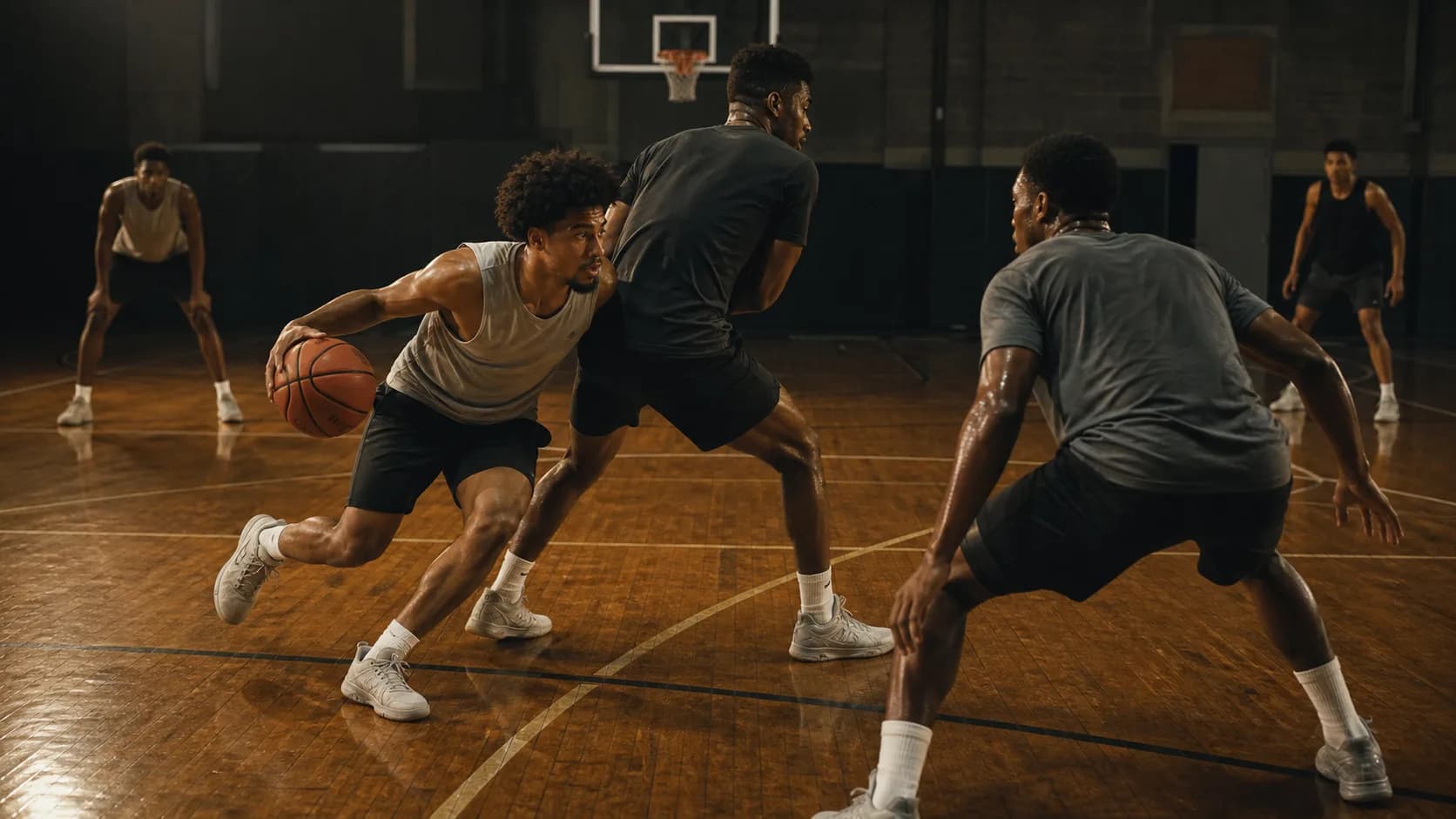
Every defensive scheme is a trade. You can't take everything away. Drop coverage trades the mid-range pull-up for everything else, no rim, no kick-three, no easy short roll. For seven months of the regular season, that trade wins. By Game 4 of a Conference Finals, against a top-tier guard, the trade often flips.
Watch the better defensive staffs over the next two weeks. You'll see a quiet transition from drop to ICE on specific actions, against specific players, at specific times. It looks subtle. It changes the entire math of the series.
What Drop Coverage Actually Concedes
In drop, the screener's defender (typically the center) sags into the paint, sometimes as deep as the dotted line. The on-ball defender chases over the screen. The trade: the ball-handler gets a clean pull-up jumper from the elbows, but the rim is protected and the corners are covered.
Across the league this still wins. Most NBA guards shoot under 40% on contested mid-range pull-ups. Conceding them is mathematically sound, until the guard you're defending isn't most NBA guards.
What ICE Concedes Instead
ICE coverage forces the ball-handler away from the screen, toward the sideline. The on-ball defender plays the screen "ice", under it, sideline-side, and the screener's defender steps up early to wall off the middle.
The trade flips. The mid-range pull-up disappears (you're forcing baseline). The rim is harder to attack at speed. But the screener gets a cleaner short-roll. The weak corner is more open if the help rotates wrong. And the offense can re-screen to get back to middle if the ICE call isn't disciplined.
ICE is what you use when the mid-range pull-up is no longer a defensive win.
The Switching Math (When the Trade Flips)
The math behind the switch is simple. Drop is good when the pull-up is a 40% shot. Drop is bad when the pull-up is a 50% shot. Somewhere in between is the threshold, usually around 46%.
But the threshold isn't fixed by the season number. It's fixed by what the player is shooting *in this series*, *under playoff pressure*, *off this specific action*. If a guard came into the series shooting 39% on pull-ups but is 8-of-13 through Game 2, the staff doesn't wait for the season number to "regress." They act on the in-series number.
That's why the switch usually shows up around Game 3 or 4. Two games is roughly the sample size where staffs trust the data enough to commit.
The Trigger Conditions Coaches Use
Three triggers move a staff from drop to ICE:
1. The pull-up is converting. This is the obvious one, if the guard is hitting them, drop has to stop conceding them. 2. The screener is a non-shooter. ICE works because the screener's defender can show high without leaving a shooter. If the screener is a stretch big, ICE leaks corner threes. If he's a non-shooter, ICE is almost free. 3. The opponent's spacing favors the strong side. When the offense is heavy on strong-side shooters and weak-side cutters, the ICE rotation has cleaner help angles. When the offense is balanced strong/weak, ICE is harder to execute.
When all three triggers fire, you'll see ICE on every relevant pick-and-roll within two timeouts.
How to Spot It Mid-Game
Three tells:
1. The on-ball defender's pre-screen positioning. In drop, he plays square. In ICE, his outside foot is slightly higher than the inside, he's already shading sideline. 2. The big man's first step on the screen. In drop, the big retreats. In ICE, the big steps up. 3. The handler's first dribble. In drop, he goes north. In ICE, he goes east-west, looking for the re-screen.
If you see the big stepping up and the handler getting pushed sideline, you're watching ICE. The clearest tell is when the offense calls the same action twice in a row and the second possession ends with the handler stuck on the sideline.
The Counter (Yes, There Is One)
Smart offenses counter ICE with a simple wrinkle: re-screen and reject. If the on-ball defender shades sideline to ice the first screen, the screener flips and re-screens going back to middle. The handler "rejects" the original screen and attacks the now-vacated middle.
The defense's counter to the counter is to call ICE on the first screen and switch on the re-screen. Two switches in three seconds. Good staffs drill this in May. Average staffs forget about it until they're down 2-1.
HoopBrief currently turns basketball and matchup questions into structured reports using public statistical and play-by-play context. It does not accept film uploads or provide possession-level video tagging.