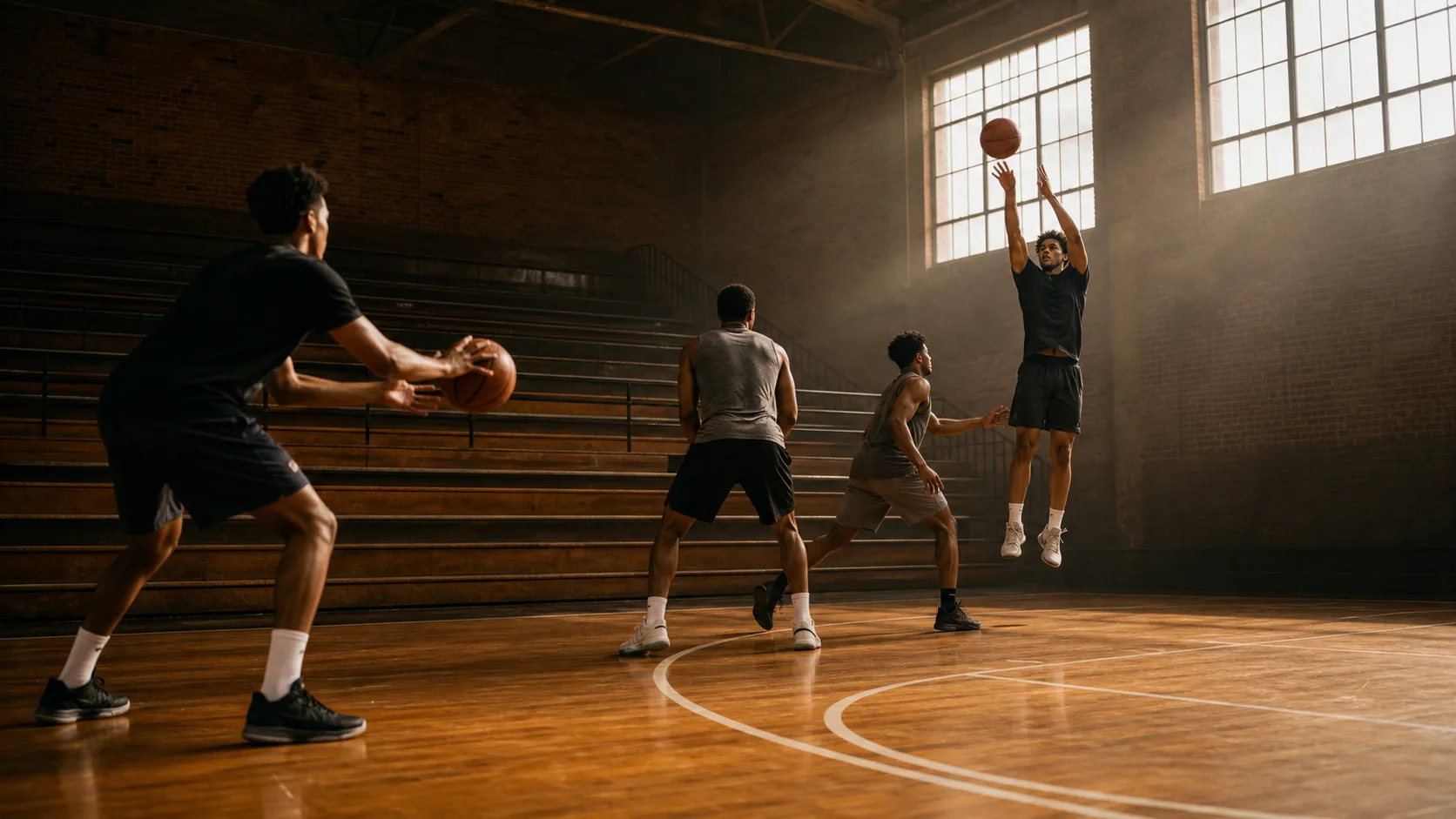
Here is what a complete youth skill session should touch:
- Ball handling that trains control, not tricks, like two-ball dribbling
- Footwork drills built on the jump stop and the pivot
- Form shooting from close range, mechanics before distance
- Passing on time and on target under light pressure
- Simple decision drills where the read changes with the defender
What ball handling drills work best for young players?
The best ball handling drills at this age build control under mild chaos, not a highlight package. Two-ball dribbling is the workhorse. A player dribbles a ball in each hand, first together, then alternating, which forces both hands to work without letting the eyes drop to the floor.
Keep the cues simple and physical. Fingertips, not palms. Head up, chest tall. Pound the ball firm so it comes back fast. A young player who learns to feel the ball rather than watch it gains a year of development over one who stares down at his dribble.
Add a stationary reaction wrinkle once the basics hold. Stand a few feet away and point left or right while they two-ball dribble. They call out the direction without looking down. Now their eyes are up and reading, which is the whole point. The handle exists to free the eyes, and that principle carries all the way up. Our guide on how to coach youth basketball covers how to sequence these so kids stay engaged.
What footwork and finishing drills should young players do?
Footwork starts with the jump stop and the pivot, because balance comes before everything. A jump-stop drill is simple: dribble in, land on two feet at the same time under control, and hold it. A player who can stop balanced can finish, pass, or pivot out of trouble. One who cannot travels or rushes.
For finishing, drill both hands from the start. Set up a mikan drill, where the player alternates soft layups off each hand under the rim in a rhythm, catching and finishing without dribbling. It builds touch, timing, and the habit of using the correct hand on each side. Most young players finish everything with their strong hand, and it caps them early.
Add a jump-stop finish to join the two skills. Player dribbles from the wing, jump stops in the paint, then finishes off two feet. Now footwork and finishing live in one rep, which is how they show up in games. Keep the distances short. The rim is the target at this age, not the three-point line.
How do you teach shooting form to an 8 to 13 year old?
Teach form up close and let distance come later, because young arms cannot reach the rim from far without breaking their mechanics. Start a few feet from the basket. The goal is a clean base, the shooting hand under the ball, the guide hand on the side, and a full follow-through with the wrist relaxed down.
Use a one-hand form-shooting drill. The player shoots from three or four feet using only the shooting hand, placing the guide hand behind their back. This isolates the mechanics and kills the two-hand shove that plagues young shooters. Ten makes, then step back a foot, but only if the form holds.
The honest rule here, and this is not for everyone: do not let a young player shoot from range they cannot reach cleanly. It feels like progress to chuck threes at ten years old. It is not. Every heaved shot grooves a broken motion you will spend years unwinding. A parent who wants quick wins should resist this one hardest, because the cost shows up later. The path from clean fundamentals up is laid out in how to get better at basketball.
What passing drills build good habits early?
Passing drills should train timing and accuracy, not just the mechanics of a chest pass. Start with partner passing that names a target. Chest pass to the numbers, bounce pass to a spot two-thirds of the way to the partner, both hands finishing toward the target. Crisp, on time, catchable.
Then add a defender to make it a read. Put a light defender between two passers who slides to deny one passing lane. The passer with the ball has to see which lane is open and deliver there, choosing chest versus bounce based on the defender's hands. Now passing is a decision, not a rehearsed motion.
Fold in the pivot from earlier. Player catches, jump stops, and pivots to find the open passer while a defender pressures. This is where footwork, passing, and reading meet. A young player who learns to pivot, look, and pass on time avoids the turnovers that come from catching and panicking.
Can you actually train basketball IQ at this age?
Yes, and the drills that do it are the ones most youth programs skip. You cannot lecture an eleven-year-old into court sense, but you can constrain a drill so the right answer changes based on what a defender does. That forces the child to look before acting, which is the root of every read.
Try a two-on-one pass-versus-drive drill. Two offensive players attack one defender. If the defender steps up to stop the ball, the answer is pass. If the defender sags off, the answer is drive. There is no fixed move. The child has to read the one defender and choose, which is exactly the decision a good player makes hundreds of times a game.
Add a simple spacing rule to teach floor balance. If a teammate drives, you fill the nearest open spot instead of standing still. Kids clump toward the ball by instinct. A drill that rewards spacing out teaches them to give the driver room. These reads are the seed of real court sense, explained further in what basketball IQ actually means and how to improve basketball IQ.
The Bottom Line
Youth basketball drills should build a stack in order: control the ball with your eyes up, stop and pivot balanced, finish with both hands, shoot with clean form from close range, and pass on time. Then add the piece most training ignores, simple decision drills where the read changes with the defender. A player who learns to read first at ten has a head start that skills alone cannot match.
When you want to see the kind of reads that separate players as they grow, ask the HoopBrief Matchup Engine about a specific situation and study the coaching cues behind a good decision.