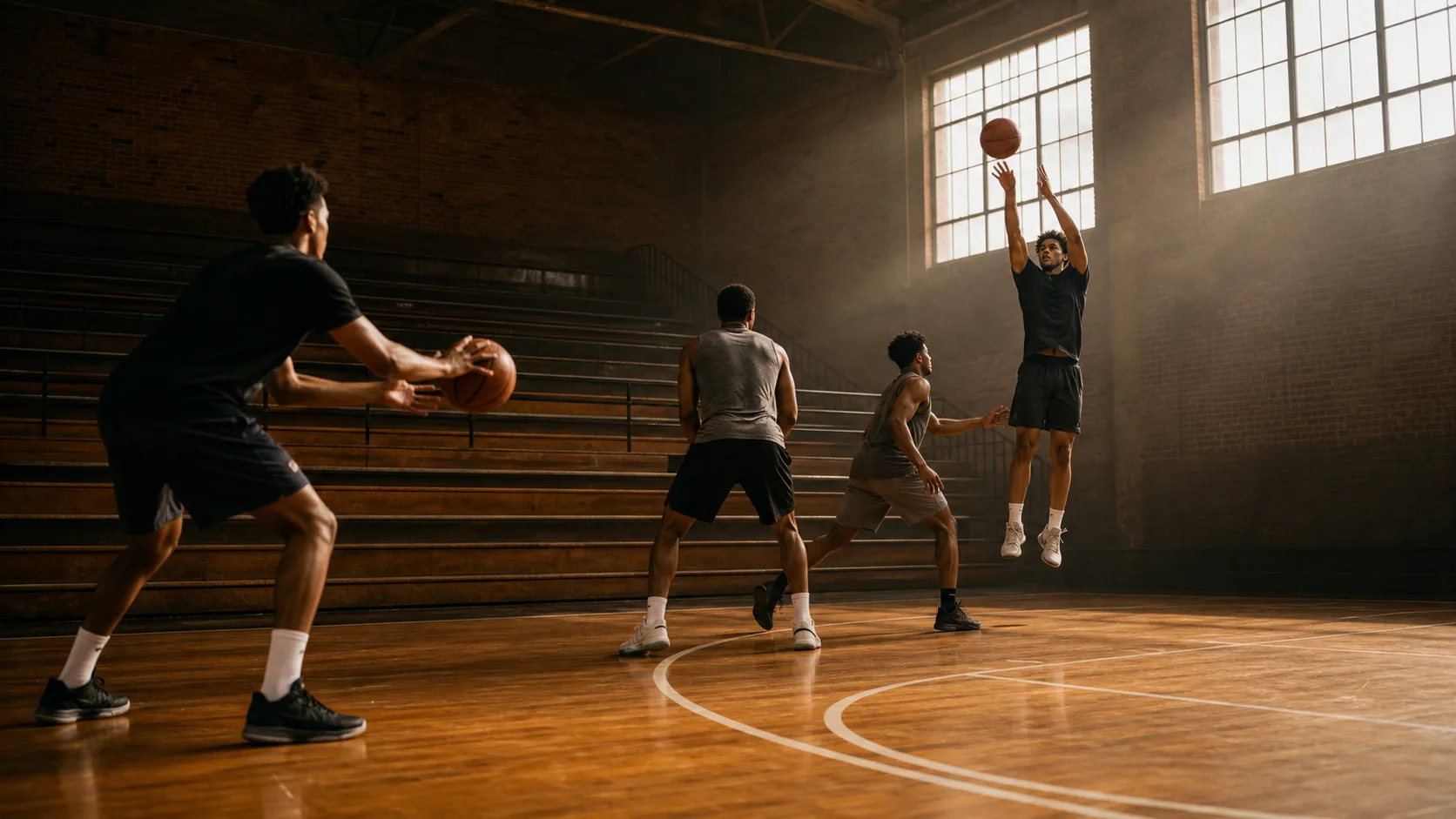
Here is what a real improvement system covers:
- Skill blocks with a clear target, not aimless shooting around
- A weekly film habit aimed at your own decisions, not highlights
- A single lens per session so you actually see something
- Honest self-scouting that names one fixable habit
- A way to test the fix in the next live game
Why do so many players plateau even when they practice hard?
Most plateaus come from repping skills while never repping decisions. You can groove a jumper for months and still stall, because the thing holding you back is a half-second late read, not your form. Volume without feedback just locks in whatever you already do.
Think about a wing who scores 20 in AAU but disappears against a good defense. His shot is fine. What breaks down is his read of the second defender. He drives, the low man tags him, and he keeps going into a wall every time. No amount of extra shooting fixes that. A study loop does, because it shows him the tag on tape and lets him plan the counter.
HoopBrief currently turns basketball and matchup questions into structured reports using public statistical and play-by-play context. It does not accept film uploads or provide possession-level video tagging.
What should you learn first?
The study loop assumes you have something to study. If you are early, build the stack in this order, because it is the order coaches actually value:
- Footwork and balance, before any scoring move. Most turnovers and missed layups trace back to bad balance. Learn to stop under control, pivot both ways, and land square.
- Finishing at the rim with both hands. It is the most common shot in any game and the easiest to practice alone. Making 8 of 10 with either hand is worth more than a pretty jumper with no touch inside.
- A repeatable catch-and-shoot jumper, taken in rhythm off a pass rather than off the dribble.
- A controlled dribble, not a highlight handle. A crossover you cannot use against pressure is a hobby, not a skill.
- A defensive stance you can hold for a whole game, which is a conditioning problem as much as a technique one.
The fancy handle is the most fun thing to practice and the least valuable early. Build the boring things first, because the boring things are what coaches keep you for. Then wrap the study loop around them.
What does a weekly improvement system actually look like?
A workable loop has three parts and fits into a normal week. Skill work in the gym, one short film session on your own possessions, and one decision you commit to changing. That is it. The magic is that the three parts feed each other instead of running as separate hobbies.
Here is a concrete week. Monday and Wednesday are skill blocks: 45 minutes of ballhandling and finishing, 30 minutes of shooting off movement. Thursday is 20 minutes of film from your last game, watched with one question. Saturday you play, and you carry one fix into the game.
The question matters more than the footage. "Where did I turn it over" beats "watch the whole game." A narrow question forces you to see cause, not just result. Our guide on how to study basketball like a pro walks through building that questioning habit rep by rep.
How do I study my own film if I have never done it?
Start with 10 possessions, not a full game. Pick a recent game, find 10 of your own touches, and grade each one on a single axis: did I make the right read, yes or no. Ignore whether the shot went in. You are grading the decision, not the outcome.
Watch each clip twice. First pass, just watch. Second pass, pause the frame right before you decide and ask what the defense is giving you. Is the help one pass away or two? Is your defender's top foot up, inviting the drive baseline? Naming the cue is the whole drill.
A worked example. You pull up for a contested two with a teammate open in the corner. On tape you see the low man had already stepped up to tag your drive, which means the corner was open a full beat before you shot. That is not a shooting problem. That is a reading problem, and now you have named it. The framework in how to study a player in ten possessions applies to studying yourself just as well.
What is the one read that pays off fastest?
If you only train one read, train this: is the help defender one pass away or two? When you drive, someone from the weak side steps in. If that helper is guarding a teammate one pass away, your kickout is open right now. If he is two passes away, the rotation is longer and you have more room to finish.
Worked example. You drive baseline and the defender guarding the opposite corner slides over to cut you off. That corner is open, because his man cannot be in two places. A player who kicks to that corner looks like a veteran, and all he did was notice who left. That single cue, help is here so the pass is there, is the seed of every more advanced read you will build.
One warning that applies to the whole system: do not measure yourself by points. A player who scores 15 on 20 shots and blows three defensive rotations is worse than the teammate who scored 6, guarded the best player, and never missed an assignment. Judge yourself by the boring stuff and you improve at the stuff that decides games.
What is the one lens rule and why does it speed things up?
The one lens rule means each film session watches for exactly one thing. One session for turnovers, another for closeouts you attacked, another for defensive positioning. When you try to watch for everything, you see nothing, because your attention has no anchor.
HoopBrief currently turns basketball and matchup questions into structured reports using public statistical and play-by-play context. It does not accept film uploads or provide possession-level video tagging.
The reason it speeds things up is pattern recognition. Watch 30 possessions with the same question and your brain starts predicting the answer before the play resolves. That prediction, built in the film room, is what shows up as anticipation on the floor. More on that in how to improve your basketball IQ.
What should I actually work on in the gym once I know my weakness?
Turn the named habit into a constraint drill. If your film says you drive into help without a plan, you do not need a new move. You need reps where the help is present and you rehearse the read. Add a coach, a chair, or a partner as the low man, and drill the kick versus the finish based on what that defender does.
Keep skill and decision work joined. Finishing drills against no defender build touch but not judgment. The same drill with a defender who sometimes tags and sometimes stays home builds the read. Our breakdown of how to improve basketball decision making covers how to load reps with that kind of live information.
Here is the honest part. This system is not for everyone, and it is slower to feel good than a shooting session. You will spend nights watching yourself make mistakes, which is not fun. If your only goal is to enjoy hoops, skip the film and go shoot. But if you want to move up a level, the tape is the shortcut that feels like the long way.
A common mistake worth naming: grading outcomes instead of reads. A good decision that misses is still a good decision. If you reward yourself only when the ball goes in, you will teach yourself to chase results and abandon the very reads that make you reliable when the shots stop falling.
The Bottom Line
Getting better at basketball is a system, not a stack of reps. Skill work sets your ceiling. A weekly loop of film, one lens, and one committed fix decides how fast you climb toward it. Start with 10 possessions of your own tape, grade the decisions and not the makes, and carry one fix into your next game.
When you want a faster read on a specific matchup or your own tendencies, try the HoopBrief Matchup Engine and ask it one honest question about your game.