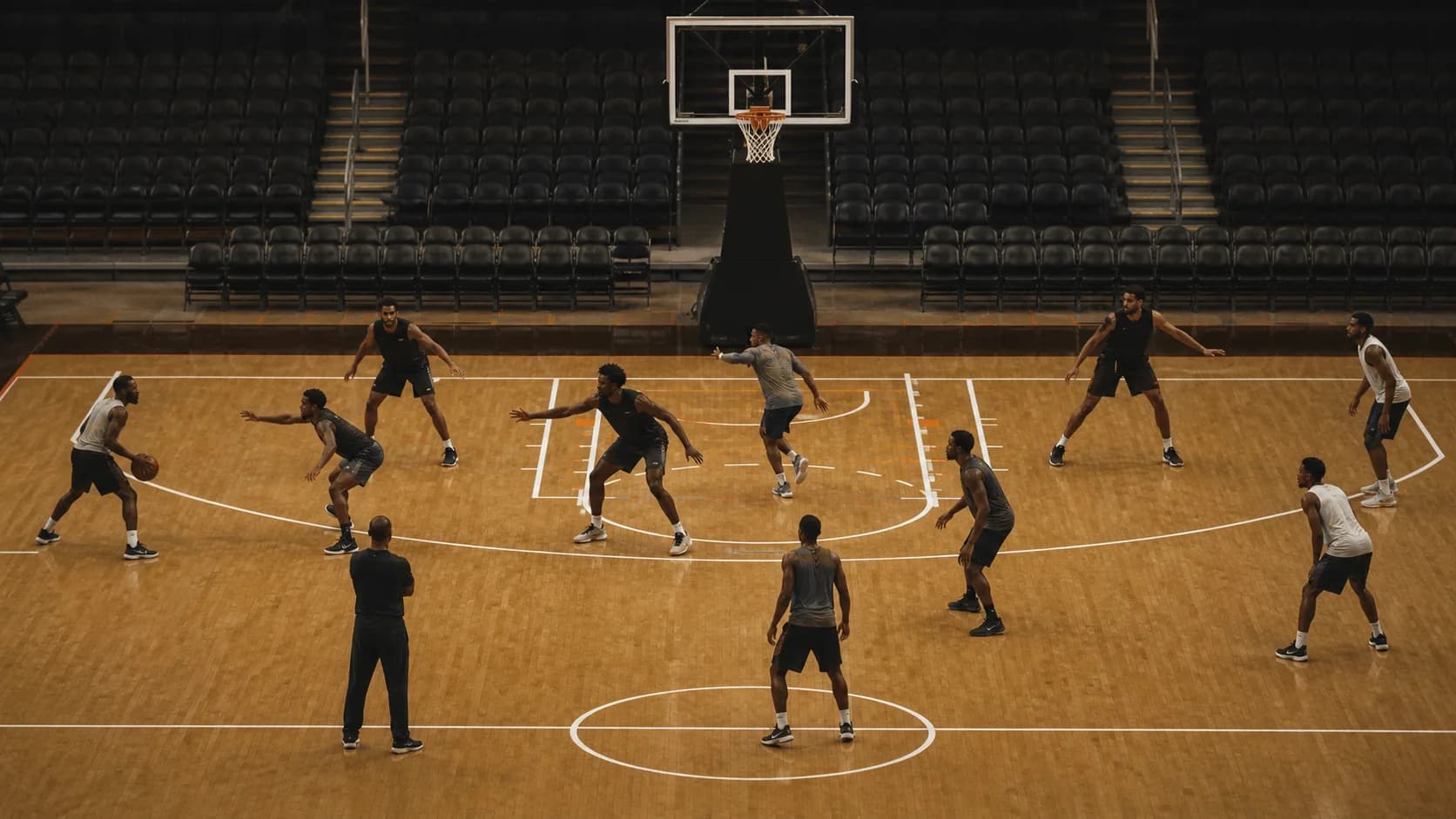
The phrase "high basketball IQ" gets used like it describes a personality trait. It does not. What people call IQ is really recognition speed and decision quality, seeing the situation early and choosing the right response. Both are skills, and skills respond to training. The coaches who develop smart players are not luckier with talent, they run practices designed to grow the reading.
Why Telling Players to Think Does Not Work
The most common way coaches try to build IQ is by talking. "Make the right play." "See the floor." "Be aware." None of it works, because none of it gives the player a rep at the actual skill. You cannot lecture recognition into someone any more than you can lecture a jump shot into them. Understanding must be built through doing, under conditions that force the read.
That is the core mistake. Awareness is not information you deliver, it is a habit you train. And you train it by removing the fixed answer from the drill.
The Core Method: Constraint Drills
The single most powerful IQ tool is the constraint drill, a rep where the right answer is not predetermined but depends on what a defender does. The player cannot run a memorized move. They have to look, read, and choose. Here are the building blocks:
- Two-on-one pass-versus-drive. Two attackers, one defender. If the defender steps up to the ball, the read is pass. If he sags to protect the rim, the read is drive. No fixed move, the defender decides for the offense.
- Three-on-two decisions. Adds a second defender and a second layer of reads. Now the attacker must read the front defender and the help, which is exactly the game.
- Advantage-disadvantage drills. Start a possession four-on-three or three-on-four so players must recognize the numbers and play accordingly, attack the advantage or scramble in the disadvantage.
- Live closeout reads. Defender closes out long or short, and the attacker reads it: drive the hard closeout, shoot the soft one.
In every one of these, the coaching cue is the same: look before you act. The drill punishes the player who moves before reading and rewards the one who sees first. Repeat it enough and reading first becomes automatic, which is precisely what IQ looks like in a game.
Add the Constraint Layer
Good coaches sharpen these drills by adding rules that force specific reads. Cap the dribbles so players must pass on time. Require the ball to touch the paint before a shot so they learn to collapse the defense. Reward a skip pass to the open weak side so eyes go off the ball. Each constraint isolates one read and makes the player solve it repeatedly.
The art is picking the constraint that targets the read your team is missing. If your players over-dribble, cap dribbles. If they never find the open man, reward the extra pass. The constraint is the teaching tool, and swapping it lets you train a different piece of IQ each day.
Then Take It to Film
Live reps build the skill, film review sharpens the recognition. But watching film aimlessly does almost nothing. The value comes from watching a few possessions with a specific question: what did the defense show here, and what was the correct read? Pause before the decision, ask the player what they see, then play it out.
This is where recognition gets faster. When a player has both taken the rep live and studied the pattern on film, they start to see it earlier in games. The film gives a name and a picture to what the drill trained physically. Guided study of even ten possessions, with a clear question, teaches more than an hour of passive watching.
Build It in a Sequence
A practical week of IQ training looks like this:
1. Introduce one read in a simple constraint drill, two-on-one, pass versus drive. 2. Add a defender so the same read happens with more chaos, three-on-two. 3. Constrain it to force the specific decision your team is missing. 4. Review on film with a single guiding question and pause before each decision. 5. Fold it into live play so the read shows up under full-game pressure.
Repeat with a new read the next week. Over a season, this stacks into a player who recognizes situations early and chooses well, the thing everyone calls a high basketball IQ.
The Honest Part
This is slower than teaching a set play, and that is why many coaches skip it. A set play produces a clean rep in a day. IQ shows up over weeks, in the possessions where a player makes a read you never drew up. If you need a quick fix, this is not it. If you want players who solve problems you did not anticipate, this is the only way, and it compounds.
The Bottom Line
Basketball IQ is a skill, and good coaches train it on purpose: constraint drills where the read is live, sharpened by targeted constraints, then locked in with guided film study. Stop telling players to be smarter and start building situations that force them to read before they act. Do it in a sequence, week after week, and court sense stops being a mystery and becomes a product of your practice plan.
Want to see how a possession reads through a coach's eyes, the correct decision, the tell, the counter? Ask the HoopBrief Matchup Engine one honest question and study the read the way you would teach it.