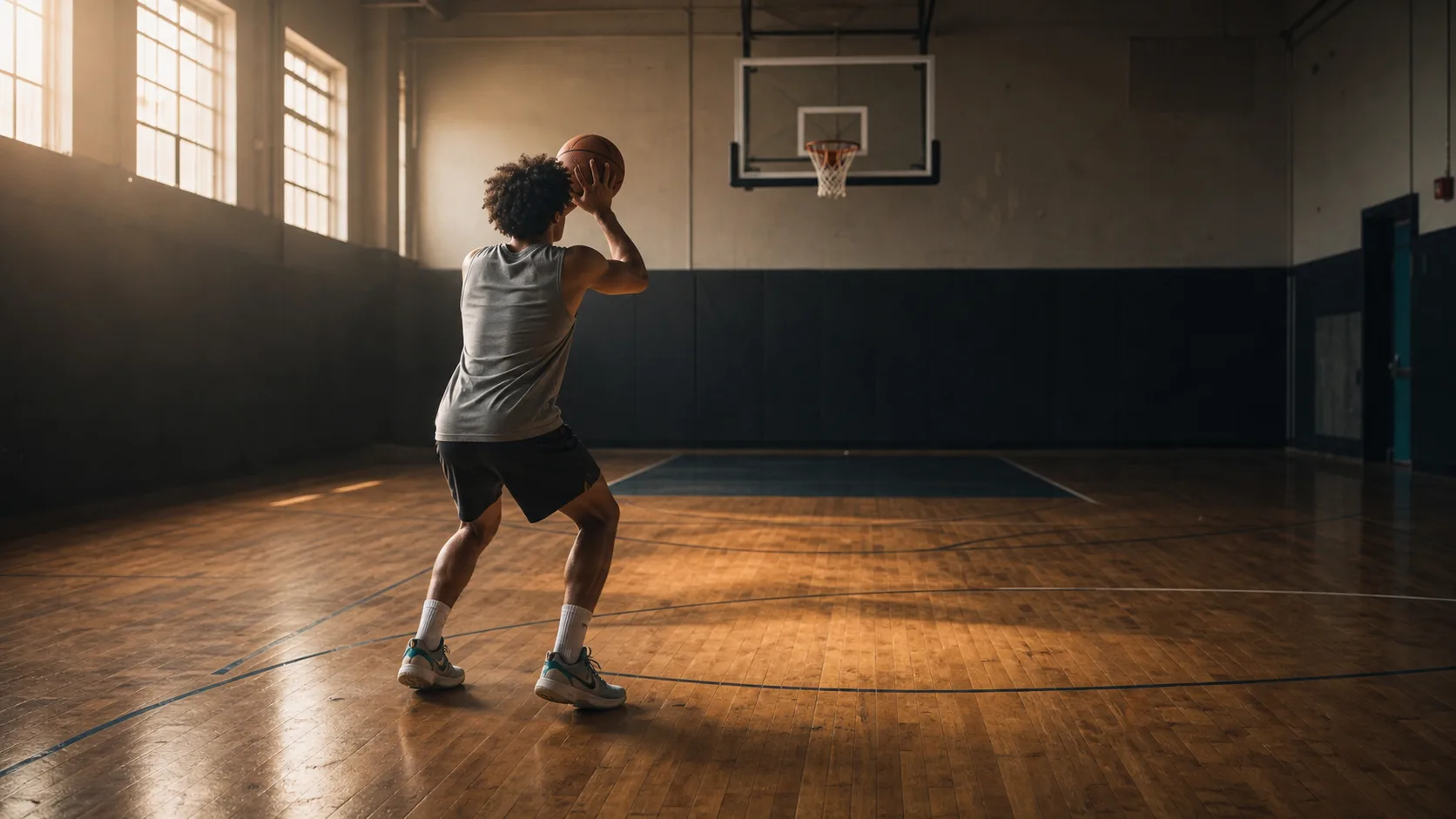
Quick answer: Stop trying to play like a tall player who got shortchanged. Your leverage advantages are real and measurable, a lower center of gravity means faster direction change and a stronger base in contact, and they are worthless unless your skill set is built to exploit them. The four that transfer are change of pace, the floater, contact balance, and pre-catch reading. The three that mostly do not are contested rim finishes, back-to-the-basket post play, and shot-blocking. Build the first four relentlessly and stop apologising for the last three.
| Physical reality | What it costs you | What it buys you |
|---|---|---|
| Lower release point | Contested jumpers over length | Faster shot preparation |
| Shorter reach | Rim finishing through contact, blocks | Quicker hands in passing lanes |
| Lower center of gravity | Almost nothing | Faster direction change, stronger base |
| Less mass (usually) | Absorbing bumps on drives | Higher work rate over four quarters |
The reframe that has to happen first
There is a version of the short guard who plays angry. He tries to dunk in warmups, he settles for contested threes to prove range, and he attacks the rim into traffic to prove he is not afraid. He is playing a game designed by someone else and losing it on purpose.
There is another version who has accepted the actual constraints and built a system inside them. He is nearly impossible to guard, because everything he does is something his body is genuinely better at than the person guarding him.
The difference is not effort or confidence. It is an honest inventory.
Height costs you exactly three things in basketball: the ability to shoot over a closeout, the ability to finish at the rim through a taller defender's contest, and the ability to block shots. That is the whole list. Everything else on a basketball court is either neutral to height or actively favours being lower.
That last part is not encouragement, it is mechanics. A lower center of mass means a shorter lever arm between your base and your torso, which means you can decelerate and redirect in less time and with less force. The commonly cited figure is a 15 to 20% faster change of direction, and while the exact number varies by study and by athlete, the direction of the effect is not in dispute. You are physically better at stopping and starting than the person guarding you.
The whole handbook is about turning that one advantage into points.
Skill one: change of pace, not top speed
Most young guards train speed. Speed is the least useful athletic trait for an undersized player, because the defender guarding you is often longer and can cover ground with fewer steps.
What beats length is rate of change. Not how fast you go, but how quickly you go from one speed to another.
Here is why it works. A defender guarding you is running a continuous prediction: where will he be in 0.3 seconds. If you move at a constant speed, that prediction is easy and his length lets him recover from small errors. If your speed changes sharply, the prediction breaks, and by the time he corrects, the geometry has changed.
The specific application. Attack the screen at 60% speed, not 100%. At 60% you can still accelerate; at 100% your only remaining option is to keep going in the same direction. Defenders in drop coverage are trained against a downhill guard. They have no answer for a guard who arrives slowly, waits for the big to commit, then goes.
This is the entire foundation of how Jalen Brunson scores against bigger, more athletic defenders, and it is why it works in a league where he is not close to the fastest player on the floor.
How to build it. Every ball-handling drill you do at one speed, redo at two. Cone drills at a constant pace build nothing. Cone drills where you decelerate hard at cone two and explode at cone three build the exact quality that beats length.
Skill two: the floater, which makes height irrelevant
The floater is not a trick shot. For an undersized guard it is the single highest-leverage skill in basketball, because it is the only way to score in the paint without entering the space where your height actually costs you.
The logic is geometric. A help defender protecting the rim is positioned to contest a shot released at the rim. The floater is released four to twelve feet away, at the top of your jump, before you enter his contest radius. He cannot block what is released before he gets there, and if he leaves early to try, he fouls.
Trae Young, at 6'1", built an entire scoring profile on this. Isaiah Thomas at 5'9" did the same. The research consensus is that mastering the shot lifts paint shooting percentage meaningfully for players in this height band, and more importantly it changes what the defense is allowed to do against you.
We wrote the full mechanical breakdown separately: how to shoot a floater.
Skill three: contact balance
Undersized guards do not get fewer bumps. They get more, because defenders correctly believe contact will dislodge them.
The counter is not getting stronger in a general sense. It is being able to absorb a hit without changing your intended path, which is a specific trainable quality and mostly about where your weight is at the moment of contact.
The principle: your base has to be underneath you when contact arrives. A guard driving with his weight ahead of his feet gets moved by a shoulder bump. A guard whose feet are underneath his hips absorbs it and continues.
That is what the two-foot jump stop teaches, and it is why nearly every effective small guard plays off two feet in traffic rather than one. Two feet means a wider base, a lower center of mass at the moment of contact, and the option to pivot either way afterward.
Drill it with contact, or you have not drilled it. A pad, a partner, anything. Balance work without an external force is balance work against a problem you do not have.
Skill four: pre-catch reading
This is the one nobody trains and it separates good small guards from unguardable ones.
A taller player can catch the ball, survey, and then decide, because his height buys him the vision and the passing angles to do that. You cannot. By the time you catch, gather, and look, the help has rotated and your window is gone.
So you have to decide before the ball arrives.
What to read on the pass. Where the help defender's chest is pointed. Whether the low man is on the split line or hugging the corner. Whether your defender is on your top hand or your bottom hand. Whether the big is in drop or at the level.
Those four facts determine what your catch should be, and all four are visible while the ball is in the air.
This is the trainable version of what people vaguely call basketball IQ, and it is the part of the game where being short costs nothing at all.
Defending bigger players, which is the actual daily problem
Every undersized guard gets posted up eventually. It is the most common counter in basketball and most players have no plan for it.
The plan has three parts.
Beat him to the spot. Post defense is decided before the catch. If he catches on the block, you have already lost most of the possession. Front him or three-quarter him on the way down, and make the entry pass the hard part.
Use your base, not your arms. Once he has the ball, arms are a foul waiting to happen. Your leverage advantage is real here, get low, get your forearm into his hip, and make him back you down over distance. Every dribble he takes is another chance for a dig or a double.
Take away the turn, not the shot. You cannot contest his shot, so stop trying. Take away the direction he wants to turn, force him to his weak shoulder, and live with a contested fadeaway over his off shoulder. That is a bad shot for anyone.
More on this in how to guard a bigger player and how to guard a faster player.
What to stop doing
Honest subtraction matters as much as addition.
- Stop taking contested twos inside the arc against length. This is the worst shot in basketball for your body type. Either get to a floater earlier or kick it.
- Stop trying to block shots. Every block attempt is a foul risk and a rebounding position surrendered. Box out instead; that is a leverage task and you are good at it.
- Stop posting up. Even against a smaller defender, the help arrives faster than you can operate.
- Stop measuring yourself against dunk highlights. They are the one part of the sport your body will not do, and they are a rounding error in winning basketball.
A twelve-week build
| Weeks | Focus | Measurable target |
|---|---|---|
| 1-3 | Change of pace | Every drill at two speeds, no constant-pace reps |
| 4-6 | Floater | 100 makes per session from 6, 8, 10 feet, both hands |
| 7-9 | Contact balance | Jump stops with a pad, finish through the bump |
| 10-12 | Pre-catch reading | Call the read out loud before every catch in live play |
The order is not arbitrary. Change of pace creates the driving lane, the floater is how you punish it, contact balance keeps you upright when they adjust, and pre-catch reading is what lets you do all three at game speed.
The honest close
Nothing here makes you taller and none of it should. The players who solve this problem stop treating height as a deficit to be compensated and start treating it as a set of constraints that rule out some solutions and strongly favour others.
The specific matchup still matters, and that is a research problem rather than a training one: what does the person guarding you tonight actually struggle against. Run a free scout on any defender and see what the tape says before you decide how to attack him.