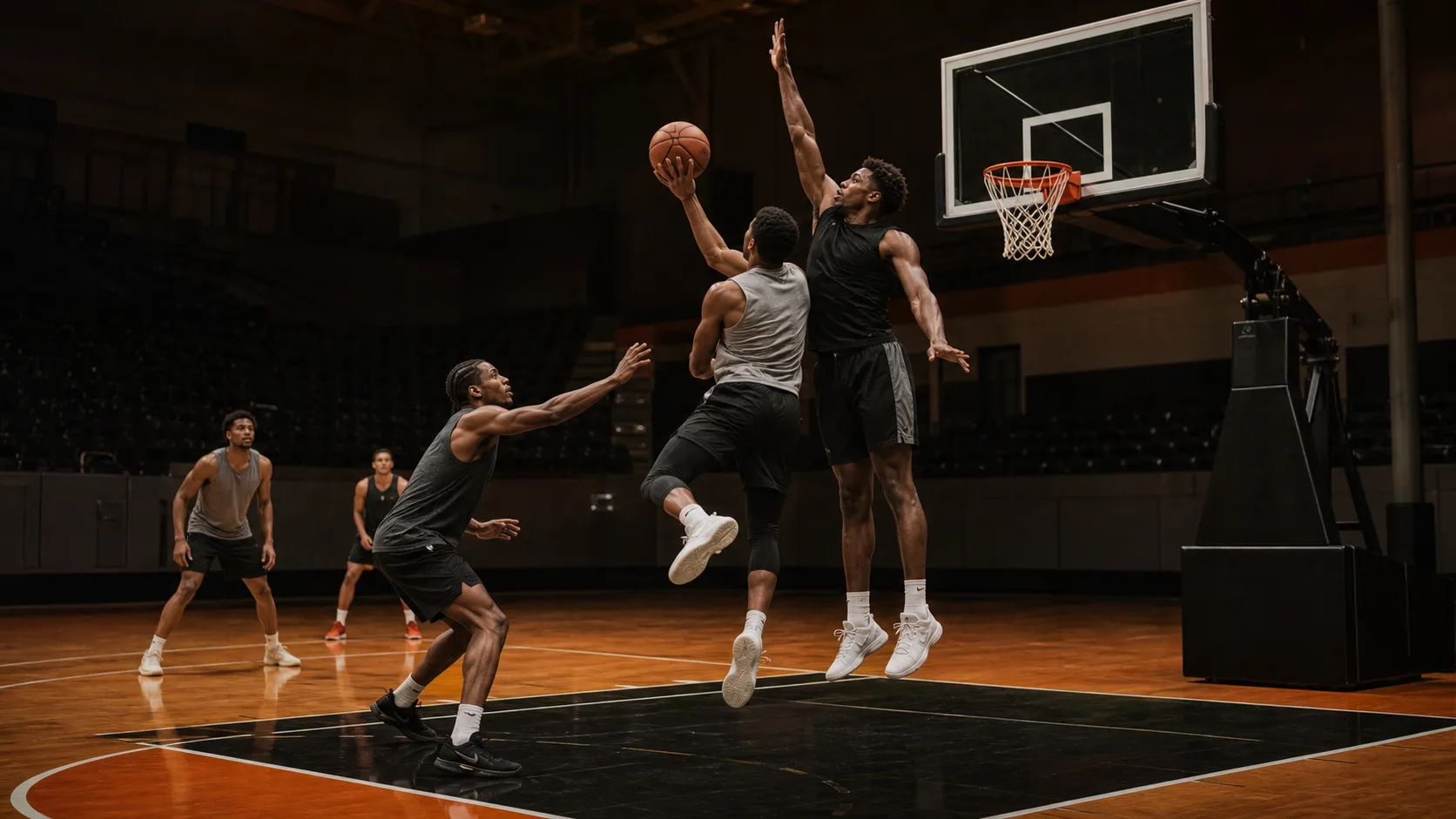
The quick checklist before we break it down:
- Deny the spot early. Position before the catch beats any contest after it.
- Choose front or 3/4 based on whether help is behind you.
- Get low and meet the back-down before he builds momentum.
- Dig at the ball on the dribble or turn, then recover.
- Contest straight up with a high hand, no jump into his body.
How Do You Take Away a Bigger Player's Best Spot?
His best spot is a deep seal on the block with a target hand up. Take it away before he gets there. The battle for post position is won on the walk-up, not on the catch. If you let him plant on the block and seal, you are already guarding from behind.
Here is the read. As the ball swings toward his side, his catch is coming. Beat him to the block by stepping across his path with your top foot, the foot nearest the baseline or nearest the ball depending on where he wants it, and put a forearm bar on his hip. Now he has to catch a step higher and a step wider. A catch at the second hash instead of the block turns a layup into a contested turnaround. That one step is the whole job.
Where you stand off the ball to be ready for this is the same discipline in positioning IQ: where to stand on defense. Good post defense starts two passes before the entry.
When Do You Front the Post Versus Playing 3/4?
Front only with help behind you. Play 3/4 when you are alone. That single decision separates good post defenders from ones who give up lobs all night.
Fronting means putting your body fully between the passer and the post man, back to him, arms up to deflect the entry. It kills the direct feed, but it surrenders the entire rim behind you. So you front only when a weak-side defender is in the paint ready to take the lob. Communicate it: the fronting defender calls for the lob help before the ball ever reaches the wing.
The 3/4 position is the safer default. You put your top arm and leg across his high side, blocking the direct passing lane, while keeping your body angled so you can still see a lob and recover to the rim. You concede a tougher entry over the top rather than an easy lob. When in doubt and alone, play 3/4. The full front without help is a highlight lob waiting to happen.
How Do You Stop the Back-Down?
Meet him early, get lower than he is, and hold a wide base. A back-down works on momentum. If he gets to full-speed contact against a defender standing tall, he wins every time. Take that momentum away before it starts.
The mechanics: bend your knees so your hips are below his, put your forearm bar on his lower back or hip, not his shoulder blades where refs look, and widen your feet so his push meets a base he cannot move. Absorb with your legs, not your chest. When he gathers to spin, that is your cue that he has run out of runway.
The mistake here is reaching over the top for the ball while he backs you down. Reaching draws the foul and pulls you off balance, which is exactly what he wants. Keep your hands in, hold the wall, and make him try to score over a set base.
When Should You Dig at the Post?
Dig on the dribble or the turn, not on the catch. A dig is a fast jab from a help defender toward the ball, aimed at his handle when his eyes are down, then an immediate recovery. Timing is everything.
The worked example: the big catches on the block and puts the ball on the floor for a dribble to gather. His eyes drop to the ball, his off-hand comes off the ball to gather. That is the dig window. The nearest help defender jumps in, swipes low at the exposed ball, and gets back out before the kickout. Dig early on the catch and you just show him the help and give him time to find the open shooter. The read is the same second-defender timing in reading help defenders off the ball, applied to the post.
Whoever digs must recover on the flight of the pass. A dig that turns into a permanent double gives up the open corner three.
How Do You Contest Without Fouling a Bigger Player?
Contest straight up with a high hand and a still body. Jumping into a bigger player is how you send him to the line and get yourself in foul trouble. Verticality beats a leap.
When he finally turns to shoot, get your feet set, jump straight up if you jump at all, and put a long high hand at the ball with your chest back, not forward. He has the height, so you are not blocking it. You are making him shoot over a hand with no bail-out foul. Let his size be the only advantage he keeps, and take away the free points at the line.
Is This Approach Ever Wrong?
Yes, and here is the honest beat. If you are giving up a lot of size and strength and the big is a genuinely skilled scorer, one-on-one defense with early position slows him but will not stop him alone. Some matchups are true mismatches that need a scheme answer, an early double, a dig-and-recover rotation, or fronting with a designated lob defender, rather than pride. Knowing when you need help is part of guarding him. Fighting a losing one-on-one battle all night just fouls you out.
The broader footwork and stance base under all of this lives in how to improve your basketball defense.
The Bottom Line
Guarding a bigger player is a positioning contest you win before the catch. Beat him to the spot, choose front or 3/4 by your help, meet the back-down low and early, and dig on the turn. You are not trying to out-jump him. You are trying to make every touch happen a step farther from the rim than he wants.
To see whether a specific matchup is a true mismatch and the exact coverage that neutralizes it, the HoopBrief Matchup Engine reads the size gap and prescribes the defensive plan in seconds.