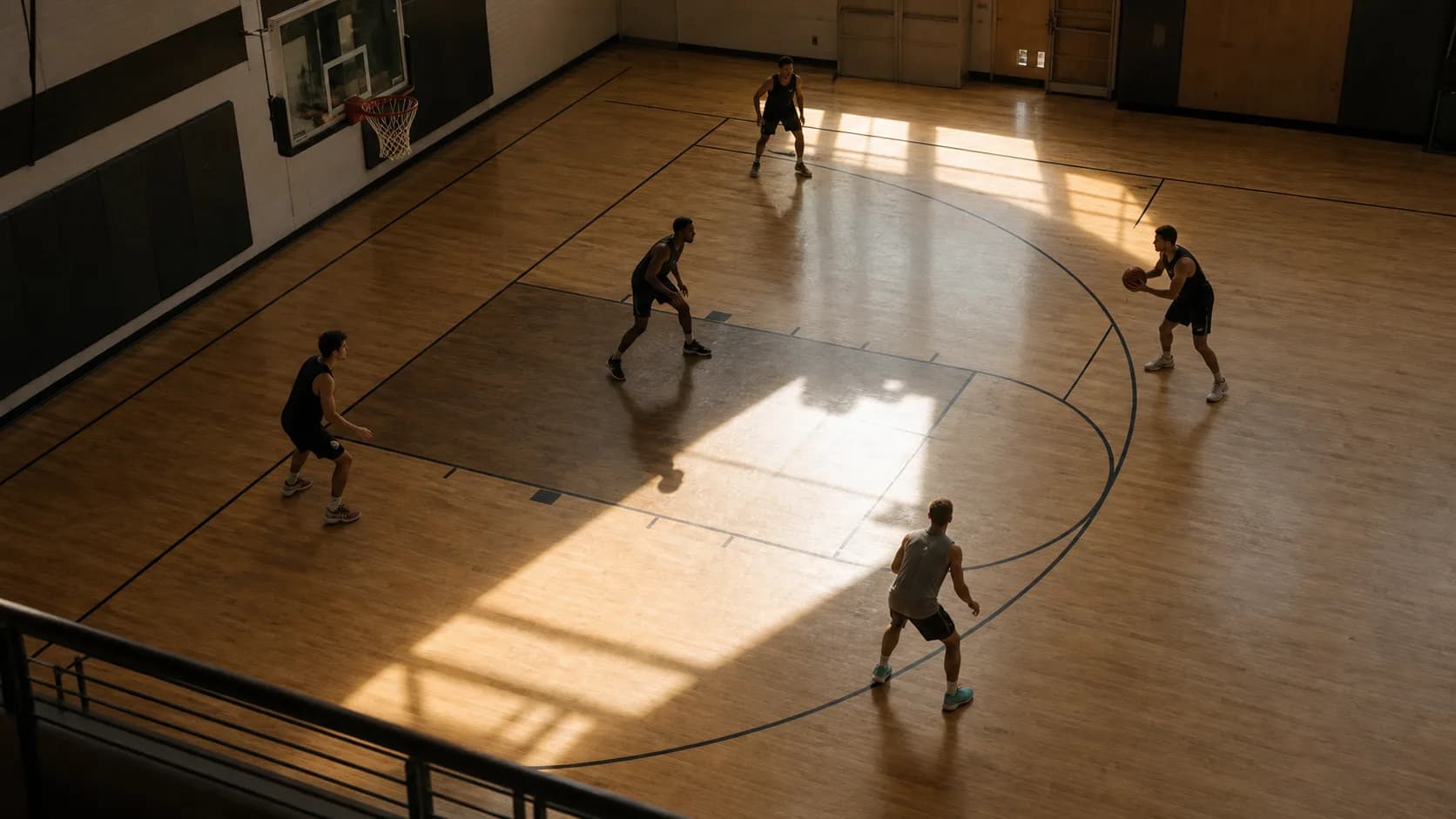
On-ball defense is the least glamorous skill in basketball and the fastest to improve, because most players never work on it. A defender with clean fundamentals frustrates far more talented scorers.
The on-ball checklist: - Sink into a low, wide, balanced stance on the balls of your feet - Keep a cushion, about an arm's length, against a driver - Use your top-foot to force the ball handler one direction - Slide, never cross your feet, and never turn your hips too early - Contest straight up with a high hand, landing where you jumped
The goal is not to steal the ball. The goal is to make every touch harder than the offense wanted, and to force the ball where your help is waiting.
How Do You Set Your Defensive Stance?
Set a stance that is low, wide, and balanced. Feet wider than your shoulders, knees bent so your hips drop, chest up, and weight on the balls of your feet so you can push off either way. Active hands, one low to bother the dribble, one ready to contest. A tall or narrow stance means you are already beaten.
The stance is the foundation for everything else, because you cannot slide, force a direction, or recover from a base you do not have. Where you set up relative to your man and the ball is its own skill, covered in positioning IQ, where to stand on defense. Stance is the physical half of that positioning.
A stance also has to be sustainable. A defender who sinks perfectly for one possession but stands straight up by the third quarter is not a good on-ball defender, he is a tired one. Build the leg strength to hold a low base for a full game, because most blow-bys late in a game come from a stance that quietly rose over four quarters.
How Much Cushion Should You Give?
Give a cushion of roughly an arm's length against a driver, and shrink it against a shooter. The cushion is your reaction buffer, the space that lets you stay in front of a quick first step without lunging. Play too tight and a fast handler blows past you, play too loose and a shooter rises up clean.
The right cushion is not fixed, it depends on who you are guarding, which is why you scout the player. A shooter with a slow first step gets crowded. A blow-by driver with a shaky jumper gets a bigger gap and a dare to shoot. Knowing that difference is basketball IQ applied to defense, and how to improve basketball IQ covers building that read. Your reaction inside that cushion is trainable too, which is the subject of how to improve reaction time.
How Do You Use the Top-Foot to Force a Direction?
Use the top-foot to dictate where the ball handler goes instead of just reacting to him. The top-foot is the foot you set higher than the other, angling your stance to wall off one side. Force him baseline by putting your top-foot on his middle side, or force him middle into your help by walling off the baseline.
This is what separates a reactive defender from one who is part of a defensive plan. When you force a direction, your help defense knows where the drive is going and can set up the tag. A defender who just mirrors the ball gives the offense a choice, and choice is what the defense is trying to remove. How that help sets up behind you is in reading help defenders.
How Do You Slide and Contest Without Fouling?
Slide by pushing off your trail foot and stepping with your lead foot, never crossing them, and never turning your hips square until the ball handler commits. Crossing your feet or opening your hips early is how quick players beat you, because you cannot change direction mid-cross. Stay in a slide as long as you can.
Contest the shot straight up. Jump vertically with a high hand in the shooter's sight line, and land where you took off. Most shooting fouls come from jumping into the shooter or swiping down at the ball as it rises. A vertical contest alters the shot without giving up two free throws, and that trade is almost always worth more than the block you were reaching for.
Who This Is Not For
This is not for the player chasing steals and blocks for the highlight. Gambling on the ball gets you beaten backdoor and puts your team in rotation. Good on-ball defense is patient, positional, and mostly invisible, and if you need the stat to feel rewarded, you will keep reaching.
It also will not make up for a total size or speed gap on its own. Guarding up in size is its own problem, covered in how to guard a bigger player. Fundamentals shrink the gap, they do not erase it.
The Bottom Line
Sink into a real stance, keep the right cushion, force a direction with your top-foot, slide without crossing your feet, and contest straight up. On-ball defense is fundamentals plus discipline, and it is the fastest edge to build because almost nobody works on it.
One way to sharpen the defensive read off the court: ask how a scout would attack the player you are guarding, so you know what to take away. The HoopBrief Matchup Engine turns a matchup into a concrete plan in seconds, and Starter is $9.99/mo.