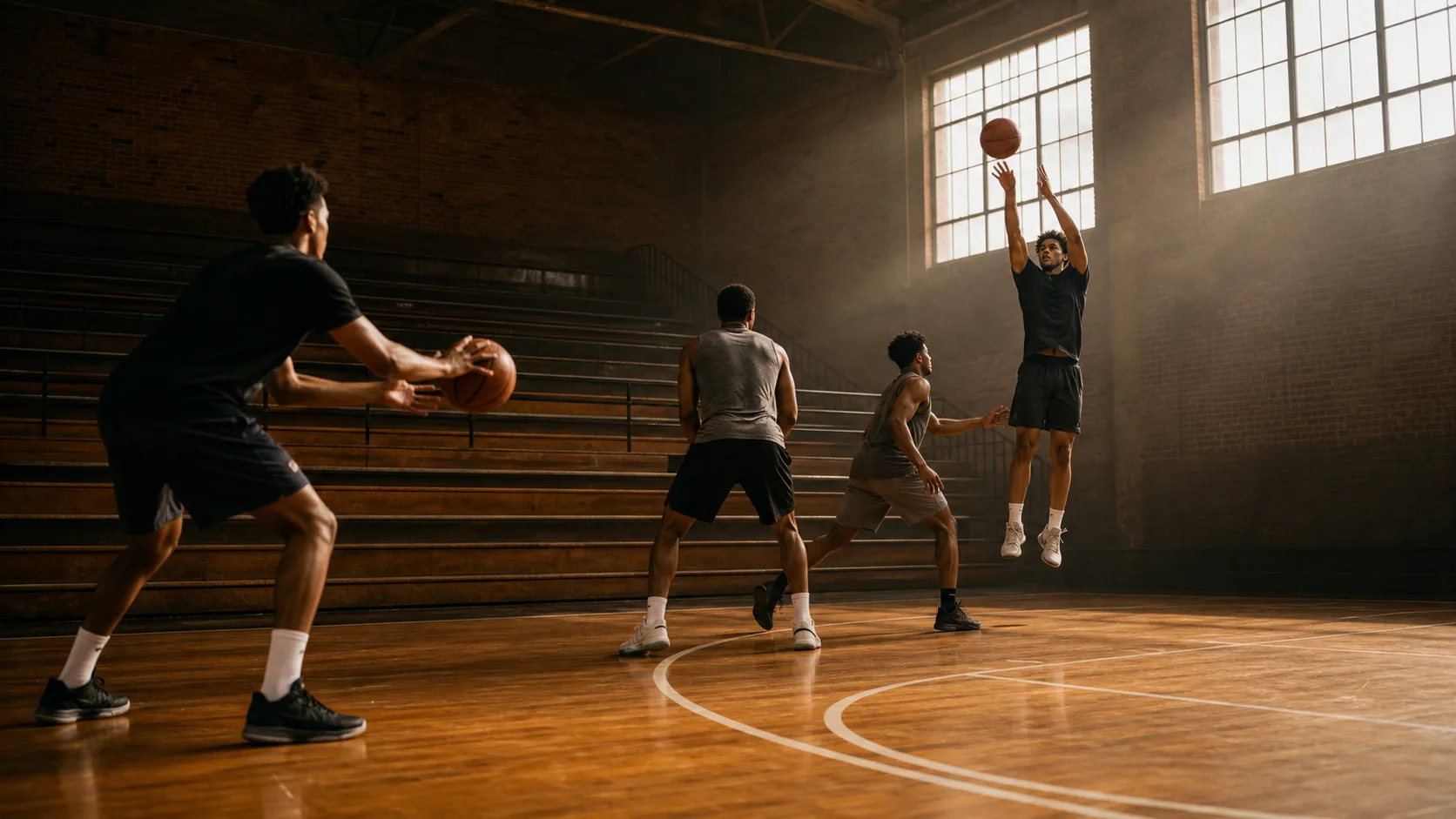
Quick answer: A floater is a high-arcing shot released before you reach the shot blocker, from roughly six to twelve feet, at the top of your jump. It works for a purely geometric reason: a rim protector is positioned to contest a shot at the rim, so a shot that leaves your hand four feet earlier is uncontestable, and if he leaves early to reach it he fouls. The two mechanical non-negotiables are a high release at the apex of your jump and a soft, high-arc trajectory. Everything else, one foot or two, which hand, how far, is situational.
| Element | Correct | Common error |
|---|---|---|
| Release timing | At the top of your jump | On the way up, rushed |
| Arc | High, steep descent | Flat, gets blocked or rims out |
| Distance | 6-12 feet | Too deep, becomes a contested layup |
| Eyes | Front of rim | On the defender |
| Off hand | Protecting, not guiding | Two-handed push |
Why the shot exists
Understand the geometry and the technique becomes obvious.
A help defender protecting the rim stands in a known place and does a known thing: he waits for you to arrive, then contests vertically. His entire effectiveness depends on you coming to him.
Every scoring option a guard has inside the arc either goes to him (a layup, a contested finish) or stops short of him (a pull-up, a floater). The pull-up jumper stops short but is a low-percentage shot from that range and gives him time to close out. The floater stops short and goes up immediately and travels on an arc he cannot reach.
That is the whole idea. You are not beating the shot blocker. You are declining to play the game he is set up for.
This is why the shot is disproportionately valuable to smaller players, and why the players most associated with it, Trae Young at 6'1", Isaiah Thomas at 5'9", Chris Paul for two decades, all share a body type.
The mechanics, in order
1. Gather early. The single most common failure. Players gather at the same point they would for a layup, which is already inside the contest radius. Your gather should happen a full step earlier than feels natural. If you feel early, you are probably on time.
2. Rise, do not drive forward. A layup carries momentum toward the rim. A floater converts that momentum upward. Forward momentum on a floater flattens the arc and sends the ball long, which is why so many attempts hit the back rim.
3. Release at the apex. Not on the way up. At the top. This is what puts the ball above the reach of a defender who is himself jumping, and it is the difference between an uncontestable shot and a blocked one.
4. High arc, soft touch. The ball should descend steeply. A steep descent has a larger effective target, the rim viewed from above is a full circle rather than an ellipse, so a high-arc miss is far more likely to drop. Flat floaters are the ones that clang.
5. Off hand protects, it does not push. Two hands on the release produces side spin and inconsistency. The off hand stays as a barrier between the ball and the defender.
6. Eyes on the front rim. Not the backboard, and not the defender. The front rim is the reference for a shot that descends steeply.
One foot or two
Both are correct, in different situations, and most players should own both.
One foot is faster and covers more ground. Off a live dribble going downhill, the one-foot floater lets you release earlier and further out. It is harder to balance and harder to adjust mid-air.
Two feet is more stable and lets you shoot either direction. Off a jump stop in traffic, two feet gives you a wider base, a pivot option if you decide not to shoot, and better balance through contact. It is slower to get into.
The rule: downhill with space, one foot. Into traffic or with contact coming, two feet.
For undersized guards specifically, the two-foot version carries extra value because it doubles as the contact-balance skill discussed in the undersized guard's handbook.
The reads: when to shoot it
Technique without reads produces a player who shoots floaters at the wrong time. Three things tell you.
The big is in drop coverage. He is sitting back, protecting the rim, conceding the middle. That concession is a floater. This is the single most common and most reliable trigger.
The help defender has committed. The moment the low man steps up, the shot is available and so is the kick to the corner he just left. Take the floater when he steps up late; kick when he steps up early.
Your defender is on your hip. If he is trailing rather than in front, a floater releases before he can recover. If he is in front of you, you do not have a floater, you have a pass.
Not sure what a specific opponent's big actually does in ball screens? That is exactly the read to check before a game rather than discover during one. Run a free scout on him and see the coverage.
The five mistakes
Shooting it too deep. Under the rim, it is just a bad layup. If you are inside five feet, finish.
Flat trajectory. Usually caused by forward momentum. Fix the rise, not the wrist.
Rushing the release. Releasing on the way up gives back the height advantage the shot exists to create.
Using it as an escape. Floaters taken because you got stuck are low-percentage prayers. It is a planned shot, not a bailout.
Only training one hand. Half the court disappears if you can only float going right. The off-hand floater is what makes the shot unguardable, because the defender cannot force you one way.
Four-week progression
| Week | Work | Target |
|---|---|---|
| 1 | Form floaters, no dribble, 6 feet, both hands | 50 makes each hand |
| 2 | One-dribble floaters from both wings and middle | 100 makes, tracking arc |
| 3 | Off a live ball screen, with a defender in drop | 60% in blocks of 10 |
| 4 | With a contest and contact, both feet and one foot | Make it under a pad |
Two notes. Make counts, not attempts, otherwise you rehearse missing. And shoot from the three distances you will actually use, six, eight and ten feet; nobody shoots a floater from fifteen.
Why it changes the whole matchup
The value is not only the points. Once a rim protector has to respect a floater, he cannot sit in drop. When he steps up, the roller is open behind him, the corner is open when the low man rotates, and your own driving lane widens because he has to honour a shot four feet earlier than before.
One shot, added properly, changes what the entire defense is allowed to do against you. That is why it is worth four weeks.