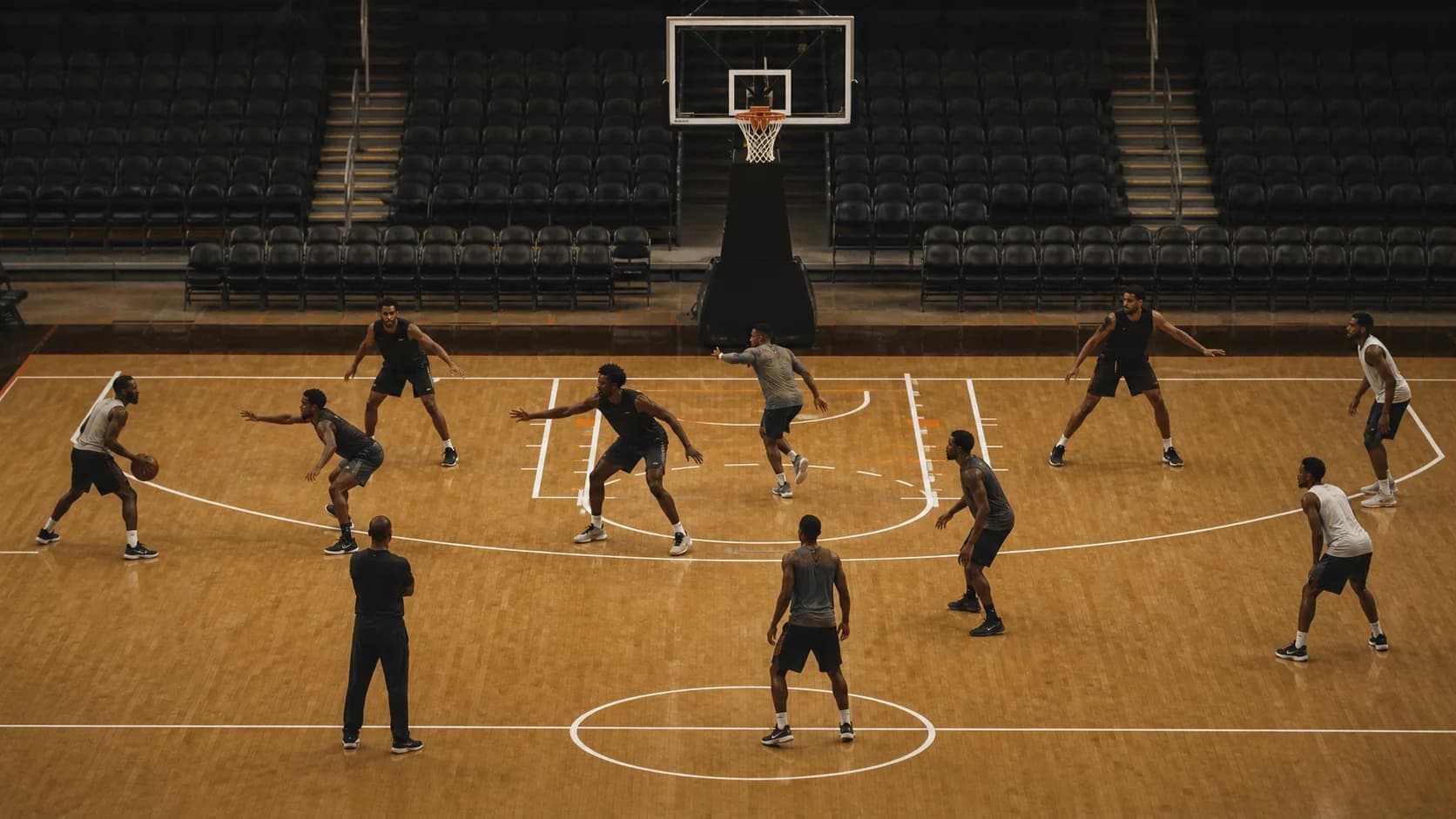
Quick answer: Team scouting answers "what do they run". Individual scouting answers "what does the person guarding me do when I go left", and that second question decides far more of your night. Eight questions cover almost all of it: stance, hands, recovery, screen navigation, help discipline, foul tendency, conditioning, and pride. You can answer most of them from one half of film, and you should convert the answers into no more than three decisions before tip.
| Question | What you are looking for | What it changes |
|---|---|---|
| Stance | Which foot is forward | Which direction is free |
| Hands | Reaching or disciplined | Whether hesitation works |
| Recovery | Speed after a first step beaten | Whether counters are needed |
| Screens | Over, under, or through | Whether to use screens at all |
| Help | Leaves early or stays home | Whether your passes are open |
| Fouls | Reaches when beaten | Whether to hunt contact |
| Conditioning | Fourth-quarter posture | When to attack hardest |
| Pride | Reaction to being scored on | Whether to bait him |
The asymmetry nobody fixes
Your coach spends Sunday night on the opponent. He watches their sets, charts their tendencies, builds a plan. Then he gives the team a scouting report about the team.
Meanwhile the thing that will actually determine your production is one person, and almost nobody prepares for that person specifically.
This is a strange gap because individual matchups are far more predictable than team behaviour. A team changes its sets week to week. A defender's stance has been the same since he was fourteen. Habits at the individual level are extremely stable, which makes them the most reliable thing you can prepare against.
The eight questions
1. Which foot is forward in his stance? Nearly every defender has a preferred foot. That foot forward means he is faster going that direction and slower recovering the other way. Watch three or four possessions and it will be obvious. Whatever direction he is set up to stop is the direction he cannot stop twice.
2. Do his hands reach? A reaching defender is a gift. Hands out means weight forward, and weight forward means a hesitation or an in-and-out moves him. A disciplined defender with hands back does not bite on fakes, and against him you need screens and pace rather than moves.
3. How fast does he recover after being beaten? Some defenders are beaten once and done. Others have long strides and recover from the first step, which means your first move only creates the second one. Against a recoverer, plan the counter before you make the first move.
4. How does he navigate screens? Over the top, under, or through. If he goes under, your pull-up is available every time and you should take it until he changes. If he chases over, the reject and the slip are available. If he switches, you have a mismatch to attack immediately, before help arrives.
5. Does he leave early to help? A defender with itchy help instincts is the reason your teammates get open, and knowing it in advance turns a reaction into a plan. If he leaves early on drives, your kick is there before the pass is even needed.
6. Does he foul when beaten? Some defenders accept being beaten. Others reach and hack. Against a reacher, hunting contact is a genuine strategy, drive into the recovery rather than away from it and shoot free throws all night.
7. What does he look like in the fourth quarter? Conditioning is the most under-scouted trait in basketball. A defender whose stance rises in the fourth is a different, worse defender than the one you faced in the first, and the plan for minute 32 should not be the plan for minute 4.
8. How does he react to being scored on? This is the psychological read and it is more actionable than it sounds. Some defenders tighten up and play better. Others gamble to get it back immediately, which means the possession right after you score him is the highest-value possession of your night.
Where to actually find the answers
Film, if you have it. One half is enough. Watch only him, not the ball. This is uncomfortable and unnatural and it is the whole skill. Twenty possessions of watching one defender will tell you more than three full games of watching the ball.
Box scores, as a weak proxy. Fouls per minute hints at question six. Minutes played hints at seven. It is thin, but it is not nothing.
Ask. Someone in your gym has played against him. Teammates, other teams in your league, a coach. Two minutes of conversation regularly outperforms an hour of film for questions one, two and eight.
Warmups. Underrated and free. You can see stance, conditioning, and often demeanour before the game starts.
Data, if the matchup exists at a level that tracks it. For NBA players this is exactly what the free scout does, it pulls play-by-play and tracking data on a specific defender and returns what the offense should attack. Useful directly if you are studying pro tape, and useful as a template for the questions to ask about your own opponent.
Turn it into three decisions, not a dossier
The most common failure is over-preparation. A player who walks on with eleven observations executes none of them.
Convert your reading into exactly three decisions:
1. The primary attack. One direction, one move, based on his stance and recovery. 2. The counter. What you do the second time, once he has adjusted. 3. The situational trigger. One if-then. "If he goes under, I shoot it." "If he reaches, I drive into the contact."
Three is the number a person can actually hold under fatigue. Write them down. Say them out loud before tip.
A worked example
Suppose your film shows: right foot forward, hands active, recovers well, goes under screens, stays home on help, does not foul much, stance rises late, and gambles after being scored on.
Primary: attack his right side, since right foot forward means slower recovering left. Counter: when he overplays left, hesitate and go back right, but expect the recovery, so plan the floater rather than the layup. Trigger: he goes under screens, so the first ball screen of the game is a pull-up, every time, until he starts going over.
And one situational note: after you score, expect a gamble, so the next possession is a straight-line drive past the reach.
That is a complete individual game plan and it fits on an index card.
Do this once and you will not stop
The first time you prepare for a specific person rather than a team, the game gets noticeably slower. Not because you got better in a week, but because you stopped discovering things in real time that you could have known beforehand.
Coaches have understood this for decades. Almost no players do it, which is exactly why it works.