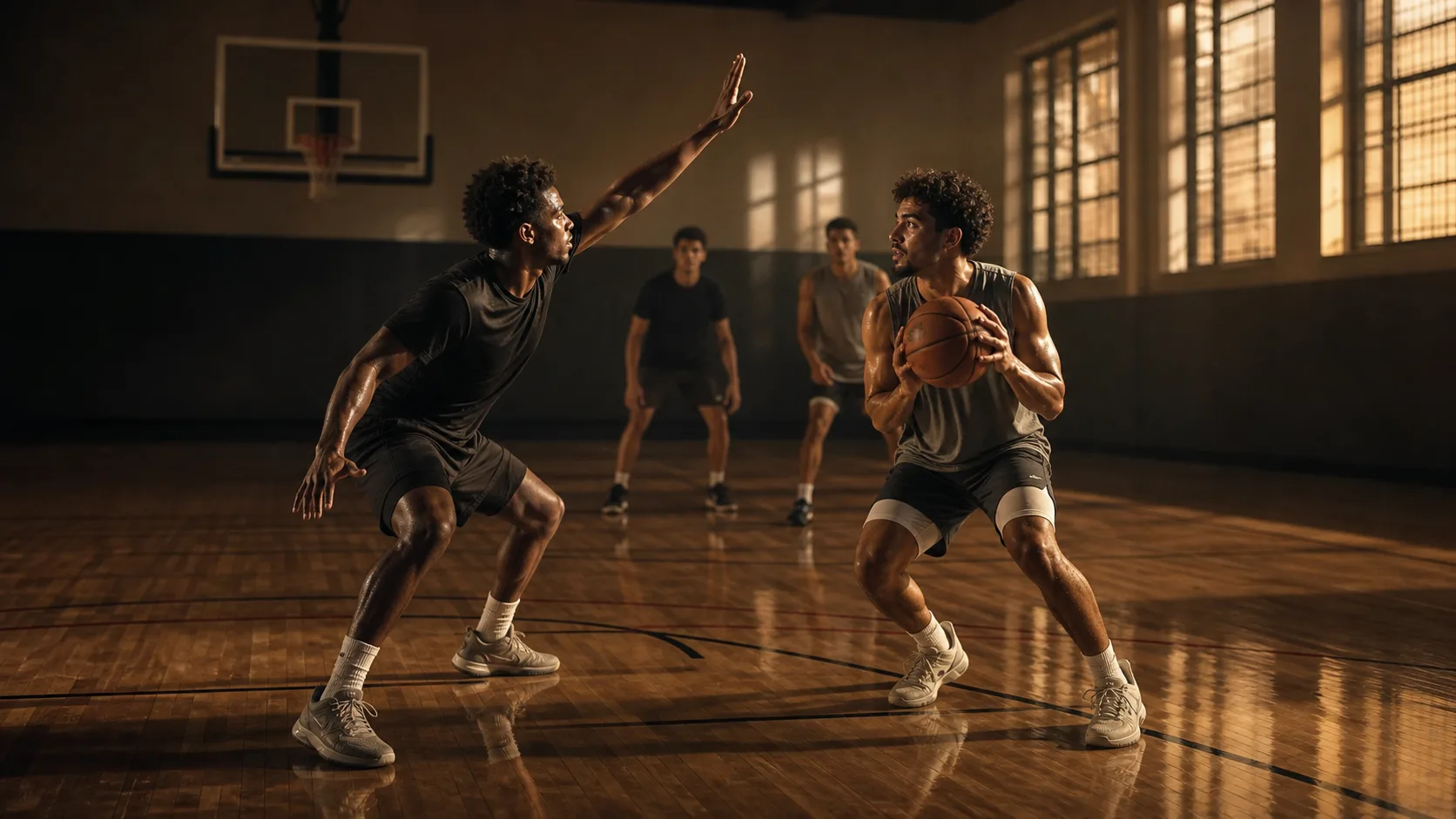
Fast version first:
- Play a half-step cushion so his burst cannot beat you in one move.
- Overplay his strong hand and force the ball weak.
- Angle him toward the sideline or into a help defender.
- Beat him to the spot with your feet, never reach.
- On recovery, cut the angle to his hip, do not chase from behind.
Why Does a Cushion Beat Crowding a Fast Player?
Because a fast player's whole game is the first step, and you cannot recover from a blow-by. Give him a cushion, a half-step of space, and his burst has nowhere to go. He beats speed with space, so take the space away from him.
Here is the geometry. If you press up into his chest, his first step is a straight line past your hip and you are chasing all night. Back off half a step and now his first move only closes the gap you gave yourself, which buys you the time to slide and stay in front. You are conceding a contested pull-up jumper on purpose. That is a trade you win. The no-middle rule in modern NBA defense is built on this same idea: give up the shot you can contest, take away the drive you cannot.
The cushion is not a fixed number. Against a pure driver it is bigger. Against a knockdown shooter it shrinks, because there you accept the drive since help waits behind you. Read which player you are guarding before you set your depth.
How Do You Force a Fast Player to His Weak Hand?
Overplay the strong hand so the only open lane runs to the weak one. Nearly every fast guard is a different, slower player going left than going right. Take his best direction away and you have cut his speed in half.
Set it with your feet and body. Slide your lead foot and your torso to wall off his dominant side, invite the weak-hand drive, and keep your top foot ready to cut it off. Now his blow-by goes to the hand he trusts less and the finish he is worse at. Force weak and steer toward the sideline, where the out-of-bounds line acts as a second defender he cannot dribble through.
The tell you are doing it right is when he crosses back over to get to his strong hand. That crossover is a beat of hesitation, and hesitation is where your feet catch up. Reading which hand and which direction a player wants is exactly the scouting layer in how to read a defense in basketball, run from the defensive side.
How Do Angles Turn Speed Into Help?
Guard the man toward your help, not away from it. Defense is a five-man geometry problem. If you steer a fast player toward the sideline or toward a stationed help defender, his speed runs him into a wall instead of an open floor.
Worked example: your man is a burner who wants the middle of the floor where he has the whole court. You take a stance angled so your outside foot invites baseline and walls off middle. Now his fast first step goes toward the baseline, where the low help defender is already sitting, ready to meet him. He arrives at a help-and-recover with his head down and a defender waiting. Two defenders now guard one fast man in a shrinking space, and his speed is neutralized. This is the same wing help geometry covered in how to read help defense on the wing, just used on purpose to trap a speed advantage.
Steer him into help and his greatest strength becomes a trap. Steer him into open floor and you are toast.
How Do You Recover Without Chasing?
If he beats you, cut the angle, do not chase the man. You cannot catch a faster player in a straight line, so never try. Instead, sprint to a spot ahead of him, aim for his hip and the ball, and force a change of direction.
The read: he turns the corner and gets a half-step. Do not run at his back. Run at the spot where his drive is heading, get your hips ahead of his hips, and reestablish a lead foot in his path. Now he has to hesitate, change hands, or pick up the dribble, and any of those buys you the recovery. If a help defender steps up to stop him, your job flips instantly: you are no longer chasing your man, you sprint to cover the shooter the helper just left. Knowing that handoff is the difference described in how to improve your basketball defense.
Why Should You Never Reach at a Fast Player?
Reaching is how a fast player gets you. A quick guard wants your hand out of position and your weight leaning, because the instant you reach, your feet stop and your balance tips. Then he is gone, and often you have fouled him.
Keep your hands active but low, mirror the ball with quick digs only when it is exposed and safe, and win with your feet and chest, not your arms. The discipline is simple to say and hard to hold under pressure: move your feet, hold your base, make him beat a defender who is always in front of him. Every reach is a gift to his speed.
Is a Cushion Always the Right Answer?
No, and this is the honest limit. Against a fast player who is also a knockdown shooter, a big cushion just gifts him open jumpers, and forcing weak-hand does nothing if he pulls up comfortably off either hand. Some fast players are genuine two-way threats, and against them a cushion is the wrong tool. There you play tighter, run him off the line, and lean harder on help and switching, the same way you would chase a movement shooter in how to guard a shooter coming off screens. Match the tool to the man. A cushion is for a driver, not for a sniper.
The Bottom Line
Guarding a faster player is about changing the race, not winning it. Play a cushion so his first step dies, force him weak, angle him into help, and recover on the angle instead of chasing. His speed only hurts you in a straight line to the rim. Take that line away and you make him beat you the hard way.
To find out whether a specific matchup calls for a cushion, a hard force-weak, or a switch, the HoopBrief Matchup Engine reads the speed gap and prescribes the coverage in seconds.