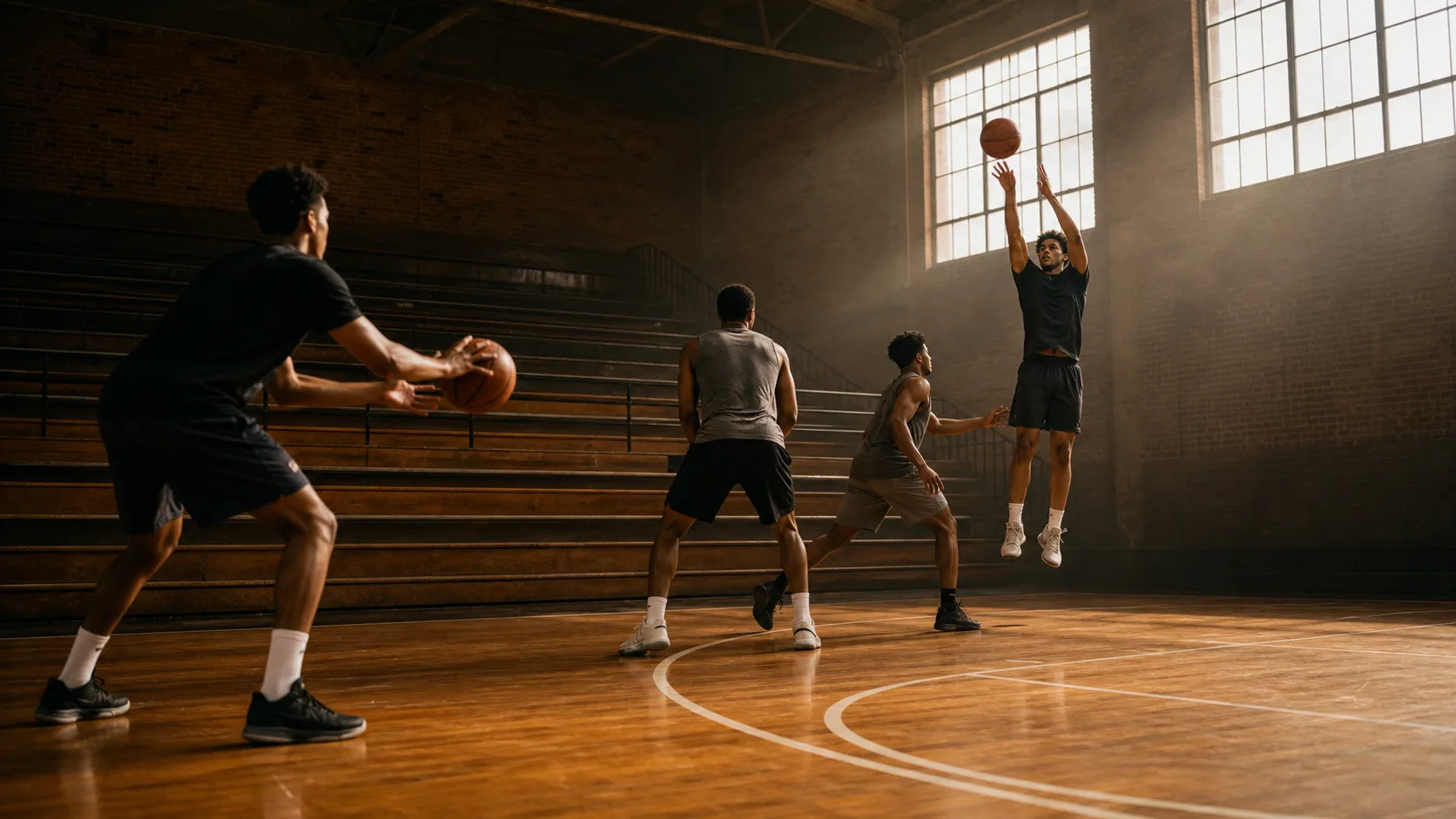
Guarding a movement shooter, think Klay Thompson, Buddy Hield, Desmond Bane, is different from guarding a ballhandler. You're not defending isolation. You're defending motion. The skill is different, the preparation is different, and most players never train it correctly.
Principle 1: The Screen Is Not Where the Action Is
Casual defenders focus on the screen itself. Good defenders focus on two things: the shooter's footwork before the screen, and the catch point after.
Before the screen, the shooter is setting you up. A hesitation cut, a body lean, a head fake, all designed to freeze you for a half-second. That's your tell. Stay glued to their top hip. Don't bite on fakes.
Principle 2: Pick the Right Navigation
- Lock and trail: trail the shooter over the screen with your top hand in their back pocket. Use when the shooter is a much bigger threat off the catch than off the dribble.
- Over the top: cut through the screen fast, beat the shooter to their spot. Use when your big is high enough to help on the catch.
- Under: go beneath the screen. Only use against non-shooters or when defending at the arc doesn't matter.
- Switch: trade assignments. Use when the screener is a big who can't punish a guard.
Most defenders pick one and stick with it. Elite defenders change navigation by action, a pin-down gets over-the-top, a flare screen gets locked-and-trailed.
Principle 3: The Close-Out Matters More Than the Chase
If you miss the chase, the close-out is what saves the possession. Close out short on a shooter, don't fly by. Hand up on the shot. Take the pump fake.
Rule: if you can't beat them to the spot, your goal isn't to block the shot. Your goal is to make them take a tougher shot than they wanted.
Drills That Actually Work
1. Five-spot chase: shooter cycles through five spots. Defender navigates a screen at each spot, closes out, resets. 90 seconds. 2. Reject drill: shooter can either accept the screen or reject it back-cut. Defender has to react without cheating. 3. Second-action drill: first possession is a pin-down. If the shooter doesn't get it, they immediately flow into a flare or DHO. Trains the "stay attached through the second action" instinct.
Defending a shooter is a trained skill. Train it.
The 4 Defensive Reads Against Movement Shooters
The defender's choice of coverage is decided pre-screen, not at contact. The four reads:
1. Chase over. Full sprint above the screen, top hand in the shooter's back pocket. Use when the shooter is a bigger threat off the catch than off the dribble. 2. Lock and trail. Stay glued to the shooter's hip, trail through the screen. Use when help is positioned to deny the catch. 3. Under. Go beneath the screen. Use only against non-shooters or when defending at the arc doesn't matter. 4. Switch. Trade assignments. Use when the screener is a credible mismatch to switch onto. The reading a switch piece covers the offensive counter.
How Offenses Counter Each Coverage
Good offenses know which coverage the defense is in and run the right counter. Chase-over invites the curl into the lane. Lock-and-trail invites the reject screen. Under invites the pull-up jumper. Switch invites the post-up or mismatch hunt.
The off-ball screens piece covers the offensive sets, pin-downs, zippers, Floppy, that exploit each defensive coverage.
Keep reading: closeout footwork, defending without fouling, and off-ball screens in the NBA.