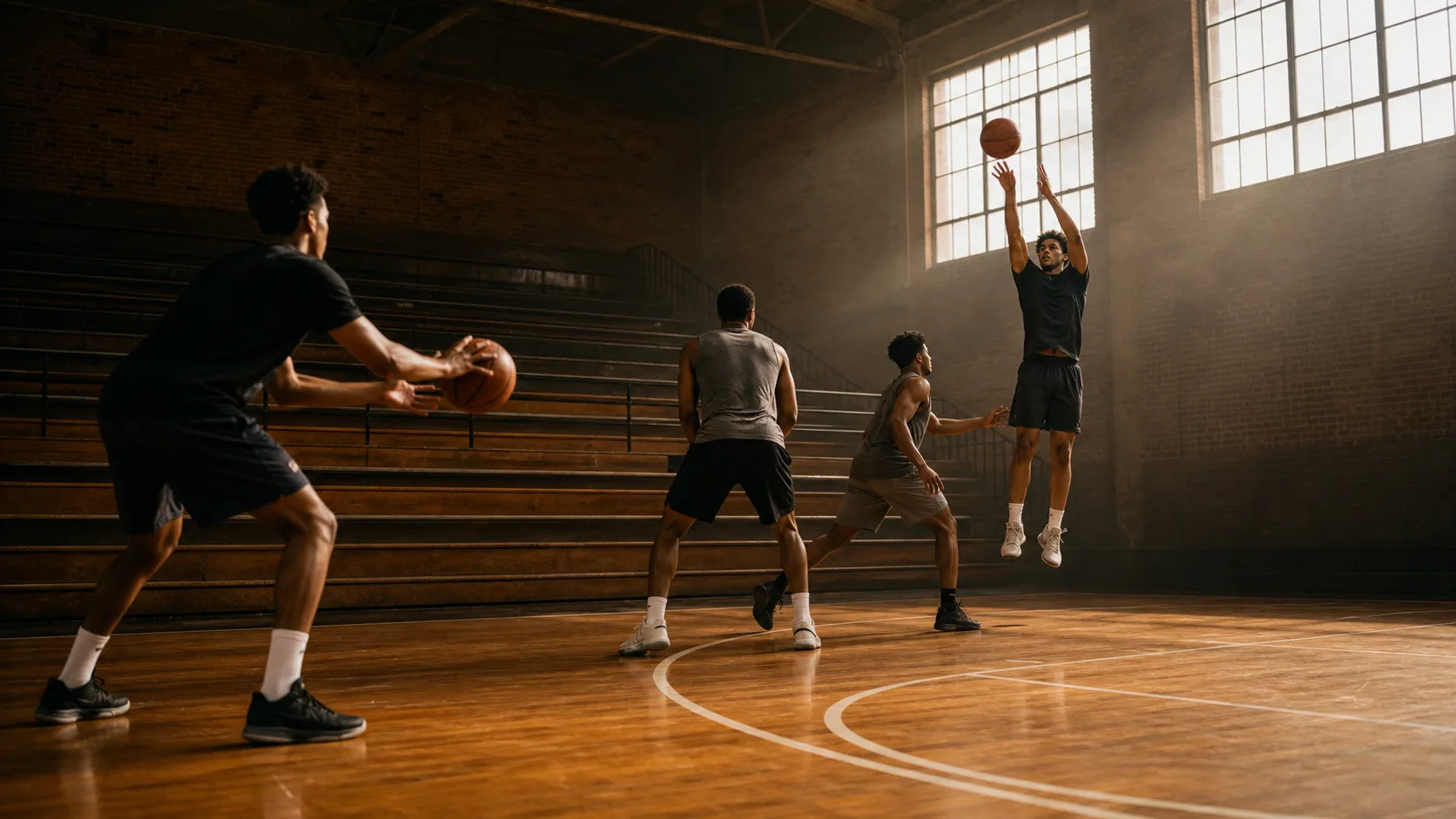
A good pre-game routine is not a ritual. It's a performance tool. The best players aren't more superstitious than anyone else, they've just figured out what actually gets them ready, and they repeat it.
The Four Goals of a Pre-Game Routine
1. Raise body temperature and heart rate to game level. 2. Prime the movements you'll use in the first five minutes. 3. Narrow your mental focus to two or three priorities. 4. Calm the nervous system so adrenaline doesn't wreck the first quarter.
Anything that doesn't serve one of those four goals is noise.
60–45 Minutes Out: Body
Dynamic warm-up. Not stretching, movement. Skips, carioca, lunges with rotation, hip openers. Heart rate should be elevated by the end. You should be sweating lightly.
Skip the foam roller marathon. One or two spots max. Long foam rolling sessions actually suppress neural drive for 10–20 minutes.
45–25 Minutes Out: Game Speed
Ball handling, then shots that mirror the game. Don't just shoot spot-ups, shoot the shots you'll get. Off the catch from the wing, off a pin-down, off a DHO, one-dribble pull-ups from both angles.
The key: you want game-speed reps, not leisurely reps. Move like you're in the game. Sweat like you're in the game.
25–15 Minutes Out: Priming
Pick three game-specific things you'll focus on. That's it. Three. "Get deep in the paint on pick-and-rolls." "Don't give up the baseline." "First look always the open shooter."
Write them down. Look at them. Walk through them mentally. Visualize making them happen in the first two possessions.
15–5 Minutes Out: Down-Regulate
Counterintuitive: you should get calmer, not more amped. Elite performers enter the game with a lower heart rate than amateurs. Slow breathing. Eyes up. Quiet body.
Pre-game music is usually too loud and too fast. It spikes you right when you should be settling.
5 Minutes Out: Activation
Short, sharp activation. Two or three quick sprints. Closeouts, slides. Feel fast. Feel ready. Enter the game with tension in the legs, calm in the mind.
What Not to Do
- Don't eat a big meal within two hours.
- Don't scroll social media, it scrambles your focus.
- Don't read commentary about your opponent 20 minutes out. Do that the day before.
- Don't change your routine game-to-game. Consistency is the whole point.
The routine that works is the one you repeat until it's automatic. Test it in practice games first. Adjust. Lock it in. Then stop thinking about it.
The 60-Minute Pre-Game Schedule That NBA Players Use
A structured 60-minute pre-game routine that produces consistent performance:
- T-60 to T-45: General warm-up. Light shooting, ball-handling, mobility work. Heart rate elevates gradually.
- T-45 to T-30: Position-specific drills. Guards do shooting and ball-handling reps; bigs do post moves and finishes. The point guard shooting drills framework is a template.
- T-30 to T-20: Team walkthrough. Last review of the scouting report; key adjustments highlighted. The scouting report build framework explains what's in the one-pager.
- T-20 to T-10: Game-speed reps. Half-court sets at game speed. The body locks into game tempo.
- T-10 to T-0: Individual mental prep. Visualization, breath work, the pre-game ritual unique to each player.
The Mental Tools That Compound
The mental toughness piece covers the broader mental skill set. The pre-game-specific tools:
- Pre-shot routine sameness. The free-throw routine should be identical pre-game and in the game. The free throw mechanics piece covers the discipline.
- Visualization sequencing. Mentally rehearse 5 specific game moments, a make, a miss, a defensive stop, a rotation call, a possession after a turnover.
- Breath control. Box breathing (4 in, 4 hold, 4 out, 4 hold) for the last 2 minutes before tip.
Keep reading: mental toughness training, free throw mechanics, and basketball conditioning.