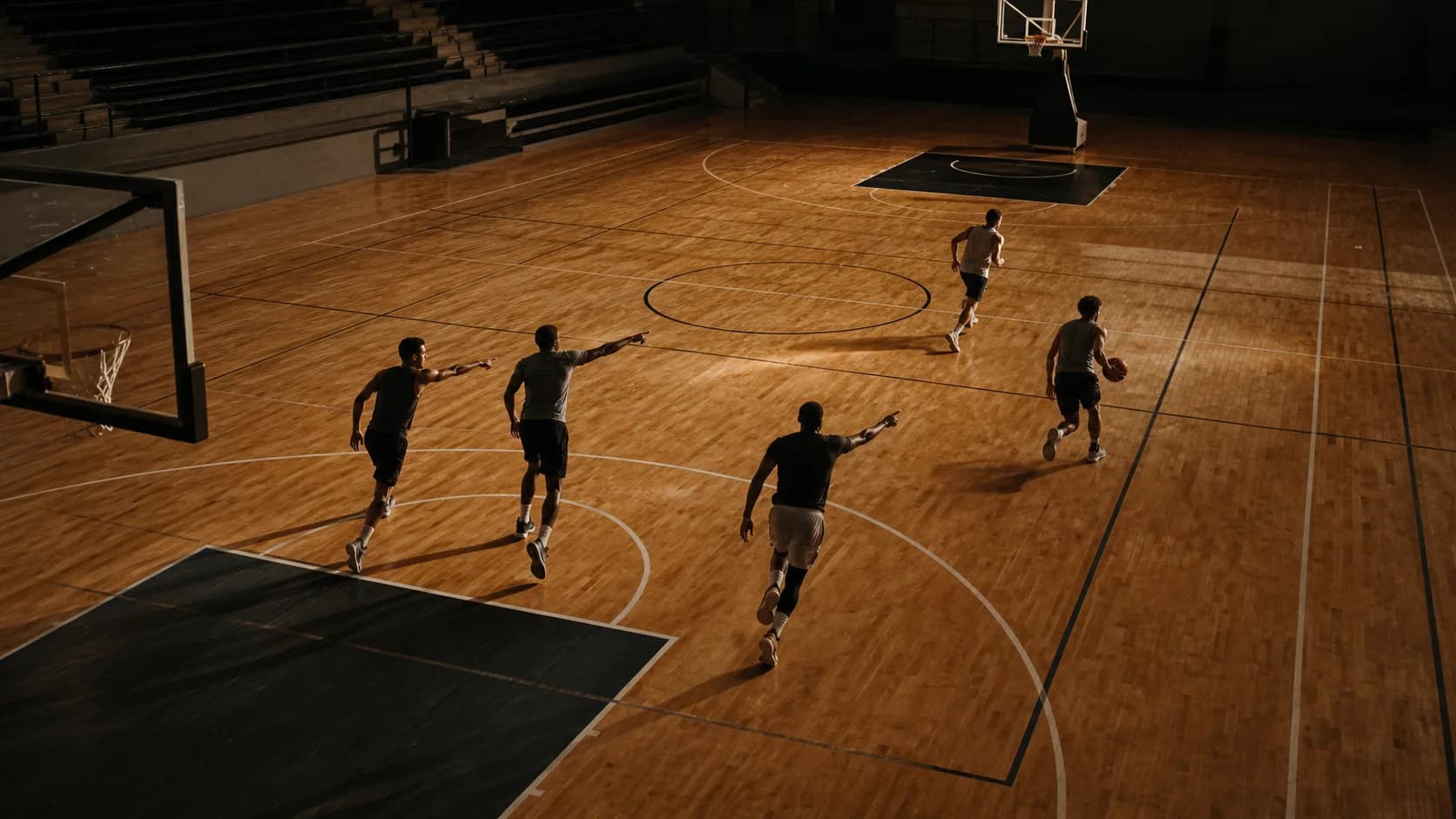
The best trainer session solves a game problem, not a social-media move. Film and scouting give a trainer the missing context: where the problem occurs, what the defender is doing, which cue the player misses, and what decision should replace the current habit.
The NBA's Coaching Development Program explicitly connects scouting-report development with individual and team skill-development drills. The 76ers have described the same loop around Joel Embiid: review how the last opponent guarded him, study the next defender, then train the answers. The principle works at every level.
Start With a Problem Sentence
Write the session objective in one line:
When [defender or coverage] does [observable behavior] in [location or action], the player needs to [decision].
Examples:
- When the big stays below the level on middle pick-and-roll, the guard needs to hold the defender on the hip and read pull-up versus pocket pass.
- When a wing defender opens the top foot on a closeout, the player needs to attack the high foot and finish before low help arrives.
- When the post is fronted with baseline help, the big needs to seal higher or become the screener instead of fighting for a dead entry.
This sentence keeps the workout attached to basketball. "Work on floaters" is a skill category. "Use the floater when the drop big retreats below the charge circle and the rear defender is attached" is a decision.
Separate Cue, Choice, and Technique
Every transferable rep contains three layers:
1. Cue: what the player sees. 2. Choice: which response fits that cue. 3. Technique: how the response is executed.
Trainers often begin at layer three because it is easiest to organize. But clean footwork without cue recognition produces a player who looks excellent in drills and late in games.
Name the cue before choosing the drill. Then give the player at least two valid choices. Technique supports the read; it does not replace it.
The 60-Minute Matchup Session
Minutes 0-8: show the problem
Use three clips: one failed decision, one better decision, and one example from the upcoming matchup or a similar coverage. Keep the conversation short.
Ask the player:
- What did you see?
- When did the decision become available?
- What would make the other choice correct?
The player's answer tells you whether the gap is recognition or execution.
Minutes 8-18: movement preparation
Warm up in the angles the game will demand. A pick-and-roll session might include hip rides, retreat dribbles, inside-foot stops, and pocket-pass footwork. A closeout-attack session might use split steps, first-step angles, and contact finishes.
Keep the starting spot and direction consistent with the game problem. Generic movement produces generic transfer.
Minutes 18-30: technique in the right geometry
Rehearse the two responses without a live defender. The goal is to remove mechanical hesitation, not to accumulate makes.
For a drop-coverage guard:
- Six pull-ups after putting a pad or coach on the rear hip.
- Six pocket passes after freezing the drop with two dribbles.
- Six inside-hand finishes when the big steps above the restricted area.
Change the response only when the imagined cue changes. Even unguarded reps should have a reason.
Minutes 30-43: guided decisions
Add a defender with two rules. The defender may stay low or step to the level, open middle or open baseline, chase over or go under. The player does not know which before the rep.
Score the read:
- 2 points for the correct choice and a quality advantage.
- 1 point for the correct choice with poor execution.
- 0 for a predetermined move that ignores the defender.
This scoring protects the session from becoming a shooting contest.
Minutes 43-55: live constraint
Play one-on-one, two-on-two, or three-on-three from the exact game action. Give the defense freedom, but use a scoring rule that rewards the target behavior.
For example, a paint touch created after holding the rear defender is worth two, a pocket pass leading to a finish is worth three, and a contested pull-up taken before reading the big is worth zero even if it goes in.
The constraint makes the hidden objective visible.
Minutes 55-60: review and prescription
Record the final live block. Show one rep immediately beside the original problem clip. End with a one-sentence cue the player can carry into the next game.
Give a small prescription, not homework overload: identify the cue three times on film, complete a short footwork set, and track the read in the next game.
Four Matchup Templates
Guard versus drop
- Cue: big below the level, rear defender attached or detached.
- Choices: pocket pass, pull-up, snake, or finish.
- Constraint: no shot before the ball handler identifies the big's depth.
Wing versus aggressive closeout
- Cue: top foot, help position, and distance at the catch.
- Choices: immediate shot, high-foot drive, one-dribble pull-up, or extra pass.
- Constraint: decision within half a second of the catch.
Big versus switch
- Cue: size of the switch, front or behind, and nail help.
- Choices: early seal, duck-in, re-screen, or short-roll playmaking.
- Constraint: advantage must be created before the defense can scram out.
Shooter versus top-lock
- Cue: defender above the route and rim protection location.
- Choices: back cut, screen reject, re-screen, or lift into space.
- Constraint: no running the denied route harder without changing the angle.
Track Transfer, Not Workout Percentage
A player can shoot 80% unguarded and fail to recognize the cue in a game. Measure the next two or three games instead:
- How often did the cue appear?
- How often did the player recognize it on time?
- Which choice followed?
- Did the decision create an advantage, neutral result, or disadvantage?
The first goal is correct recognition under pressure. Execution percentage can improve after the decision stabilizes.
Use the free Scout to frame the matchup problem, then bring the player-specific film and your coaching eye. HoopBrief supplies a structured first read from public statistical and play-by-play context; the trainer owns the individualized diagnosis, live constraint, and technical correction.