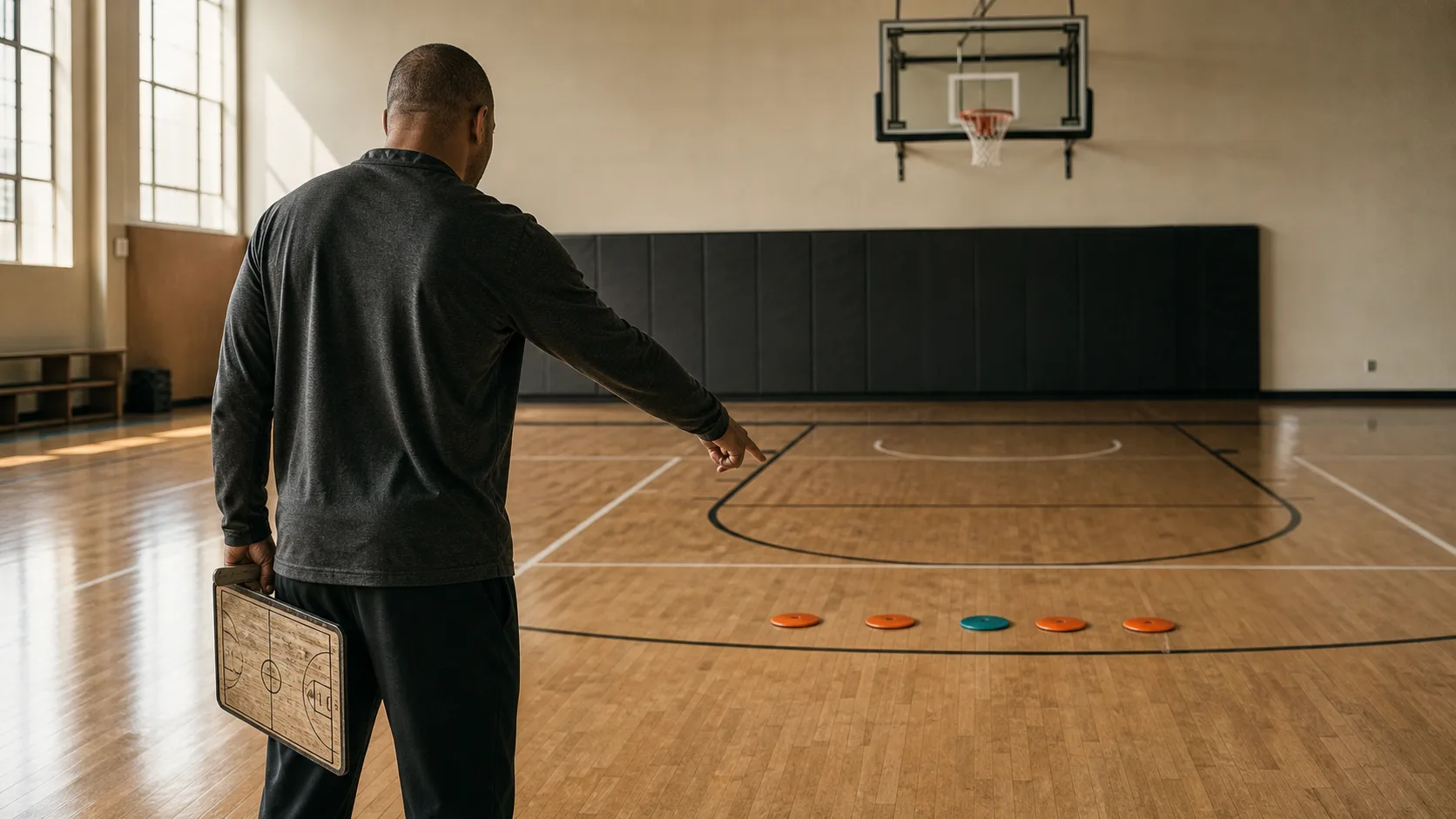
Ask your coach about playing time by asking which responsibilities you must perform more reliably. Bring two specific examples, ask for one priority and agree on when to review it. A productive meeting gives you an action to practice; it does not require the coach to promise a particular number of minutes.
In a February 2026 public discussion, a parent asked why a player with strong scoring numbers was still getting limited minutes. The situation illustrates a common gap: a box score can describe production without explaining the assignment, lineup fit or decision the coach is evaluating.
Choose the moment and the purpose
Request a short conversation away from the immediate emotion of a game. Use the team's communication policy. If you are a younger player, a parent can help you prepare and follow the program's safeguarding expectations without turning the conversation into a confrontation.
A useful opening is: “I want to understand my role and work on what will help the team. What is the most important responsibility I need to perform better to earn a bigger opportunity?” It gives the coach room to name the job rather than defend a substitution.
Avoid comparing yourself with a teammate in the opening. You do not know every assignment that teammate received. Keep the question on work you can control and evidence the coach can explain.
Ask these five role questions
1. What job do you want me to do when I enter the game? 2. Which mistake most often makes you hesitate to use me? 3. Can you show me one possession where I did the job and one where I missed it? 4. What would a better response look like in our system? 5. When can we review my progress, and what evidence should I bring?
Do not rush through all five if the first answer needs clarification. “Improve your defense” may mean containment, weak-side position, communication, rebounding or knowing the coverage. Ask which one matters first.
The coach's playing-time policy guide explains the program-wide side of this issue. This article is the player's preparation for an individual conversation, not a way to negotiate around that policy.
Bring a small evidence card
Use clips only when you have permission to access and share them. You do not need a highlight reel or a spreadsheet ranking every teammate.
| Responsibility | Example to discuss | My understanding | Question for coach |
|---|---|---|---|
| Transition defense | Time or possession | I thought I was protecting the rim | Which player or space was actually mine? |
| Weak-side spacing | Time or possession | I moved toward the ball | Where should I hold or relocate? |
| Ball pressure | Time or possession | I tried to force a turnover | Was containment the priority? |
These rows are hypothetical examples. Replace them with the responsibility the coach names. Write what you thought the assignment was, because a misunderstanding may be more useful to resolve than a debate about effort.
Turn the answer into a practice agreement
Suppose the coach says the priority is arriving in the correct help position. Ask what triggers that movement and where you can rehearse it in practice. After the agreed period, bring a few relevant examples rather than a broad claim that you have worked hard.
Your progress card can contain the cue, the expected response and a brief observation. Keep outcomes separate. The opponent missing an open shot does not prove the rotation was correct. Your team conceding after another breakdown does not erase a correct initial response.
If the coach gives several priorities, ask which comes first. A list of ten shortcomings can leave you with no useful next repetition. One clear responsibility is easier to observe and discuss.
What to do when the answer is unclear
Repeat your understanding back: “So you want me to stay connected to the corner shooter until the specific help call, rather than chasing every drive. Is that right?” That gives the coach a chance to correct the rule before you practice the wrong one.
If you still cannot get specific feedback, follow the program's process for a later conversation with an appropriate adult or staff member. Do not use an online scouting tool as proof that your coach owes you a role. Selection and playing time depend on factors an outside product cannot see.
Prepare a better basketball question
You can study a free NBA matchup example to see how a responsibility, cue and response can be described. HoopBrief does not know your coach's private assignments, and an NBA player's role is not a verdict on your minutes.
Use the example to make your own question clearer, then return to your team. A useful next step might be a film-study notebook and an agreed check-in. Judge the conversation by whether you leave knowing what to practice, not whether you leave with a guarantee.