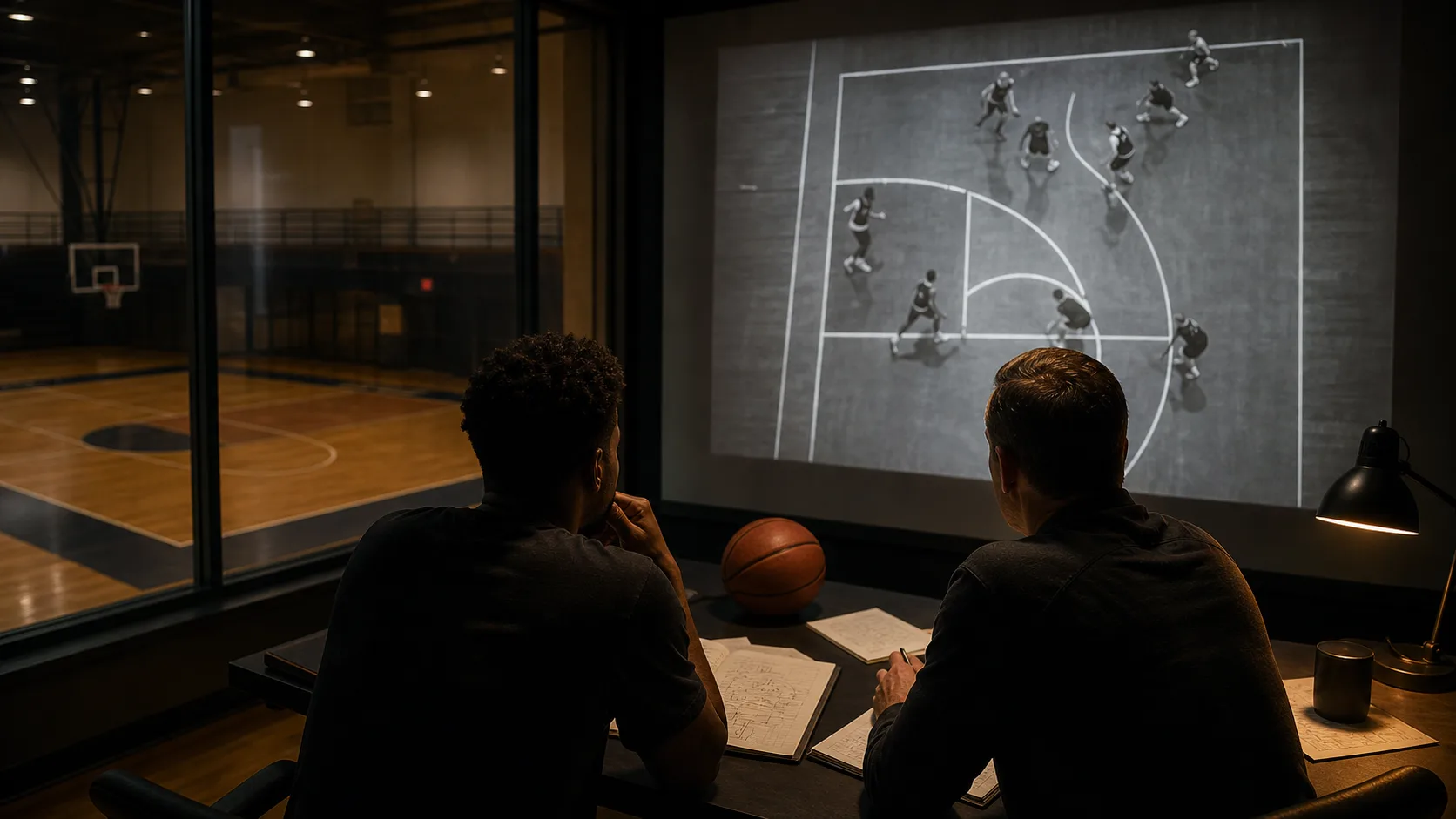
A useful basketball film-study notebook records a decision, the cue you missed, and what you will do next time. Start with five ordinary possessions from one game. You do not need a paid editing platform, a page of motivational quotes, or a record of every basket to produce a useful next practice.
If you finish a film session knowing only that you need to “play harder,” the notes are too broad. The purpose of this template is to turn one visible problem into one action you can rehearse. It works on paper or in a spreadsheet beside a recording you already have permission to watch.
The seven-column notebook template
Copy these headings into your notebook. Write short observations that another person could locate in the same clip.
| Clip | Situation | My job | Cue available | My decision | Result | Next rep |
|---|---|---|---|---|---|---|
| Time or possession number | Score, spacing and action | Assignment in our system | What happened before I acted | What I chose | What followed | One response to practice |
“My job” matters because the right decision depends on your team's rules. Helping off the corner may be a mistake in one coverage and the assigned rotation in another. Put a question mark beside an assignment you cannot confirm, then ask the coach. Do not grade yourself against a rule you invented during the replay.
Separate decision from result. A pass to an open teammate can be a good choice even when the shot misses. A difficult shot going in does not prove you recognized the defense correctly. Record both columns so the scoreboard does not rewrite the possession.
Three filled examples
These are hypothetical practice examples, not descriptions of a particular NBA game.
| Clip | Situation | My job | Cue available | My decision | Result | Next rep |
|---|---|---|---|---|---|---|
| Q1, 4:10 | Teammate drives from the wing | Keep the corner spaced | My defender turns toward the drive | I drift toward the ball | Two defenders cover one passing lane | Hold the agreed spot until the help commits |
| Q2, 1:32 | My player is one pass away | See ball and assignment | Attacker changes pace behind me | I watch the dribbler | Backdoor pass reaches the rim | Reposition early and communicate the cut |
| Q3, 6:05 | I catch against a hard closeout | Read the next defender | Help defender steps into the lane | I attack the crowd | I pick up with no outlet | Identify the next pass before the first dribble |
The final column is deliberately specific. “Work on offense” cannot guide a repetition. “Catch, locate the helper, and pass before the second defender arrives” can.
Run a ten-minute review
Use a short timer as a boundary, not as a promise that every problem is solvable in ten minutes.
1. Choose five ordinary possessions, including a miss or turnover and a possession that went well. 2. Pause before your decision. Predict your assignment and name the available cue. 3. Play the clip and fill the decision and result columns separately. 4. Group repeated problems. Look for the same missed cue rather than five unrelated flaws. 5. Select one next rep and one question for your coach.
If the camera misses the weak side, mark the evidence incomplete. Do not fill the missing space with a confident story. The same discipline applies when using a scouting report: a clear answer still needs enough evidence behind it.
Use the notes at practice
Take the highest-priority cue into a small live situation. For the hard-closeout example, use an attacker, a closeout defender, a helper and an outlet. Vary the helper's position. If the same pass is always available, the drill can become a memorized route instead of a read.
Ask the coach what counts as a successful decision in that exercise. Track whether you recognized the cue and chose an available option. Keep made shots in a separate tally. After the next game, find a comparable possession and check whether the response carried over.
You can use the basketball decision-making guide for broader exercises. This notebook is the smaller tool that tells you which exercise belongs in your week.
Study an NBA example without confusing it with your own film
Try a free HoopBrief scout to study how a real NBA matchup is framed. Compare the question, the evidence and the recommended response, then return to your own recording and your coach's rules. The example does not establish that you face the same coverage or have the same role.
HoopBrief produces structured basketball answers from public data. It does not watch or tag your personal recordings. Keep your notebook and clips in the tools you already use. If the free example helps you prepare better questions, compare the subscriber features before choosing a plan.