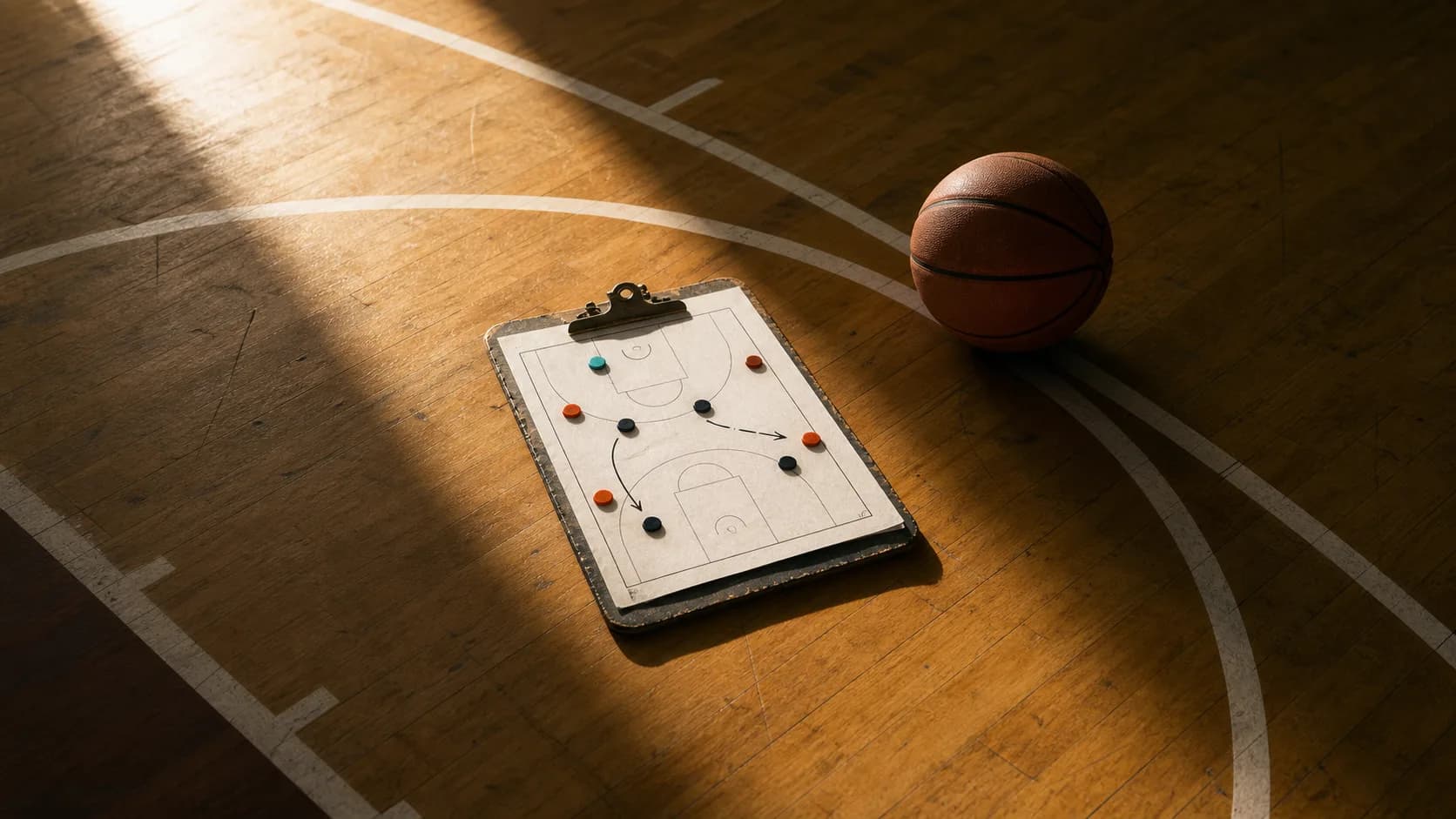
An AI scouting report should shorten collection, not remove coaching judgment. The useful standard is not whether every sentence sounds convincing. It is whether the report identifies the right people, describes a repeatable tendency, survives a small film check, and produces a plan your team can actually execute. Run those checks before any generated report reaches a player.
FIBA's coaching guidance makes the core responsibility clear: the scout should focus on what your team will do, and the tactic has to draw from what the team has practiced. That principle matters even more when a tool produces a polished answer in seconds. Fluency is not evidence. The coach remains the final editor.
The Five-Check Validation Protocol
1. Identity: is the report about the current team?
Start with facts that can invalidate everything below them.
- Is the opponent and competition correct?
- What date range does the answer cover?
- Which five players are likely to close?
- Has a starter returned, been traded, or changed roles?
- Is the named ball handler still initiating the same unit?
A tactically sharp answer built on an old rotation is still the wrong answer. Put identities and availability at the top of the review because every matchup and coverage recommendation depends on them.
2. Sample: is this a tendency or an event?
Ask what had to happen for the sentence to be true. One hot shooting night is an event. A guard rejecting ball screens to the same hand across five opponents is a tendency.
Use three labels as you read:
- Stable: repeated across opponents and game states.
- Conditional: appears against a specific coverage, lineup, or score situation.
- Unproven: plausible, but the report does not show enough support.
Stable tendencies can anchor the plan. Conditional ones belong in if-then language. Unproven claims become film questions, not player rules.
3. Context: did the opponent cause it, or did the defense invite it?
Basketball data is interaction data. A team may appear to avoid the rim because it faced two elite paint defenses. A guard may appear turnover-prone because three recent opponents trapped. A center's post volume may rise only when a small lineup switches.
For every major claim, add one sentence: This happened when... If you cannot finish that sentence, the tendency may be missing its trigger. The trigger is often more useful than the average.
4. Film: what deserves a manual check?
Do not rewatch four full games. That defeats the purpose of using a fast first draft. Verify only the claims capable of changing your plan:
1. The action you expect to guard most often. 2. The matchup you plan to hide or attack. 3. The opponent's late-clock release valve. 4. The first counter to your preferred coverage.
Watch several examples, including one where the action failed. Successful possessions show the intended outcome. Failed possessions often reveal the read and the counter more clearly.
5. Fit: can your team execute the recommendation?
A correct read can still produce a bad game plan. If the report recommends switching every screen but your center has never practiced peel switching, the plan adds more uncertainty than it removes. FIBA's manual explicitly warns against choosing a tactic simply because an opponent struggled with it when your own team has not practiced it.
Score every recommendation on two axes:
| Question | Score |
|---|---|
| How strongly does the evidence support it? | Low / medium / high |
| How ready is our team to execute it? | Low / medium / high |
Only high-evidence, high-readiness ideas become primary rules. High evidence with low readiness becomes an offseason teaching point, not a Friday experiment.
Turn the Validated Read Into Player Language
Players do not need the audit trail. They need decisions.
Compress the final report into:
- Three rules: the actions everyone must recognize.
- One contingency: what changes if the opponent beats the first plan.
- One metric: the observable result that tells you whether the plan is working.
For example: keep the ball on the sideline, tag the roller from the low man, and no corner help off the best shooter. If they reject twice, change the angle of the screen coverage. Grade paint touches allowed in the first quarter.
That is a game plan. Twenty unranked observations are research.
A Red-Flag List for Generated Reports
Pause when you see any of these:
- Exact confidence without a stated sample.
- A recommendation that ignores your personnel.
- A claim based entirely on percentages with no action or game-state context.
- Player roles that no longer match the current rotation.
- Language that sounds tactical but cannot be turned into a player cue.
- A plan that requires installing several new concepts in one practice.
The NCAA's responsible-technology guidance is aimed at performance tools broadly, but its standard transfers: selection and use should account for privacy, consent, data security, and unintended effects. Do not paste private athlete health information, internal film, or personally identifying notes into a system unless your program has approved that use.
The 30-Minute Review
- Minutes 0-5: identity, roster, role, and availability.
- Minutes 5-12: label major claims stable, conditional, or unproven.
- Minutes 12-25: film-check the highest-leverage four claims.
- Minutes 25-30: write three rules, one contingency, and one metric.
Use the free Scout to generate a first read, then run this protocol on it. The goal is not to agree with every line. The goal is to arrive at a smaller, clearer, coach-owned plan faster.