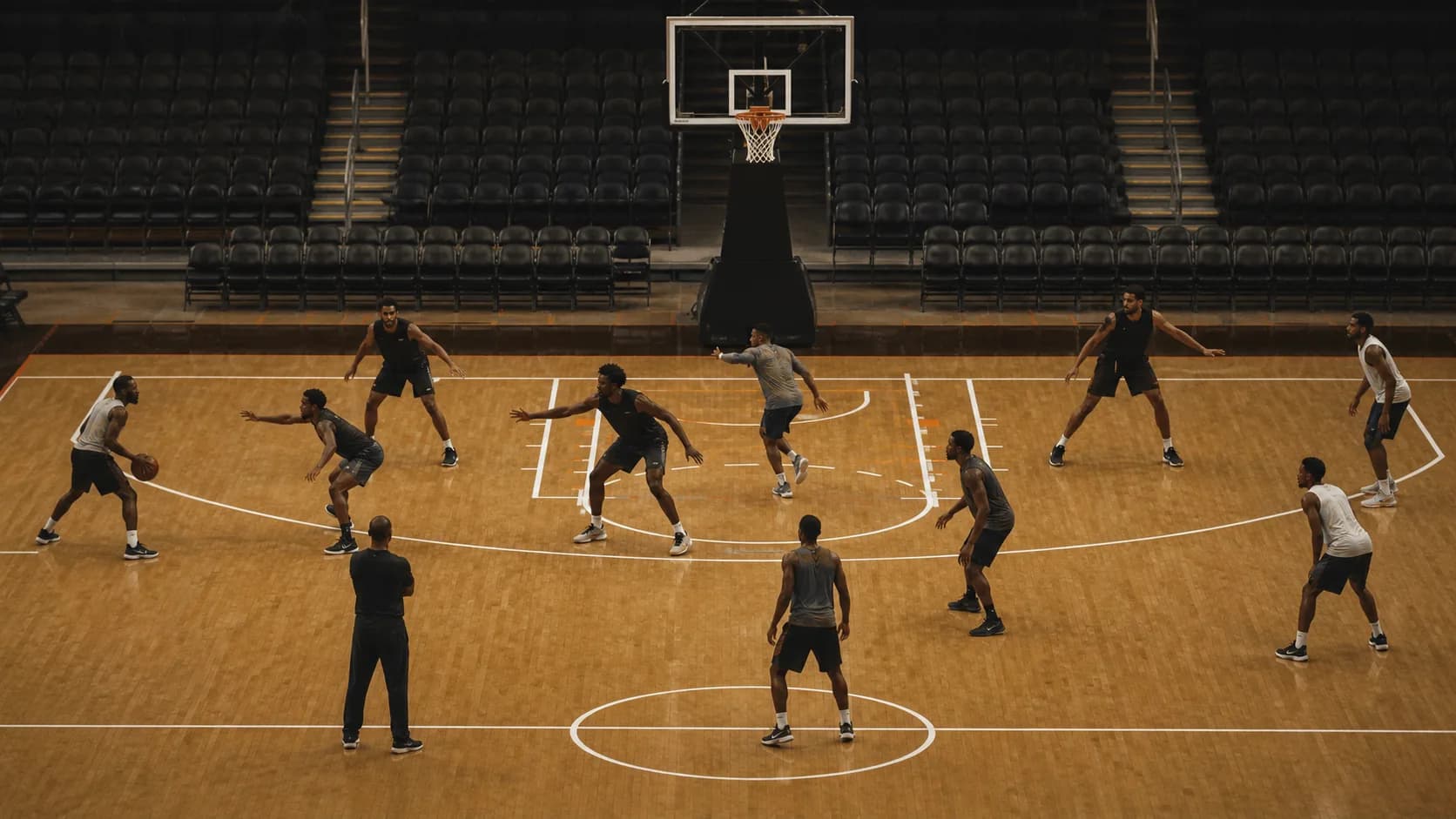
To stop ball watching on defense, rebuild the connection between the ball, your assignment and your help responsibility. The useful correction is not “never look at the ball.” It is to notice when the ball or your attacker changes position and adjust before your view disappears.
Backdoor cuts often expose an earlier mistake. You may have stood too high, turned your shoulders completely toward the dribbler, or denied a passing lane without the help your team expected. Review that starting position before blaming your speed.
Diagnose the possession before the cut
Take three clips where you lost your assignment. Pause each one before the attacker cuts. Ask four questions:
- Could I locate the ball and my assignment without a complete body turn?
- Was I denying, helping or recovering according to our actual coverage?
- Did the attacker change pace while I watched the dribble?
- Was the expected teammate help in position?
This is different from a general help-defense lesson. You are finding the moment your information disappeared. A film clip that begins with the pass in flight starts too late to answer that question.
FIBA's coaching material treats individual position and the team's defensive scheme together. Use that as a foundation, then confirm the details with your coach. A universal rule such as “always stand here” cannot cover every denial, switching or help scheme.
Use a two-trigger scan
Choose two events that will remind you to update your position: a pass and your attacker's movement. When either happens, locate the new ball position, locate your assignment, and recover the view needed for your job.
This is a practical learning cue, not a requirement to flick your head at a fixed interval. Blindly checking the ball every two seconds can make you miss the cut that happens between checks. Tie your attention to changes in the possession.
Communication adds useful information. Call a cut when your team uses that call. If your assignment screens away, identify the screen and follow your team's switch or chase rule. Looking at the right player is not enough if you act on the wrong assignment.
A simple two-on-two progression
Start with an offensive player on the wing, a passer up top and two defenders. Set the team's actual help or denial rule before the rep begins.
1. Walk through a wing catch, a backdoor cut and a screen away. The defender identifies the cue aloud. 2. Let the attacker choose a cut or a catch while the passer moves the ball. Keep the pace controlled until the assignments are clear. 3. Play live two-on-two. The attacker can punish a lost view, but cannot use the same scripted cut every time. 4. Rotate roles so the defender experiences what the cutter sees.
Stop a rep at the first lost assignment rather than after the layup. Ask what changed and which cue was available. Reset the starting position and replay with a different offensive choice.
The purpose is to make scanning useful, not to create a drill where a defender wins by staring at one predetermined cutter.
Track the habit, not only the layups
Use this review card for the next practice or game. The numbers are your own observation counts, not a published basketball benchmark.
| Opportunity | View maintained? | Correct assignment? | Communication needed? | What to change |
|---|---|---|---|---|
| Pass to wing | Yes / no / unclear | Yes / no / unclear | Call used or missed | Starting angle |
| Attacker cuts | Yes / no / unclear | Yes / no / unclear | Cutter identified | Earlier repositioning |
| Attacker screens | Yes / no / unclear | Yes / no / unclear | Coverage call | Confirm team rule |
A team can concede a basket despite a sound individual decision. Conversely, a passer missing an open cutter does not erase your mistake. Keeping the process visible makes your next conversation with the coach more useful.
When “stay attached” is the better assignment
Some shooters should receive very little help from their defender. Your coach may want you close to your assignment even when another player drives. Other situations call for a deeper help position. Ask which responsibility wins when the two conflict.
Do not freelance between both jobs and assume effort will repair the gap. If a teammate has the low help responsibility, your job may be to communicate and recover rather than chase the ball. For the related on-ball problem, see how to guard a faster player.
Turn the problem into a useful scouting question
A better question than “How do I improve my defense?” is “When I guard a corner shooter, which cues tell me to stay attached and which trigger our help rotation?” It gives a coach or trainer a situation to work with.
Study a free NBA matchup example, then compare its context with your team's system. HoopBrief's public-data examples can help you organize the question; they do not identify your private opponent's habits. Use the next practice to test the answer rather than treating the report as a substitute for team instruction.