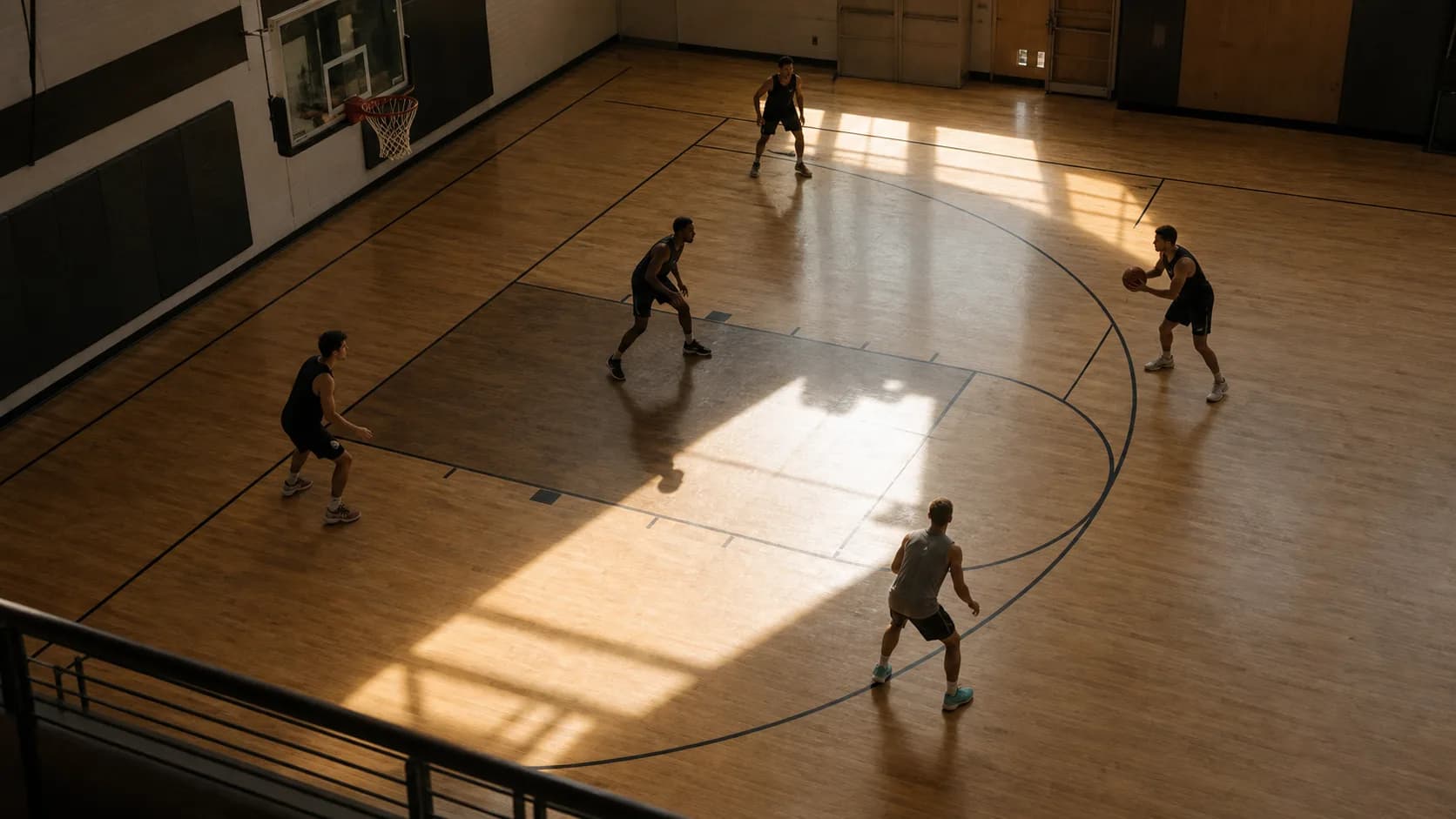
If you play well in workouts but struggle in games, find the decision that practice removes. A cone does not change direction, a passing sequence does not deny the first option, and an uncontested shot does not require you to recognize a closeout. You may be rehearsing a skill without rehearsing when to use it.
Coaches discussing this problem publicly in 2026 distinguished knowing the answer from seeing and executing it under pressure. That distinction gives you a practical diagnosis. Do not assume every difficult game means you lack confidence, effort or intelligence.
Sort the problem into three parts
Use one recurring possession type rather than evaluating your entire game. A wing catch against pressure, a ball-screen read or a defensive recovery is narrow enough to observe.
| Question | What a “no” suggests | A useful next rep |
|---|---|---|
| Did I notice the important cue? | Recognition needs work | Pause film before the action or reduce the live situation |
| Did I choose an available response? | The decision rule is unclear | Discuss two options and let the defender choose between them |
| Could I execute the chosen response? | The skill or pace is limiting the choice | Rehearse execution, then restore the live defender |
This is a coaching framework, not a psychological diagnosis. If several constraints overlap, start with the first one visible in the possession. A player who cannot control the ball may never reach the point where they can observe the helper.
Replace one scripted exercise
Keep useful technical work. The change is to add a decision at the end, not to turn every warmup into a competitive game.
Suppose you normally catch on the wing and complete the same drive-and-finish sequence. Add a defender who can close short or hard, plus an outlet. The attacker must choose an available shot, drive or pass. Begin with enough space and time to identify the choice, then change the defender's position.
If the attacker knows the defender will always fly past, the new exercise is still scripted. Give the defender a genuine choice and allow the possession to continue. The feedback should name the cue, the response and the execution separately.
For a player who stops the dribble too early, use the pickup diagnosis. For a defender losing cutters, use the ball-watching progression. Matching practice to the actual problem is more useful than adding random difficulty.
Reduce the game without removing the read
Smaller games can make the relevant information easier to see. Two attackers against one defender can isolate a passing decision. Two-on-two can reveal screening and communication responsibilities. Three-on-three can add a helper and a second passing option.
USA Basketball introduced its 3X Play initiative in March 2026 with age- and skill-adapted resources. It is one practical starting point for organizing smaller games. The specific exercise you choose should still come from the problem you observed, rather than assuming any three-on-three game will fix every decision.
Keep the information you need to practice. If you remove the helper to make the drill easier, you may also remove the very cue you want the player to recognize. Reduce speed, space or the number of choices instead, then add complexity gradually.
Score the decision separately
Use a small observation card during practice. Set the definitions with your coach before you begin.
- Recognized: the player identified the relevant defender or teammate movement.
- Chosen: the response was available and fit the team's rules.
- Executed: the player completed the skill under the pressure of that rep.
- Outcome: record the basket, miss or turnover without allowing it to rewrite the first three observations.
A good pass that leads to a missed shot can still satisfy the first three categories. A difficult make after ignoring an open teammate can still reveal the decision you need to change. The point is to make your feedback less dependent on luck.
Review one transfer opportunity
After the next game, find a possession similar to the practice situation. Did the cue appear? Did you recognize it? Was the response available at game pace? If the camera cannot answer, mark it unclear rather than guessing.
If the practice response did not transfer, look at what changed. Perhaps the game defender started closer, the outlet was unavailable, or the team ran a different spacing rule. Adjust the exercise to include that condition. Do not automatically double the number of repetitions of the old version.
Use scouting as a question generator
Try a free NBA matchup example to see how a coverage and a counter can be framed. HoopBrief can organize a basketball question using public data; it does not measure your reactions or analyze a private recording.
Bring one useful cue into your next coach or trainer conversation. If you want structured subscriber features after trying the example, compare the current plans. Paying for more information only helps when the next practice contains a way to use it.