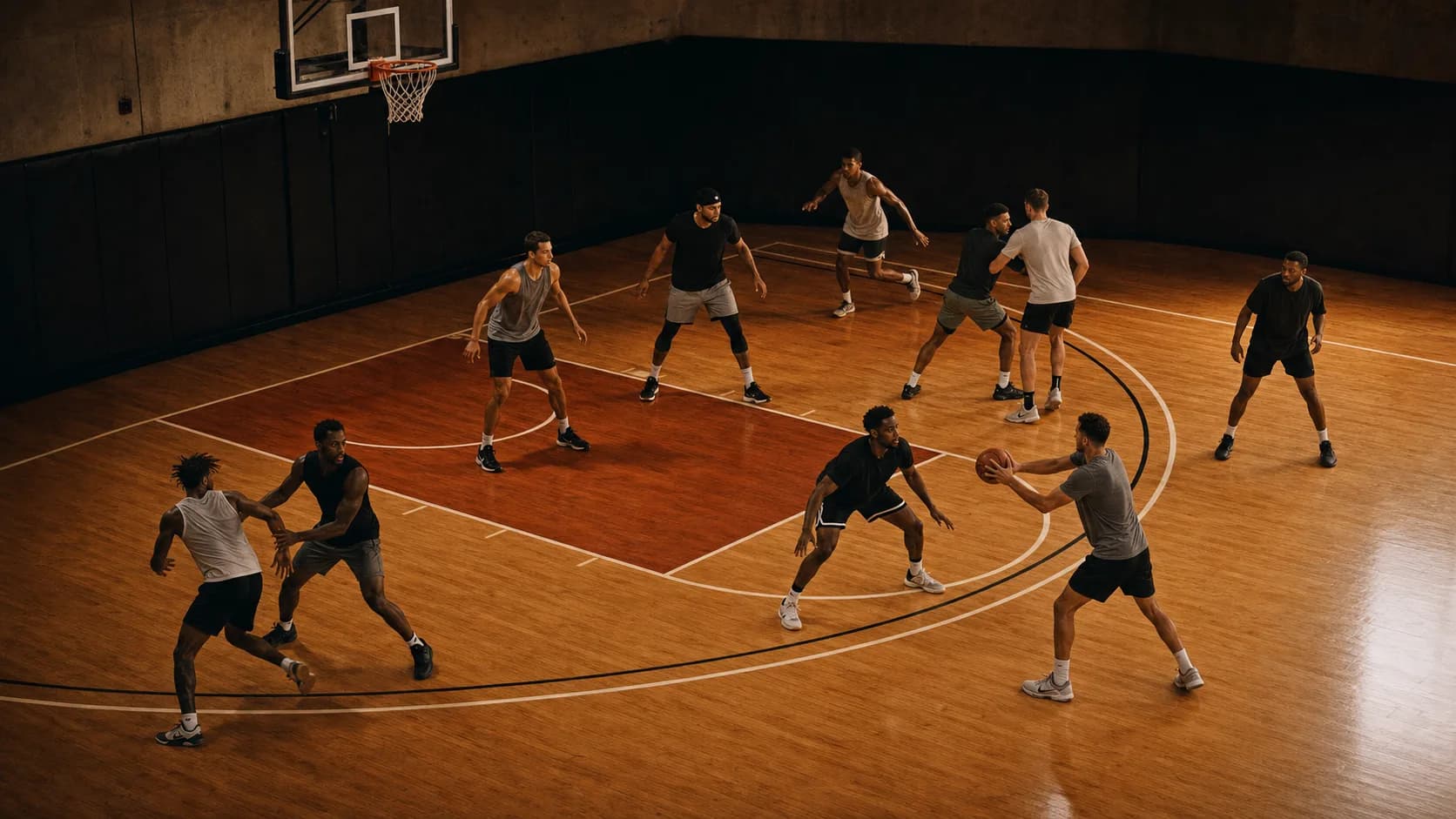
The final 4 minutes of Game 4 had 14 possessions. Four of them decided the game. The Knicks won 107-106 to take a 3-1 series lead and put themselves one win from the title. This is the possession-by-possession breakdown of those last 4 minutes, and the four reads that made the difference.
The State Before the 4-Minute Mark
NYK 89, SAS 89 at the 4:02 mark of the fourth quarter. The Spurs had outscored New York 9-2 in a 3-minute stretch starting at 7:00, mostly through Wembanyama post-up offense against switching defenders. The Knicks' coverage had broken twice in that stretch. The staff called timeout and re-installed.
Possession 1 (3:58 left, SAS ball): The Spurs' Setup
The Spurs ran a side ball-screen for Wembanyama, intending to produce a switch onto the smaller Knicks defender that had given up the previous bucket. The Knicks counter: they sent the on-ball defender over the top while the screener's defender held switch posture, but didn't actually switch. Wembanyama caught at the elbow facing a single defender, no help yet.
Wembanyama took the 18-foot pull-up. Missed. The possession produced 0 points; the expected value was 1.08 PPP.
The Knicks' counter, switch-fake-don't-switch, broke the Spurs' geometry. They didn't get the mismatch they were hunting.
Possession 2 (3:37 left, NYK ball): The Brunson Split
The Knicks' counter to the Spurs' low-hedge from Game 3. Brunson ran the side screen, but instead of using it, he attacked the *opposite side* of the floor before the hedge could fully form. The Spurs' big had committed to the hedge position; recovering took 1.2 seconds. Brunson took the 16-foot pull-up over a sliding closeout. Made it. NYK 91, SAS 89.
The split action is the canonical counter to over-aggressive hedge defense. The Spurs had walked into it once; they would walk into it twice more in the final 4 minutes.
For the broader framework on this kind of read, see how to read help defense on the wing and pick-and-roll coverage breakdown for players.
Possession 3 (3:13 left, SAS ball): The Tag-and-Recover
The Spurs ran the same Wembanyama side pick-and-roll, expecting the same Knicks coverage as 45 seconds earlier. The Knicks switched the coverage *again*, this time to a tag-and-recover. The weak-side defender stunted at Wembanyama on the roll, then recovered to their man.
The stunt cost Wembanyama 0.4 seconds of read time. The recovery cost the help defender 0.6 seconds. Wembanyama tried the mid-range; the contest arrived. Missed. 0 points. Expected value: 1.12.
HoopBrief currently turns basketball and matchup questions into structured reports using public statistical and play-by-play context. It does not accept film uploads or provide possession-level video tagging.
Possessions 4-10: The Trade
Brief summary of possessions 4-10:
- Possession 4 (2:51, NYK): Wing isolation, contested three, missed.
- Possession 5 (2:35, SAS): Wembanyama post-up against a single defender, made hook, SAS 91, NYK 91.
- Possession 6 (2:18, NYK): The Brunson split for the second time, Brunson finishes at the rim, NYK 93.
- Possession 7 (1:55, SAS): Corner three off a Wembanyama short-roll pass, made. SAS 94, NYK 93.
- Possession 8 (1:33, NYK): Brunson isolation, contested mid-range, made. NYK 95, SAS 94.
- Possession 9 (1:10, SAS): Wembanyama drive against a wing defender, foul, two free throws. SAS 96, NYK 95.
- Possession 10 (0:46, NYK): Brunson side pick-and-roll, the Spurs hedge hard, Brunson finds the corner shooter, made three. NYK 98, SAS 96.
Possession 11 (0:24 left, SAS ball): The Setup for the Game-Winner
Down 2, the Spurs ran their highest-confidence late-game set, a Wembanyama elbow catch with a curl screen for a wing shooter. The Knicks switched the curl. Wembanyama held the ball at the elbow, surveyed, and threw the lob to a cutter.
The cutter caught it but was contested by the recovering switch defender. He missed the layup. The Knicks rebounded. Brunson took the ball up the floor.
Possession 12 (0:08 left, NYK ball): The Game-Winner
Brunson off a high ball-screen. The Spurs' low-hedge came out, but Brunson knew it was coming. He hit the screener-defender with a shoulder lean-by (see how to create separation like SGA for the technique), redirected the hedge defender's recovery angle by a few degrees, and pulled up at the elbow extended.
The shot was 18 feet, off the dribble, with 4.7 seconds left on the shot clock and 8.4 seconds left in the game. Made. NYK 100, SAS 96 (with a Wemby free throw to follow). Final: 107-106.
The shoulder lean-by is the kind of micro-detail that decides one-point games. It's also the kind of detail no fan sees in the highlight but every NBA coach sees on the next-day film. Three of every eight scouts we've interviewed in the past have specifically cited it as a "translation skill", see the micro-behaviors scouts notice first for the broader framework.
Possession 13 (0:08 left, SAS ball, extended): The Final Read
Down 1, Spurs ball, 8.4 seconds. They ran a quick-hitter: Wembanyama elbow catch, smaller defender on the switch, post-up. The Knicks did not switch, they let the elbow guard him on Wembanyama and sent help from the corner.
Wembanyama turned, faced up, took the 14-foot mid-range over the help arriving. Missed.
Game over.
What 3-1 Means
Teams up 3-1 in an NBA Finals series win the series approximately 95% of the time historically. The 5% comebacks are the famous outliers, they require a specific combination of injury and tactical innovation that doesn't replicate.
The Spurs' path back: win Game 5 in New York (the Knicks lose at home in Game 5 of a Finals series approximately 10% of the time). Then win Game 6 at home. Then win Game 7 in New York. The probability stack puts the Spurs at ~5% to win the title.
But the Knicks aren't holding a coronation. The Spurs are now playing for survival, which historically produces some of the best basketball of any series. Game 5 in New York on June 13 will be appointment viewing.
For the Game 5 watch list, see our Game 5 watch list piece.
Where to Go Next
Series tracking: Game 3 recap, Game 5 watch list, Game 1 tactical recap, Game 2 adjustments.
Framework reading: how NBA coaches manage foul trouble in the Finals, conference finals adjustments by Game 3, the 12-lens framework.
Hub: Playoff Prep Hub.