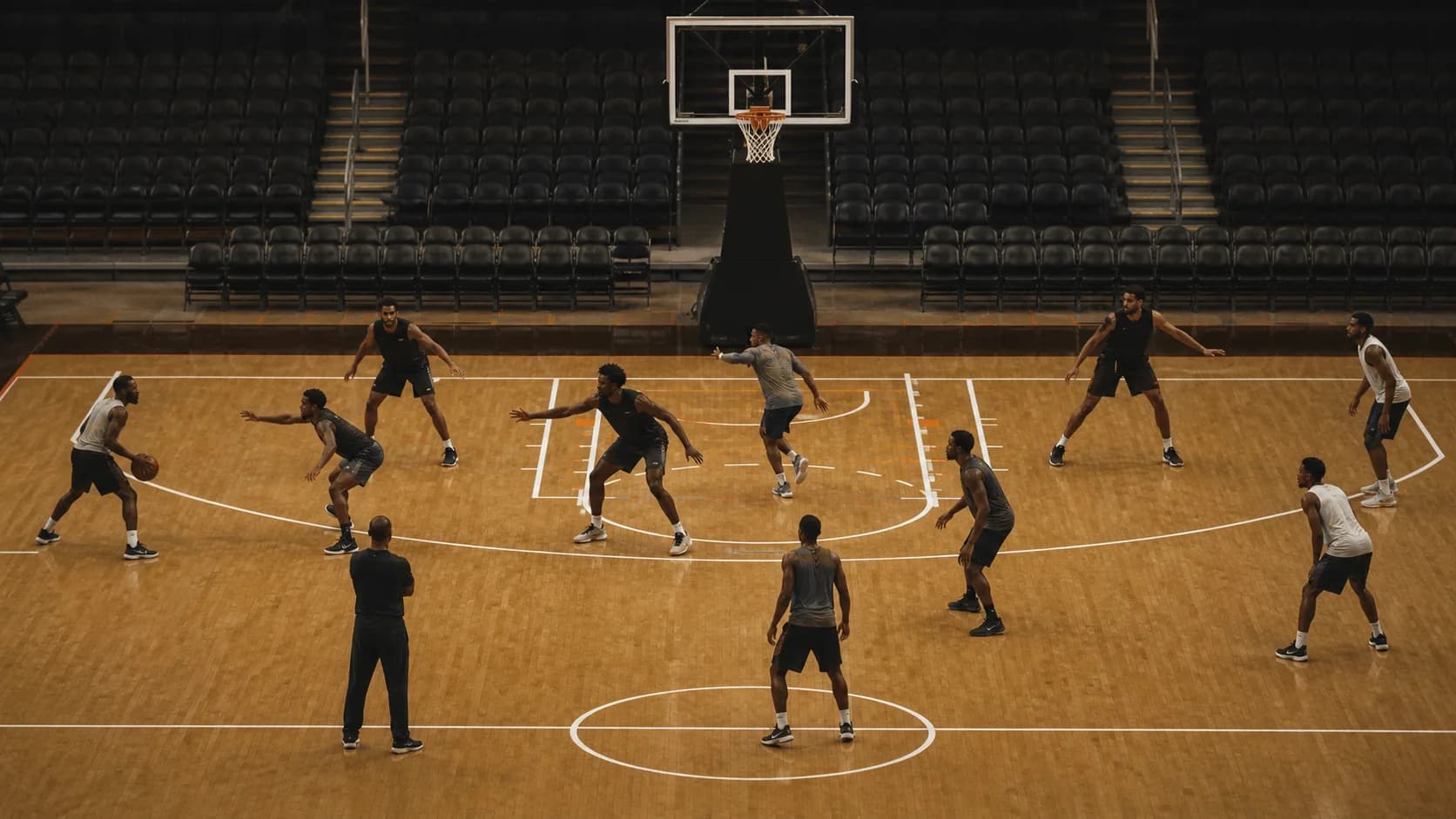
Game 5 is where the 2026 NBA Finals gets decided. Not Game 7, Game 5. The historical record is clear: when a Finals series is tied 2-2 entering Game 5, the Game 5 winner takes the series 82% of the time. When a series is 3-1 entering Game 5, the team up 3-1 wins the series 95% of the time. Either way, Game 5 is the single biggest probability inflection in a 7-game series outside of Game 7 itself.
This is the watch list, the five adjustments to track tonight, what each one tells you about the rest of the series, and the historical pattern for each. If you haven't read it yet, the Game 4 tactical recap covers the package each staff held through Games 3 and 4, and the Game 3 watch list covers the package install.
Adjustment 1: The Coverage Commit
The question: which coverage does each staff commit to on the opposing star's pick-and-roll?
Both staffs have now run two coverages on the opposing star across four games. They have the data. Game 5 is the commit game.
What to watch: - The first defensive possession. Does the staff run the Game 3-4 coverage or revert to the Game 1-2 coverage? - The coverage on the first pick-and-roll of the third quarter. Halftime adjustments usually surface here. If the coverage changed, the staff is hedging. - The coverage in the last 90 seconds. This is the coverage the staff trusts most. It's the truest signal of what the staff believes about the matchup.
A staff that commits to one coverage and runs it 90%+ of the time is the staff that's seen enough data. A staff that's still rotating between two coverages is still searching, and a searching staff in Game 5 is usually a losing staff.
Adjustment 2: The ATO Counter Package
The question: how many new ATO sets does each staff install, and which ones target the opposing coverage?
Both staffs have scouted the opposing ATO sets from four games. Game 5 will see 3-5 new ATO sets per staff, specifically designed to attack the opposing ATO coverage. The counter is usually a geometry change, a set that produces a switch where the opposing coverage normally hedges, or a set that produces a corner kick where the opposing coverage normally helps to the nail.
What to watch: - The first ATO of the game. New set, old set, or hybrid? Tells you the staff's confidence in the package. - The ATO in the last 4 minutes. This is the most-prepared ATO in the staff's playbook. Whatever they run here is what they trust most. - The ATO PPP. If the new ATO sets produce 1.10+ PPP against the opposing coverage, the counter package is live. If they produce under 1.00, the package didn't work and Game 6 will see another iteration.
HoopBrief currently turns basketball and matchup questions into structured reports using public statistical and play-by-play context. It does not accept film uploads or provide possession-level video tagging.
Adjustment 3: The Rotation Cut
The question: does each staff cut from 9 to 8?
Game 4 typically tightens the rotation to 9. Game 5 typically tightens to 8. The cut is the role player whose minutes have produced the lowest net rating across Games 1-4.
What to watch: - The starting unit's first sub. When the first bench unit comes in, who's missing from the Game 4 rotation? - The first quarter end. By the end of Q1, you've seen 6-7 players. Anyone missing is at high risk of a DNP-CD. - The 8th man's minutes. If the 8th man plays under 10 minutes, the staff is hedging toward 7. If the 8th man plays 18+, the rotation held.
The rotation cut also signals which player the staff trusts least under Game 5 pressure. That signal travels, it tells you something about how the staff will manage Game 6 closing minutes.
Adjustment 4: The Star Usage Reshuffle
The question: where do the stars get their possessions in Game 5?
By Game 5, both staffs have seen the spots where the star is most efficient against the opposing defense. The Game 5 plan will concentrate the star's usage in those spots and drop the inefficient ones.
What to watch: - The first three offensive possessions for each star. Same spot? Pick-and-roll, iso, or off-ball? - The set called out of the first timeout. Staffs save their highest-confidence sets for after timeouts. The first one tells you where they think the star is most exploitable. - The fourth-quarter shot location chart. If the star takes 70%+ of their fourth-quarter shots from the same spot, the reshuffle is committed. If the spots are scattered, the staff is still hunting.
Adjustment 5: The Defensive Effort Spike
The question: which staff brings the bigger Game 5 defensive effort spike?
This is the least tactical adjustment on the list, but historically the most predictive. Game 5 of a tied Finals is the highest-pressure 48 minutes of basketball most of the players have ever played. The team that brings 5-8% more defensive effort than they brought in Games 1-4 usually wins.
What to watch: - Closeout speed in the first quarter. Are defenders sprinting at closeouts or coasting? - Help rotation timing. Are help defenders rotating before the pass or after? - Box-out commitment. Are defenders engaging the box-out on every possession or only the contested ones? - The defensive transition. First three steps after a missed shot, sprint or jog?
These are choices the players make. They're not in the playbook. But they decide Game 5 more often than the coverage decisions do.
The Series Implications
If Game 5 ends with one team up 3-2, that team wins the series 82% of the time. The 18% comebacks usually involve the trailing team flipping one of the five adjustments above between Games 5 and 6, most commonly a coverage flip or a rotation expansion.
If Game 5 ends with one team up 3-2 in a 3-1 series, the team up wins 95% of the time. The 5% comebacks (the famous 3-1 comebacks) are vanishingly rare and require a specific combination of injury and tactical innovation that doesn't replicate.
Either way, Game 5 is the game that decides who plays Game 7. Watch it like the staff watches it.
How HoopBrief Subscribers Are Tracking Game 5
HoopBrief currently turns basketball and matchup questions into structured reports using public statistical and play-by-play context. It does not accept film uploads or provide possession-level video tagging.
- Coverage PPP breakdowns for every coverage each staff ran.
- ATO set efficacy by set with PPP data.
- Lineup net ratings and the rotation cut analysis.
- A Game 6 contingency map showing the most likely adjustments.
Want it in your dashboard? Start a HoopBrief plan today and the Game 5 report drops tomorrow morning.
Where to Go Next
Series tracking: Game 1 recap, Game 2 adjustments, Game 3 watch list, Game 4 tactical recap.
Framework reading: 12-lens system, conference finals adjustments by Game 3, how NBA coaches manage foul trouble, playoff adjustments, what changes across seven games.