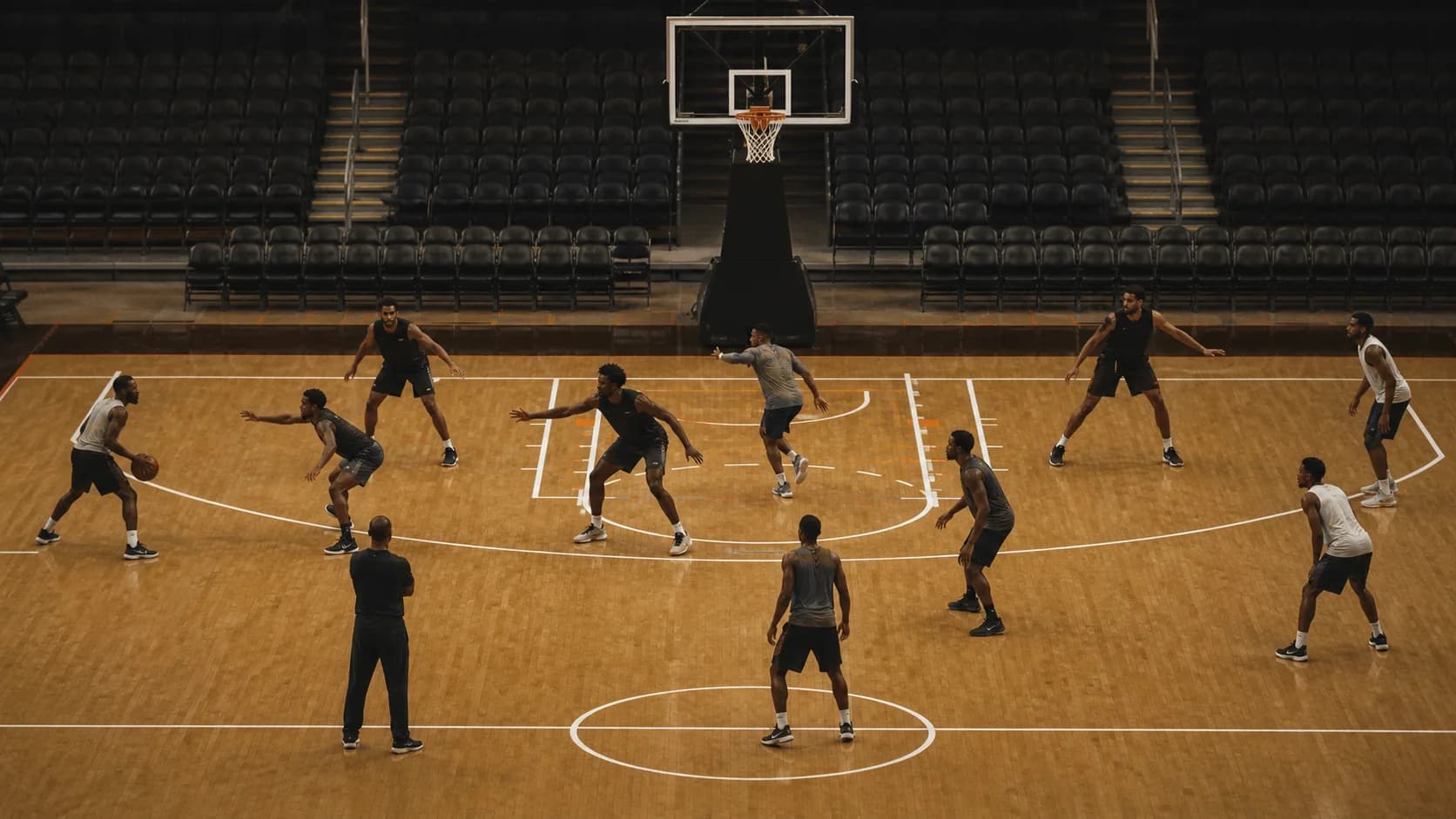
Game 3 is the inflection point of an NBA Finals series. Game 1 is recon. Game 2 is initial adjustments. Game 3 is where the staffs install the package they've been building since Game 1 ended, three coverage changes, four new ATO sets, two matchup swaps, and at least one bench-unit experiment. The Conference Finals adjustments piece covers why Game 3 is the universal pivot point in a 7-game NBA series.
This piece is the watch list for Game 3 of the 2026 NBA Finals. The Game 1 recap and Game 2 adjustments piece cover what's already happened. What follows is the five tactical decisions to watch tonight, and what each tells you about the rest of the series.
Watch List 1: Coverage Stability
The question: do the coverages each staff installed in Game 2 hold, or do they flip again?
If the coverages hold, that's a signal both staffs are confident in the matchup math and willing to live with the trades they've made. The series settles into a tactical pattern that will define Games 4-5.
If a coverage flips again, particularly if a staff goes back to drop coverage on the opposing star, that's a signal the Game 2 coverage didn't produce the suppression the staff expected, and they're now running out of bench-of-counters. Flipping back to a coverage that already got beaten in Game 1 is a tactical concession; the staff is hoping for variance.
What to watch: the first pick-and-roll involving each team's primary scorer. The coverage call on that single action signals the rest of the night.
Watch List 2: The First-Half Substitution Pattern
The question: when does the first bench unit come in, and for how long?
In Game 1, both staffs ran tight 8-man rotations, three minutes on the bench per starter in the first half. If Game 3 shows a 9-man rotation (a fourth bench player gets minutes), it signals one of two things: foul trouble on a starter (forced expansion) or a deliberate bench-unit experiment (controlled expansion).
Controlled expansion is the more interesting case. It usually signals the staff has identified a matchup-specific lineup that produces a +PPP differential against the opponent's bench unit. The coach trust piece explains how staffs build these matchup-specific lineups during a series.
What to watch: the second-quarter bench unit. If two new faces appear, that's a deliberate test for Game 4-5 use.
Watch List 3: The Late-Clock Special
The question: what does each staff run in the final five seconds of the shot clock in the half-court?
Late-clock possessions are the most-scouted possessions in basketball. Every staff has a playbook of late-clock specials, actions designed to get a specific player a specific shot when the clock dictates. The Game 3 late-clock calls reveal which players each staff trusts in the highest-leverage offensive moments.
The classic Game 3 late-clock special is something neither team has run yet in the series. The ATO playbook piece catalogs the standard late-clock options; what's interesting in Game 3 is what falls outside that catalog.
What to watch: any late-clock action that hasn't appeared in Games 1-2. That's the staff signaling "we've been holding this for Game 3."
Watch List 4: Transition Discipline
The question: which team gives up fewer transition possessions?
Across Games 1-2, both teams have averaged 7-9 transition possessions yielded per game. The team that gives up 12+ in Game 3 loses the game. The math is unforgiving, the transition defense primer walks through the PPP math; 12 transition possessions at 1.31 PPP yields 15.7 expected points to the opponent on those possessions alone.
The discipline that produces transition control isn't sprint speed, it's floor balance pre-shot. Watch which team has a designated safety on every possession, which teams crashes the glass with fewer than two players, and which team allows the opponent to outlet cleanly. The 5-second rules piece covers what suppression looks like at NBA speed.
What to watch: the second possession of every quarter. Floor-balance discipline is highest at the start of a quarter and lowest at the end. The dropoff pattern tells you about conditioning, attention, and staff messaging.
Watch List 5: Foul Trouble Management
The question: does either staff face a foul-trouble decision in the third quarter, and how do they handle it?
The foul-trouble management piece walks through the rubric. A Finals coach facing a 3-foul star in the third quarter has to make a real-time math problem, bench now (definite cost) versus ride out and risk fouling out in the fourth (probabilistic but high-leverage cost).
Watch the decision and the contingency. If the staff pulls the star, what coverage do they run without him? If the staff rides out, do they shift to more conservative defense to protect him from the fourth foul? The decision pattern is the signal.
What to watch: the third quarter, between the 8:00 and 4:00 mark. That's the window where foul-trouble decisions are highest-leverage.
The Series Implication
A Game 3 win by the away team in any 7-game NBA series shifts the series probability significantly, historically by 12-15 percentage points. A Game 3 win by the home team consolidates the series. Either way, the tactical package that wins Game 3 typically holds through Games 4-5, which means the staff that wins Game 3 also wins the tactical sub-game for the next 96 minutes of basketball.
The 12-lens system gives you the framework to watch Game 3 the way an NBA staff watches it, system, precision, defensive, analytics, advance-scout, micro-behaviors, all running in parallel. HoopBrief's subscriber reports include a per-game tactical recap and a series-long adjustment tracker. See plans.