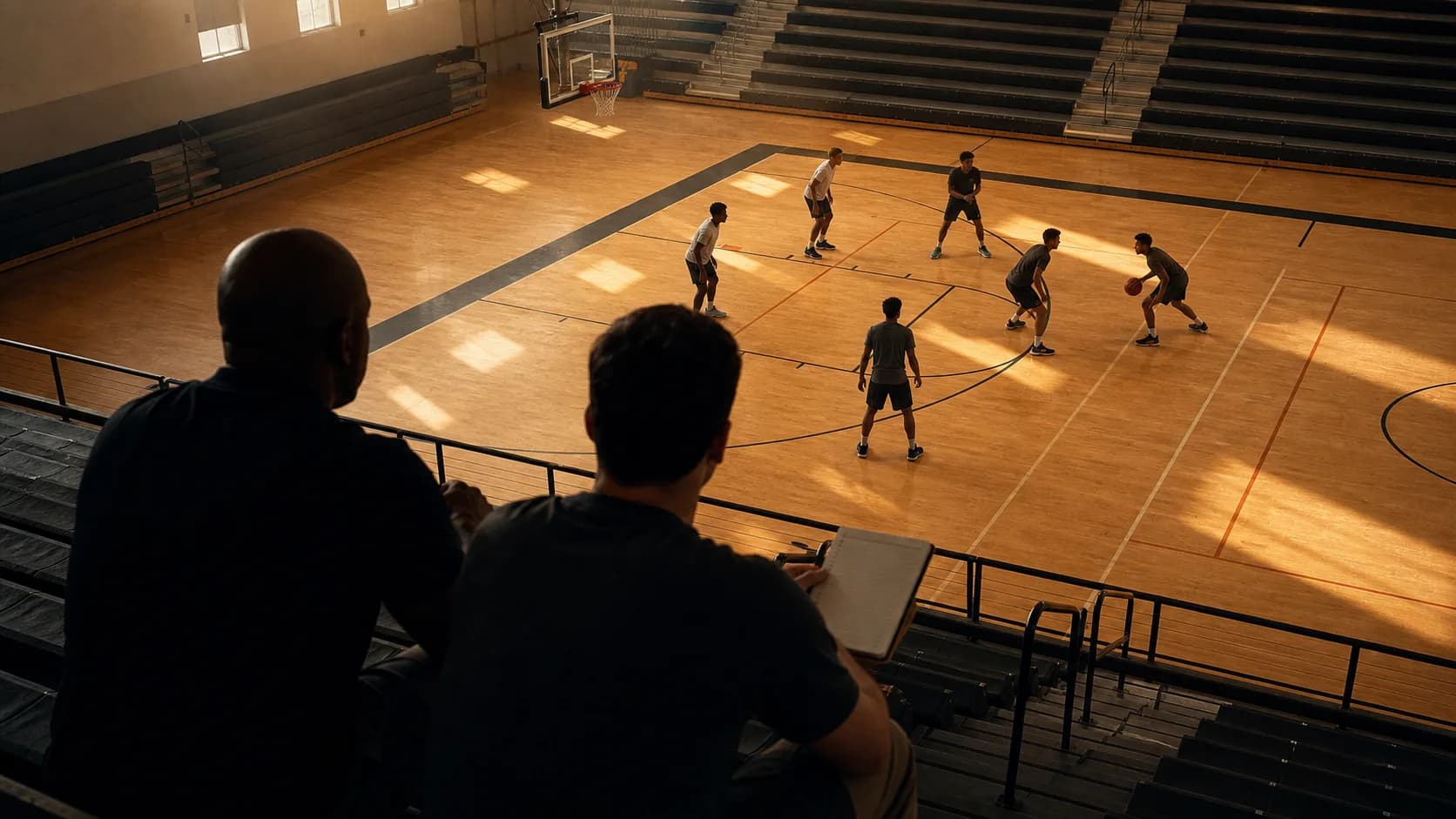
College basketball recruiting is a projection exercise, not a scoring leaderboard. Coaches are deciding which skills translate to their level, which weaknesses can improve, and whether they can trust the player inside a role. The nine traits below are a practical film-review order, not a universal formula or a guarantee of an offer.
This is the recruiting-side framework. For the NBA-translation version of the same lenses, see our what NBA scouts look for in middle school and high school players piece.
The 9 Traits, Ranked by Decision Weight
1. Decision-making speed, the gap between defensive cue and correct read. 2. Defensive versatility, can guard at least 2 positions effectively. 3. Motor under fatigue, third quarter of back-to-back game effort. 4. Off-ball value, cuts, screens, relocations, spacing. 5. Shot quality, not shot volume, efficient shots at credible levels. 6. Frame projectability, projected adult body at age 22-24. 7. Coachability + reaction to feedback, visible in real time. 8. Off-court character + academic profile, eligibility floor + tiebreaker. 9. The trust signal, does your own coach use you in winning time.
The first 5 are skill/behavior traits the player controls. The 6th is mostly genetic. The 7th-9th are character signals that travel coach-to-coach independently of film. A scholarship offer typically requires scoring well on 6+ of the 9.
Trait 1: Decision-Making Speed
The single most-predictive trait. Recruiters measure it informally, they pause game film at the moment a defensive cue appears (coverage commit, help rotation, closeout) and time how quickly the player makes the correct read.
The benchmarks:
- D1-ready: 0.5 seconds or faster from cue to read.
- D2/mid-major ready: 0.7-0.8 seconds.
- D3/JUCO range: 0.9-1.0 seconds.
This is the trait that most-clearly distinguishes "elite high school player who will be a college role player" from "elite high school player who will be a college star." The latter has elite decision speed; the former just has elite athleticism. Recruiters know the difference.
For the deeper grading rubric, see our how scouts evaluate decision-making piece.
Trait 2: Defensive Versatility
Can guard at least 2 positions effectively. The modern college game switches everything; a one-position defender limits the coach's scheme.
What recruiters grade:
- Lateral mobility from a low base
- Closeout discipline (short-stride, high-hand)
- Defensive communication
- Recovery after the first beat
A wing who can guard 1s through 4s gets recruited by every program in the country. A wing who can only guard 3s gets a much shorter list. The skill-stack required is the same as on the NBA side, just less polished, see our how scouts grade defensive versatility piece for the full framework.
Trait 3: Motor Under Fatigue
The trait recruiters look for during the second game of an AAU weekend, in the third quarter, when nobody is watching the highlights.
The 4 motor signals that scholarship offers come from:
- Sprinting back on defense after a missed shot at the other end
- Closing out at full speed in possession 75+
- Boxing out on every possession (including non-natural matchups)
- Recovery after a defensive mistake (no arguing the call, immediate next-possession focus)
Motor is the cheapest trait to add to your game and the most underrated by young players. It's a choice, you can decide today to play with high motor on every possession. Recruiters who see you across multiple games will notice within 2-3 games. See our why motor matters in scouting reports piece for the deeper rubric.
Want to grade your own motor signals on game film the same way college coaches do? Start a HoopBrief plan, the 12-lens framework includes a motor lens that tags transition defense, closeout effort, and box-out commitment per possession.
Trait 4: Off-Ball Value
What you do on the 60-70% of possessions you don't touch the ball. The four habits:
- Baseline cut when the help defender's head turns
- Pin-down screen for a teammate
- Relocation after a pass (never standing)
- Spacing discipline (right spot for the action)
Off-ball value is the trait that separates a "scorer" from a "winning player." College coaches recruit winning players for the same reason NBA coaches do: you can only have one or two ball-dominant scorers on the floor at a time.
See our off-ball value: the trait most fans miss piece for the catalog of moves and the 4-week build.
Trait 5: Shot Quality, Not Shot Volume
College recruiters care more about shot quality than shot volume. The breakdown:
- 30+ PPG against weak competition: worthless. Recruiters discount it entirely.
- 18-22 PPG at 60%+ TS% against AAU EYBL competition: elite signal.
- 15 PPG at 55%+ TS% with high off-ball value: D1-recruitable wing.
What scoring volume tells coaches is usage, not value. What scoring efficiency tells them is whether you can score at the next level. The combination of efficiency + competition level is what drives recruiting decisions.
Trait 6: Frame Projectability
The trait you can't fully control. Recruiters project what your body will look like at age 22-24, adult frame, weight, lateral burst, vertical.
The signals:
- Parental heights and frames
- Hand and foot size relative to current height
- Wingspan-to-height ratio
- Growth velocity over the previous 18 months
You can't change your genetics. But you CAN feed the trajectory, clean nutrition, sleep discipline, age-appropriate strength training. The 1-2 inches of height a teenager gains between 15 and 18 often decides which tier of D1 program comes calling.
See how tall do you have to be to make the NBA for the NBA-side version of this calculus.
Trait 7: Coachability + Reaction to Feedback
Recruiters watch the bench. They watch the timeouts. They watch the 4 seconds after the coach corrects you in real time.
Body language signals:
- Eye contact during instruction
- Nodding and follow-through (going back in and doing the corrected thing)
- No arguing the call
- No sulking after a missed shot or turnover
By age 17 most players' body-language patterns are deeply set. Recruiters read them as character traits, not situational habits. You can change yours but it takes 2-3 months of deliberate self-awareness work.
Trait 8: Off-Court Character + Academics
Two parts:
Academics: NCAA eligibility floor (2.3 GPA + sliding-scale SAT/ACT for D1). Many programs have program-specific minimums above the floor. A 3.4 GPA opens dozens of programs that a 2.7 closes.
Off-court: social media, locker-room presence, interactions with officials and teachers. Every college program reviews recruits' social media before extending offers. Posts involving drugs, alcohol, violence, slurs, or disrespect toward authority figures are common disqualifiers, many late-stage offers have been pulled over social media discoveries.
Trait 9: The Trust Signal
The character signal that travels coach-to-coach independently of film.
Does your head coach play you in the last 90 seconds of close games? If yes, that's real information about your composure, decision-making, and basketball IQ in moments that matter most. If no, that's also real information.
Every program seriously recruiting you calls your high school and AAU coaches. The single most-asked question on those calls: "Do you trust him in winning time?" The answer often decides the scholarship.
You earn the trust signal by taking care of the ball in close games, taking the right shot rather than the high-volume shot, and defending the other team's best player in the last possession. It's earned over hundreds of possessions, not in a single game.
What to Do With This Framework
If you're a current high school player working backward from a D1 scholarship goal:
- Today's choices: motor, off-ball value, defensive intensity, coachability. All choosable in your next practice.
- 6-month build: decision-making speed (constraint-based film study works), defensive versatility (8-week lateral build), shot quality (drill smarter shots, not more shots).
- 1-2 year earn: the trust signal, frame projection (feed it but be honest about ceiling).
- Calendar: junior year recruiting timeline + senior year recruiting timeline.
HoopBrief currently turns basketball and matchup questions into structured reports using public statistical and play-by-play context. It does not accept film uploads or provide possession-level video tagging.
Where to Go Next
Recruiting calendar: junior year recruiting timeline (month-by-month), senior year recruiting timeline, basketball signing day 2026 + 12-month timeline.
Tactics: how to build a recruiting film that stands out, what makes a recruit stand out in film, recruiting mistakes that cost players offers, how to make a strong first impression in recruiting.
Hub: Recruiting Hub.