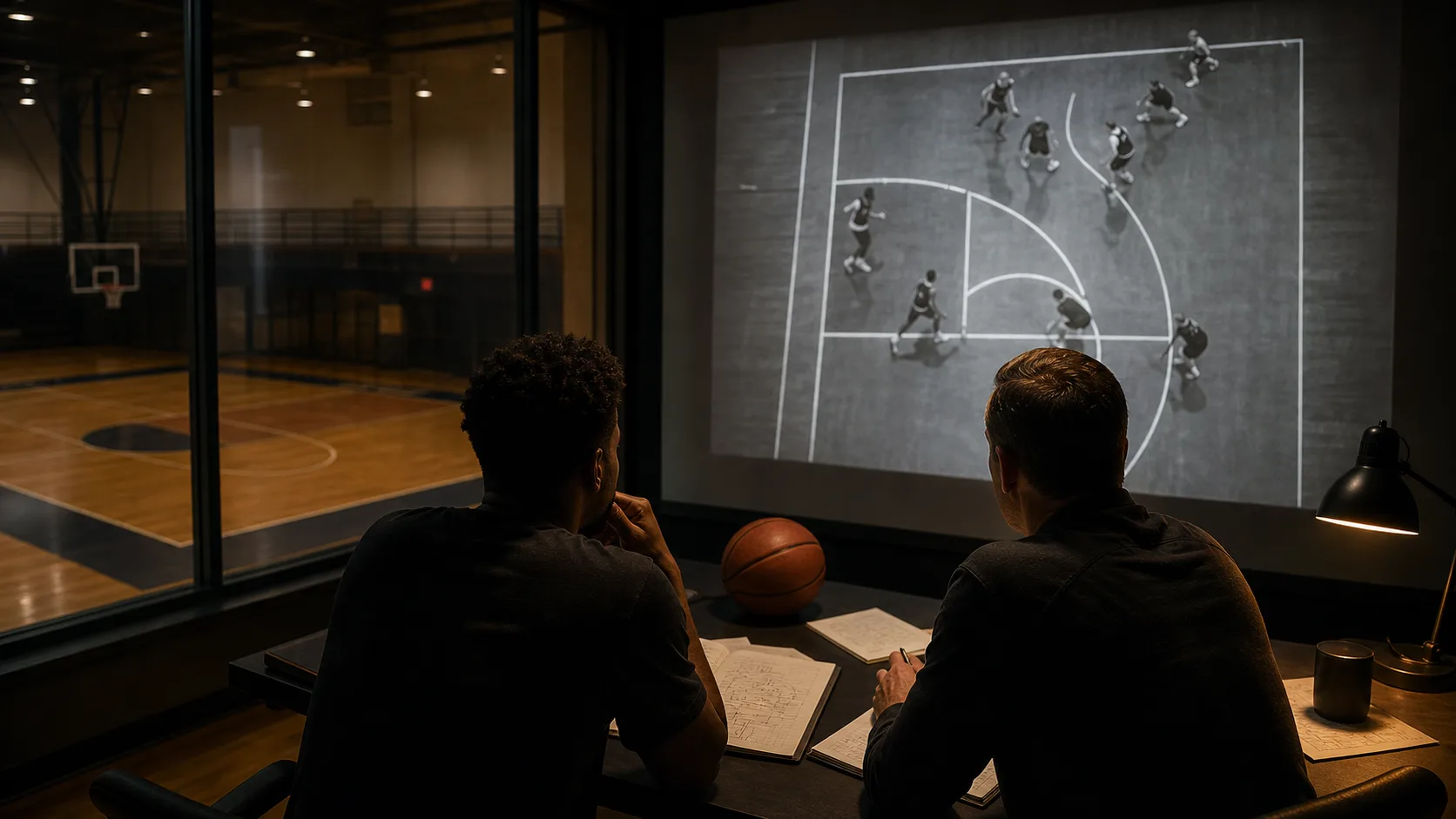
Most recruiting reels are highlight tape with no defense, no role play, and no losing clips. Coaches see hundreds of those per week and skip 80% of them by the 30-second mark. The reels that stand out, the ones that produce response emails and follow-up requests, follow a specific structure that proves both your skill and your basketball IQ. This piece is that structure.
This is part of the Recruiting Hub cluster.
The Reel That Stands Out: Structure
A 4-5 minute reel with the following composition:
- Opening 30 seconds: A winning play, not just a scoring play. Set up a teammate for the game-tying shot, hit the late-game defensive stop, or run the inbound that produced the win.
- Offensive clips (4-5 total, ~90 seconds): Variety, not repetition. Rim finish, mid-range pull-up, three, kick to open shooter, transition play. Don't include three of the same clip type.
- Defensive clips (4-5 total, ~75 seconds): Ground covered, switch defense, closeouts at speed, weak-side rotation, late-shot-clock contest.
- Off-ball clips (2-3 total, ~30 seconds): Cut to the rim, screen for a teammate, relocation that opened a shot for someone else.
- Losing clips (1-2 total, ~20 seconds): A possession where you missed the shot but made the right play. The bravest part of the reel.
- Closing 15 seconds: Another winning play or a clear "next steps" graphic with contact info.
Total: 4-5 minutes. That's the sweet spot. Longer and coaches skip; shorter and you don't have room for the variety.
The 5 Must-Include Clip Types
If your reel doesn't include all five, you're leaving recruiting attention on the table.
Clip type 1: The Winning Play
A possession where you affected the outcome of a close game positively. Doesn't have to be a buzzer-beater, it could be a defensive stop, a key rebound, a late-game pass that set up a teammate. Coaches watch this clip to assess whether you're a winning player or a stat-padder.
Clip type 2: The Defensive Possession
The single most-undervalued clip type by recruits. A defensive clip should show ground covered (15+ feet on the possession), a successful contest or stop, and motor that didn't drop at the end. Defensive clips signal that you understand what coaches value.
Clip type 3: The Off-Ball Clip
A possession where you didn't touch the ball but affected the outcome. A back-cut that opened the kick to the corner. A pin-down screen that produced an open shot. A relocation that dragged the defender out of help. Off-ball clips tell coaches you're a "winning player" instead of just a "scorer."
Clip type 4: The IQ Clip
A possession where you made a decision that showed above-average basketball IQ. A pass that anticipated a rotation. A defensive switch that arrived early. A late-shot-clock decision that wasn't the obvious choice. Coaches who see two or three IQ clips put you on the priority list.
Clip type 5: The Losing-But-Right Clip
The bravest clip in any reel. A possession where you missed the shot but made the right play, took the open look, kicked to the open teammate, defended the assignment to the buzzer. Coaches see this and grade your basketball IQ as real, not constructed.
What Coaches Skip Past
Three clip types that lose coach attention:
- Three of the same clip type in a row. If you have three identical mid-range pull-ups, you have one, pick the best.
- Highlight-only offense with no defense. Signals you're a half-skilled player or you don't know what coaches value.
- Clips against obviously weak competition. Coaches discount scoring against weak opponents and weight strong-opponent role play heavily. If you can't include strong-competition clips, the reel itself signals competition-level concerns.
Want to build a film cut that includes the right clip types? Start a HoopBrief plan and use the 12-lens framework to identify which possessions in your tape are highest-leverage for each clip type.
What to Send With the Reel
The reel alone is necessary but not sufficient. The complete recruiting outreach package:
HoopBrief currently turns basketball and matchup questions into structured reports using public statistical and play-by-play context. It does not accept film uploads or provide possession-level video tagging.
Who to Send It To
Don't email the head coach. Head coaches' inboxes are unmanageable; messages rarely get through.
Email the assistant coach who recruits your region. Most program staff pages list the assistants and their recruiting territories. The assistant is the one who actually watches film first pass; they then bring the prospects they're high on to the head coach.
The first email should be short:
- 1 sentence intro (who you are, height, position).
- 1 link to the 4-minute reel.
- 1 link to the recruiting profile.
- 1 sentence on academic standing.
- 1 sentence on next steps (your AAU schedule, when you're available for visits).
Five sentences. No more. The reel does the work.
HoopBrief currently turns basketball and matchup questions into structured reports using public statistical and play-by-play context. It does not accept film uploads or provide possession-level video tagging.
Where to Go Next
Recruiting calendar: Junior Year Recruiting Timeline, Senior Year Recruiting Timeline, Basketball Signing Day 2026.
Pre-AAU and early evaluation: What High School Players Should Do Before AAU Season, How College Coaches Evaluate Recruits Early.
Tactics: Recruiting Mistakes That Cost Players Offers.
Hub: Recruiting Hub.
Foundation reading: What College Coaches Want From Recruits, the basketball film study guide.