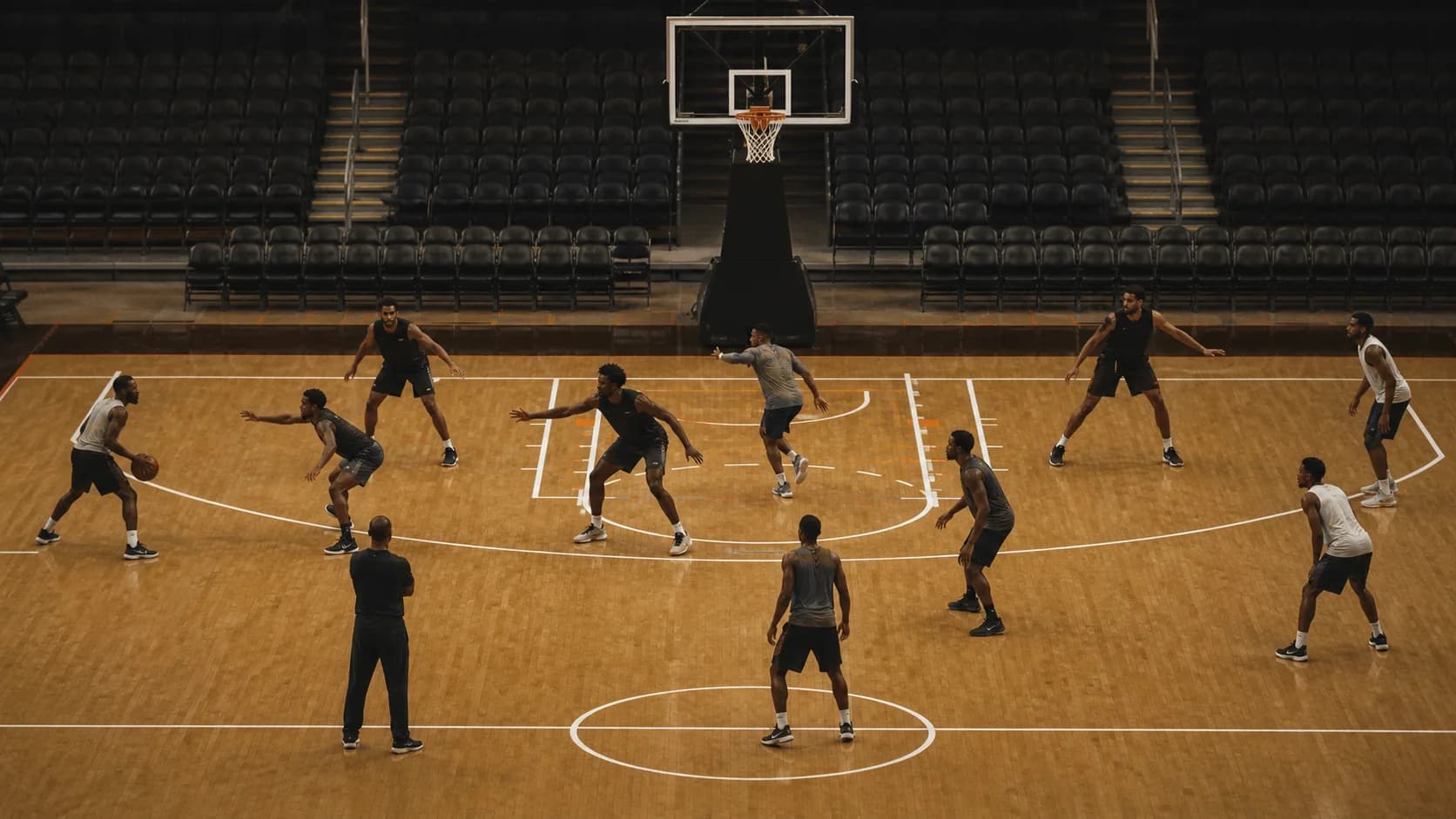
Anticipation gets talked about like it is a gift, but the best floor-readers are not guessing. They are reading spacing and cues that make the next play predictable. This article is specifically about the live geometry of a possession, how far apart players stand and what that forces, which is a different skill from knowing an opponent's plays from film. For the tendency-and-scouting side of anticipation, see how to anticipate plays in basketball. Here we are focused on spacing.
What does it mean to read the floor?
Reading the floor means using the current spacing and angles to predict the next action before the ball moves. Ball-watchers react to passes after they happen. Floor-readers see the geometry, where the gaps are, how far apart players stand, which side is loaded and which is empty, and know what that geometry forces. The read is available to everyone on the court, but only players who look away from the ball actually see it.
The core idea is that spacing dictates options. A drive toward a loaded side has less room and invites a help rotation; a drive toward an empty side has a runway but also a longer close for the help defender, which means the kick-out pass will be open longer. You do not need to have scouted the team to read this. It is pure geometry, and it is one of the most trainable parts of basketball IQ.
How do you know where help defense will come from?
Help comes from the nearest defender who can rotate without surrendering a layup or an open corner three, and the spacing on the floor tells you exactly who that is. Before any drive, scan the weak side. If two offensive players occupy one corner, the low defender is stuck and cannot help early. If the weak-side corner is empty, the help defender has farther to travel and will arrive a beat late, which means the skip pass to the opposite wing is the payoff.
This is the read that makes off-ball defenders look psychic. They are not guessing the pass, they counted the spacing before the drive started and knew they were the help, so they were already sliding into the gap. The offense reads the same picture in reverse: a passer who sees that the help must come from the weak-side corner already knows the skip is coming open. This mirror image of the same read is why spacing knowledge helps you on both ends, and it connects directly to positioning IQ.
What cues predict the next pass?
Small body cues predict passes a full second before the ball leaves the hand: the passer's eyes, shoulders, and pivot foot, plus a receiver's move to get open. A dribbler who picks up their dribble and squares their shoulders to the weak side is about to skip it. A cutter who plants to change direction is telling you where they want the ball. These tells combine with spacing to remove almost all of the guesswork.
Here are the highest-value cues to train yourself to see.
| Cue | What it predicts | How to use it |
|---|---|---|
| Passer's eyes and shoulders | The side the pass is going | Jump the passing lane early on defense |
| Loaded corner (two players) | Help cannot come from there | Attack that side on offense |
| Empty weak side | Help arrives late, skip opens | Prepare the skip pass or the relocation |
| Dribbler picks up the ball | A pass is coming now, drive is dead | Close the gap and deny the outlet |
| Cutter plants and changes pace | A cut to the open window | Beat them to the spot or feed the cut |
A worked example: reading one possession
Picture a wing drive from the right side. Before the driver even takes a step, you scan the floor: the strong-side corner is filled, the weak-side corner is empty, and the weak-side wing is one pass away with their defender already stunting toward the paint. The geometry tells you everything. The driver's kick-out will not go to the filled strong-side corner, it will go weak side, because that is where the help is vacating from.
As the off-ball defender guarding the weak-side wing, you now have a choice you can make early instead of late: stunt to help on the drive, then recover to your shooter, or stay attached and trust the low man. As the offensive player in that same spot, you read the identical picture and relocate one step higher so the skip pass finds you in rhythm. Same possession, same spacing, opposite jobs, and both players are acting on a read that was available before the ball moved. That half-second head start is the entire difference between anticipating and reacting.
You train this by pausing film right before each pass and predicting the next action, then checking yourself, hundreds of times, until the patterns are automatic. It is the same underlying skill that shows up when scouts evaluate young players and a real part of the path to the next level. Want to test a read on a specific action? Ask HoopBrief what the spacing makes available and get a possession-level answer.