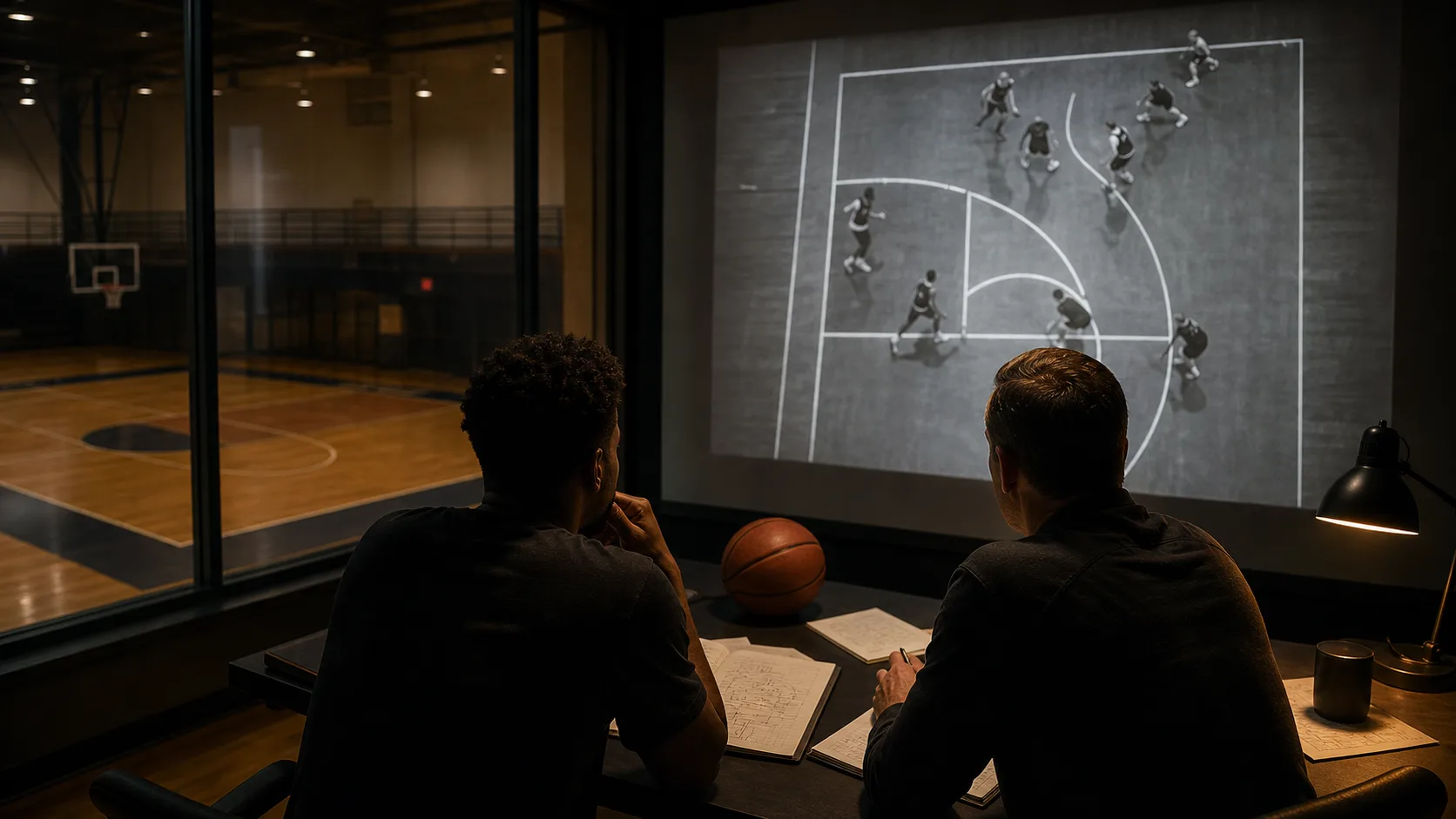
Most defenses default to drop coverage because it is simple and safe against a rolling, rim-running big. The problem is that a stretch big is built to punish exactly that. He sets the screen, then instead of diving he steps back behind the arc, and your rim protector is now stranded in no-man's-land, too deep to contest and too high to protect the rim. If you want to defend this player, you have to accept a different set of trades. Let us walk through them.
How do you guard a big man who shoots threes?
You defend the pop, not the roll. Against a stretch big, the screener's defender cannot sink into a deep drop, because that leaves a wide-open trailing three. Instead he plays up-to-touch, meeting the ball-handler near the level of the screen, then sprinting back out to the popping big. Your low man rotates up a step to cover the rim you vacated, and the weak side stays alert for the skip pass.
The mental shift is treating the big as a perimeter threat first and a screener second. In a normal ball screen, the roller is the danger. Here, the man spacing to the arc is the danger, and your coverage should be organized around getting a body to him on the catch. That means the big defender's first job after the screen is not rim protection, it is the closeout. Read more on how these reads chain together in how to read a defense in basketball.
Drop vs up-to-touch: choosing your coverage
Pick your coverage off two questions: how good is the big's three, and how fast can he put it on the floor. If he is a spot-up shooter who does not drive, up-to-touch is your answer, because you can show and recover without fearing the attack off the catch. If he is a stretch big who also drives closeouts, you may need to switch or pre-switch so no long closeout ever happens. If his shot is streaky and his handle is loose, you can live in a higher drop and run him off the line on the catch.
Here is the decision tree in one place.
| Big's profile | Best coverage | The trade you accept |
|---|---|---|
| Knockdown popper, no drive | Up-to-touch, hard closeout | Ball-handler gets a step downhill |
| Pops and drives closeouts | Switch or pre-switch | A guard-on-big mismatch |
| Streaky shooter, loose handle | Higher drop, run him off | You gift a few contested pop threes |
| Elite handle and shot | Blitz or hedge, rotate behind | Your back line plays 4-on-3 |
Notice there is no free option. Every coverage concedes something. Your job is to concede the thing this specific big is worst at punishing, which is exactly the kind of tendency read covered in how to improve your basketball defense.
A worked example: defending the pick-and-pop
Picture a middle ball screen. The ball-handler comes off the big's screen going right, and the big, instead of rolling, plants and pops to the top of the arc. In a deep drop, your big is standing at the dotted line, and the pass hits the popper for a rhythm three before your defender has taken two steps. That is the possession you must erase.
Now run it in up-to-touch. The big defender meets the ball-handler at the level of the screen, gives one hard touch to stall the drive, then immediately flips his hips and sprints at the popping big. He closes out short, one long step under the shooter, chopping his feet so he is balanced, high hand up to contest but body low enough to wall off the drive. Meanwhile your low man has bumped up to the nail to take away the ball-handler's runway during that brief 4-on-3 window, and your on-ball defender has fought over the screen to get back into the play.
The read for the offense is now a bad one: a contested pull-up over the show, or a pocket feed into a loaded paint, or a rushed pop three with a hand in the face. You did not take everything away. You took away the clean three, which is the shot this player is on the floor to get. This is the same funnel logic you use in a post-up, just pushed out to the arc.
Closing out short without giving up the drive
The closeout is where stretch-big defense is won or lost. Close out long and flat and you fly by, surrendering the drive. Close out too soft and you concede the shot you spent the whole possession trying to prevent. The answer is a short, choppy, side-on closeout that arrives under control with the high hand up.
Coach it in three beats. First, sprint the first two-thirds of the distance to eat ground, because the closeout on a popping big is long by nature. Second, break down into short chop steps over the final third so you can change direction. Third, close out to a side, high foot up, forcing the big toward help rather than giving him a straight downhill lane. If he is a shooter only, crowd him and live with the drive. If he can drive, sit a hair lower and force the pull-up you can live with. For the full closeout mechanics, pair this with your coverage rules in pick-and-roll coverages explained.
Want a coverage plan built for the exact stretch big on your next opponent, with his pop tendencies and drive counters mapped out? Ask HoopBrief and get the matchup broken down possession by possession.