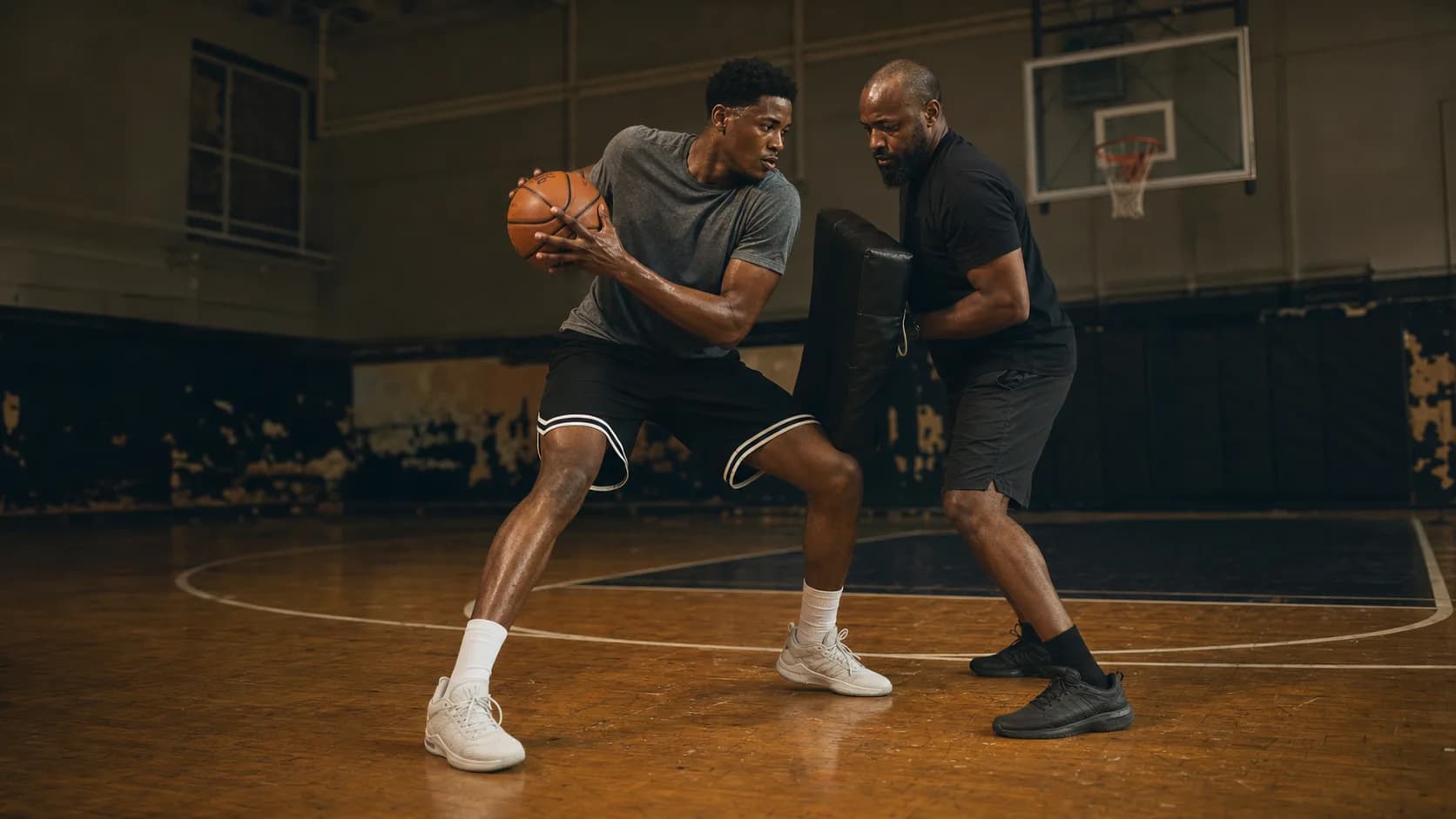
The short answer: Post defense happens before the ball arrives. Where you sit pre-catch decides 80% of the possession. A defender who fronts 70% of the time and accepts being burned 30% gives up about 0.78 PPP. A defender who plays behind every time gives up 1.04 PPP. The fronting tax is worth paying.
Post defense is the most under-coached defensive skill at every level below the NBA. High-school coaches teach guards to defend the perimeter and bigs to "rebound." Nobody teaches angles, fronting, or the lower-body discipline that makes a 6'8" defender survive against a 6'11" post-up.
The good news: post defense is mostly geometry. Once you understand the angles, you can defend players bigger than you because the math is on your side.
The Pre-Catch Positioning Rule
Post defense starts when the offensive player begins his post-up walk. Most defenders react to where the offensive player ends up. Elite post defenders decide where the offensive player will end up by occupying the spot first.
The rule: get to the post spot 1-2 seconds before the post-up player does. Plant. Hold ground. Use legal lower-body contact (the offensive player gets to push, the defender gets to absorb). By the time the offensive player arrives, they're 6 inches further from the rim than they wanted to be, and that 6 inches is the difference between a hook shot and a kick-out.
If you watch Bam Adebayo or Brook Lopez post-defend, you'll notice they almost never look reactive. They're already in the spot the offensive player wanted.
Fronting vs Three-Quartering vs Full-Behind
Three pre-catch positions, three different EV outcomes:
Front (between offensive player and ball). Highest EV for defense. Forces a lob entry, which is the lowest-success post entry pass at the NBA level. Only ~30% of fronts get burned by lob, and even those are contested.
Three-quarter (one shoulder in front, one behind). Middle ground. Allows the entry pass but contests the shoulder. The offensive player has to spin or face up before scoring. Concedes 0.92 PPP league-wide.
Full behind. The "natural" post defense most players use. Concedes 1.04 PPP. The offensive player gets the ball cleanly, has both shoulders to work with, and you're playing reactive defense the whole way.
The math is brutally clear: front when help is available, three-quarter when it's not, never sit fully behind unless the offensive player is a non-threat.
The Lower-Body Tax
Post defense lives below the waist. Most amateur post defenders try to use their hands, they reach, they swipe, they push with the upper body. All of this fouls.
The lower-body version: hips wide, knees bent, weight on the balls of the feet. The offensive player pushes; you absorb with your legs, not your back. Your hands are at chest height, palms facing the ball, never on the offensive player's body.
The cue is simple: if your hands are on him, you're fouling. If your legs are doing the work, you're defending.
Reading the Up-and-Under
The up-and-under is the post player's answer to good defense. He pump-fakes, gets the defender airborne, then steps through for the layup. It's a 1.30+ PPP move when it works.
The defense: don't leave your feet on a pump fake. Period. The offensive player's first move is almost always a fake; the second move is the real shot. Stay grounded on the first, contest the second.
Drill: post defender plays a 30-second possession. Coach awards 0 points for the offensive player's pump fake. If the defender bit (left feet), the rep counts as a loss even if no shot was taken. Trains the discipline of staying down.
The Digger and the Help
Post defense isn't 1-on-1 unless your team is bad. Modern post defense is shell defense:
The digger. The wing defender one pass away from the post comes down to put a hand on the ball. Their job: disrupt the dribble, force the post player to put the ball on the floor, and recover before the kick-out.
Low-man help. The weak-side defender lowest to the rim is responsible for stunting at the rim if the post-up player tries to drive. Their stunt isn't a full rotation, just a step toward the rim and back.
Top-side weak-side. When the digger comes down, somebody has to cover the digger's shooter. Usually the strong-side wing defender shifts.
This is the standard NBA help-rotation pattern on post-ups. If your team isn't running it, the post defender is fighting alone, which is why post-ups score 1.04 PPP against bad defensive teams.
The Drill That Builds It
Five-on-five live, but the offensive coach can call "post!" at any moment, and the offense has to enter the ball into the post. The defense has to execute the full shell rotation: front (when possible), digger comes down, low-man stunts, weak-side covers the digger.
Score: defense earns 1 point per stop. Offense earns 1 point per made basket. First to 10. The drill rewards complete defensive execution, not individual heroics.
Frequently Asked
What if I'm smaller than the post player? Front more often. The size disadvantage matters less when you've taken away the catch entirely.
What about defending the elbow post (high-post)? Different problem. Elbow post defense is more about denying the catch and forcing the offensive player off the elbow. Sit 3/4 behind, drive him toward the corner.
Should I let post players catch and double them? Only if the post player is a poor passer. Good passers shred doubles. Marginal-passing posts get destroyed by them.
The Quiet Edge
Watch a great defensive big in their off-ball stance during a perimeter possession. Notice they're already positioning for where the post-up will happen, even when the ball is 30 feet away. Post defense at the highest level isn't reactive. It's anticipatory. The catch happens where you've already decided it will.
The position you take three seconds before the catch is worth more than every move you make after it.
Keep reading: defending without fouling, defensive positioning, and the no-middle rule.