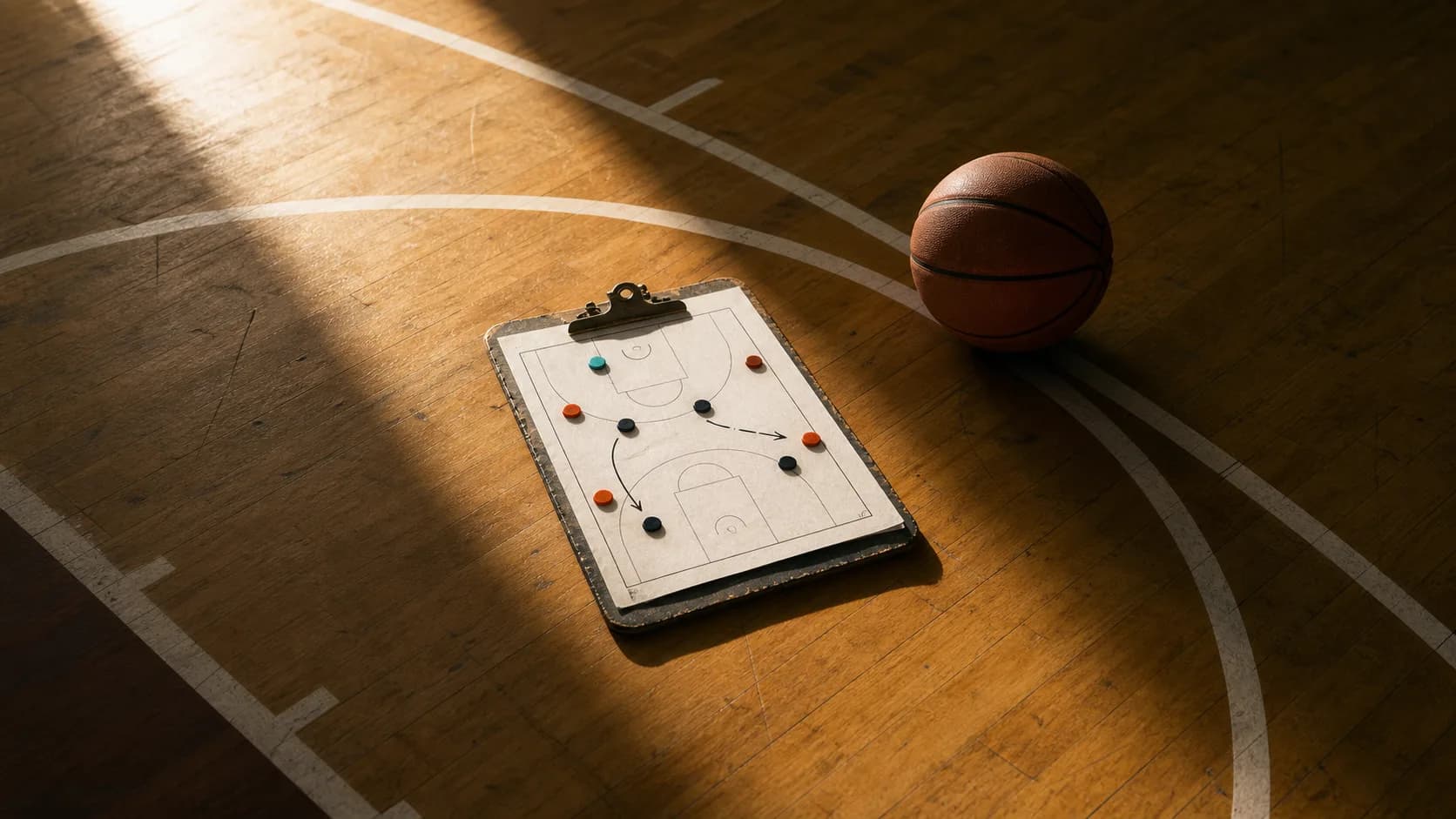
A slasher is not a shooter you crowd or a big you body. He is a downhill athlete whose entire game is speed and angle to the rim. If you defend him like a normal scorer, standing square and reacting to his first move, you lose, because his first move is faster than your recovery. The way to beat him is to remove the geometry he needs before the possession even develops. That starts with your stance.
How do you stop a player who always drives to the basket?
You deny the angle, not the ball. A slasher needs a straight line to the rim, so your defensive stance should already be taking that line away. Shade him hard to his weaker hand, position your body so his best driving lane is closed, and force him toward the sideline or baseline where your help is waiting. You are not trying to keep him from catching, you are trying to make sure that when he drives, he drives into a crowd.
The mistake defenders make is playing dead square and honest, which gives the slasher his pick of directions. Instead, take a side. If he is right-hand dominant, sit on his right, force him left, and trust your rotations to cover the rest. This is the same funneling logic that organizes an entire defense in the no middle rule, applied to one dangerous individual.
No middle: forcing him where help lives
No middle is the single most important principle against a slasher. Middle penetration is the most dangerous attack in basketball because it splits the floor and opens skip passes to both wings at once. Sideline and baseline penetration is far less valuable, because the baseline itself acts as an extra defender and the help rotations are shorter and cleaner.
So every rep, you push him one direction. On the wing, that means forcing baseline into your loaded low man. Up top, it means forcing him to a side and away from the nail. When the whole team commits to no middle, the help defenders know exactly where the drive is going before it happens, so they can pre-rotate rather than scramble. Middle-heavy penetration generates roughly 1.18 points per possession in the modern game, while sideline penetration sits closer to 0.94, and that gap is the entire reason the rule exists. Sharpen how you read those help responsibilities in how to read a defense in basketball.
A worked example: walling up on the baseline drive
Say the slasher catches on the right wing. You are shading his right hand, so he drives baseline, which is where you sent him. Now the read chain fires. Your low man, the weak-side big or the defender one pass away in the corner, steps up to the front of the rim to tag the drive early, meeting the slasher at the block before he gathers. That defender does not slide under and take a charge risk, and he does not reach. He walls up: chest square, both arms straight vertical, feet set.
The slasher now has three bad options. He can pick up and try to finish over a vertical wall, which is a tough contested shot. He can jump into the wall and hope for a foul, which he will not get against legal verticality. Or he can kick to the corner, where your low man came from, and your next rotation closes out. Meanwhile your on-ball defender has stayed on his hip the entire way, so there is a second contest at the rim. You turned his best play, a downhill baseline drive, into a low-percentage possession without fouling. That is the whole game against this player, and it rewards the same anticipation you build defending a faster player.
Loading the help and living with the kick
Against a slasher, your help defense has to be committed and early, and you have to be at peace with giving up the pass. You cannot both stop the drive and stay glued to every shooter. So you load your help toward the ball, tag the roller and the drive, and accept that the correct read for the offense is now a kick-out, not a layup.
Here is how the trade lands.
| Coverage choice | What you take away | What you give up |
|---|---|---|
| Load help strong, wall up | The rim finish | A kick to the weak-side shooter |
| Stay home on shooters | The catch-and-shoot three | A one-on-one drive to the rim |
| Full gap, no help | Nothing reliably | Everything, if he beats his man |
The right answer against a rim-first slasher is almost always the top row. Make the reluctant shooters and role players beat you from outside rather than letting your primary threat get to his spot. A slasher who has to become a passer and a shooter is playing a game he did not want to play. Build the fundamentals underneath all of this in how to improve your basketball defense.
Want the exact driving tendencies of your next opponent's slasher, his go-to hand, his favorite counter, and where his kick-outs go? Ask HoopBrief for a possession-level breakdown of the matchup.