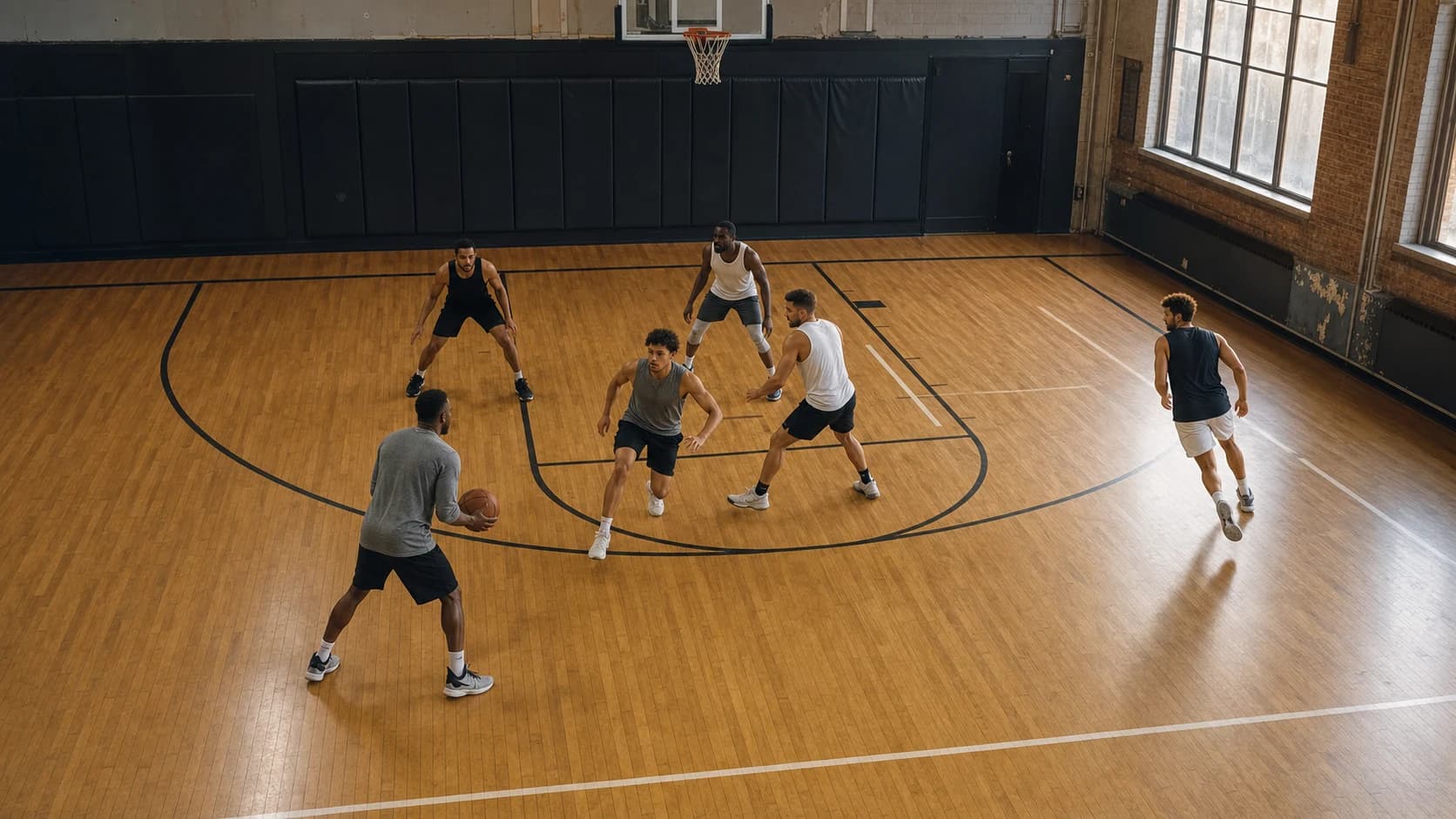
Learning the names is easy. Learning what each player must see is the useful part.
This guide explains the traditional 1 through 5, the modern roles hiding inside those labels, and the reads that decide whether a player stays on the floor.
What Are the Five Basketball Positions?
Each traditional position begins in a different area and carries a different first responsibility. The table is the cleanest starting point.
| Number | Position | First offensive job | First defensive job | Core read |
|---|---|---|---|---|
| 1 | Point guard | Organize pace and create an advantage | Contain the ball and pressure the handler | Where is the second defender coming from? |
| 2 | Shooting guard | Space, shoot, and attack a tilted defense | Chase shooters and contain guards | Should I shoot, drive, or move it? |
| 3 | Small forward | Connect actions from the wing | Guard the strongest perimeter matchup | Can I punish the closeout without stopping the ball? |
| 4 | Power forward | Screen, space, cut, and rebound | Switch, help at the nail, and finish possessions | Should I pop, roll, slip, or screen again? |
| 5 | Center | Create rim pressure and screen angles | Protect the rim and call coverage | Can I stop the ball and still recover to the rim? |
The numbers are lineup shorthand. They are not jersey numbers, rankings, or a rule that limits what a player may do.
1. Point Guard: The Organizer
The point guard controls the first decision of the possession. The 1 brings the ball up, communicates the action, changes pace, and gets teammates into useful spots.
The best point guards do more than dribble. They put two defenders on the ball, identify the open teammate, and deliver the pass early enough for that teammate to attack. On defense, they set the tone at the point of attack.
The point guard's core film question is simple: where did the help come from after I created an advantage? A lead guard who cannot answer that question is playing one defender at a time.
If this is your role, study how to play point guard and how to read a defense.
2. Shooting Guard: The Advantage Extender
The shooting guard stretches the defense with shooting, movement, and quick decisions. The 2 may start away from the ball, but should be ready to shoot, attack a long closeout, or move the ball without holding it.
This role is not measured only by points. A shooting guard creates value by relocating after a pass, lifting from the corner when a teammate drives, and occupying the defender who would otherwise help at the rim.
On defense, the 2 often chases movement shooters and guards secondary creators. That requires screen navigation, top-foot discipline, and the stamina to stay connected through several actions.
3. Small Forward: The Connector
The small forward is usually the lineup's most flexible perimeter player. The 3 can cut, handle a second-side pick-and-roll, attack a mismatch, rebound, and defend several positions.
A connector keeps an advantage alive. If the first drive forces a rotation, the 3 catches and makes the next correct decision before the defense resets. That may be a shot, one more pass, or a straight-line drive.
This is why a low-usage wing can be essential. The player does not need to dominate the ball. The player needs to make the possession easier for everyone else. Becoming a better off-ball player is often the fastest route into this role.
4. Power Forward: The Flexible Frontcourt Player
The power forward connects guards and centers. A traditional 4 operated near the post. A modern 4 may screen, pop to the arc, attack a closeout, make a short-roll pass, or switch onto a guard.
The position is built around timing. A screen set one beat too early lets the defender recover. A roll into a crowded lane removes space. A late weak-side cut arrives after the passing window closes.
Defensively, the 4 often has the widest rotation map. The player may tag a roller, stunt at a driver, close to the corner, and rebound in the same possession.
5. Center: The Back-Line Decision-Maker
The center gives the lineup a reliable target at the rim and a stable voice behind the defense. The 5 sets screens, rolls, seals, rebounds, and creates space through physical positioning.
Modern centers also pass. When two defenders follow the ballhandler, the short-roll big may catch near the foul line and play four-on-three. That decision can be as valuable as the original screen.
On defense, the center usually sees the whole floor. The 5 calls the ball-screen coverage, protects the rim, directs low help, and ends the possession with a rebound. Size helps. Early recognition matters more than size alone.
How Modern Basketball Roles Differ From the 1 Through 5
Traditional positions tell you where a player starts. Modern roles tell you what the player does when the possession moves.
Most effective lineups cover these responsibilities:
- Primary creator: bends the first defender and forces help.
- Secondary creator: attacks after the first rotation.
- Spacer: occupies help with shooting or cutting gravity.
- Connector: makes fast decisions that keep the advantage alive.
- Screener or rim pressure player: changes defensive positioning with contact, angles, cuts, and rolls.
- Point-of-attack defender: takes the hardest ballhandling matchup.
- Back-line defender: calls coverage, protects the rim, and organizes help.
That is more than five labels because one player can cover several jobs. A point guard may be the creator and spacer. A wing may be the connector and point-of-attack defender. A center may be the screener, passer, and back-line defender.
Positionless basketball works only when the lineup still covers every responsibility. Five players standing outside the arc are not positionless. They are missing rim pressure and screening. Five creators without a connector usually stop the ball.
What Does Each Basketball Position Do on Defense?
Offensive positions get more attention, but defensive responsibility often determines playing time.
| Position | Typical matchup | Help responsibility | Possession-ending job |
|---|---|---|---|
| Point guard | Primary ballhandler | Dig at drives without losing the outlet | Secure long rebounds or start transition |
| Shooting guard | Shooter or secondary handler | Chase actions and tag from the perimeter | Find a body after switches |
| Small forward | Best wing scorer | Nail help, stunt, and switch across the perimeter | Rebound outside the paint |
| Power forward | Bigger wing or mobile big | Low-man rotation and second jump | Box out the opposing frontcourt |
| Center | Roller, post player, or rim runner | Call coverage and protect the basket | Own the defensive rebound |
These are defaults, not permanent assignments. Matchups change them.
A smaller guard may front a post player after a switch. A wing may become the low defender. A center may step to the level of the screen. Good defenders recognize when the role changed before the ball exposes it.
Which Basketball Position Should You Play?
Choose your primary position from the decisions and tasks you perform reliably. Do not begin with height alone.
Use this five-question audit:
- Can you create a clean advantage against pressure? Train as a point guard or primary wing creator.
- Can you shoot, relocate, and decide in under a second? Train as a shooting guard or spacing wing.
- Can you defend several matchups and keep the ball moving? Train as a small forward or connector.
- Can you screen, rebound, switch, and attack a closeout? Train as a power forward.
- Can you protect the rim, communicate coverages, and finish inside? Train as a center.
Then choose a secondary role. A point guard who can play off the ball fits more lineups. A center who can pass from the short roll stays useful against pressure. A forward who can guard up or down gives a coach more matchup options.
Your position should describe your current responsibilities. It should never cap your development.
How Youth Players Should Learn Positions
Young players should learn every core skill before specializing. USA Basketball's player development curriculum uses mastery levels rather than assigning every progression only by age, grade, or physical size.
That matters because early size can be temporary. The tallest 12-year-old may not be the tallest 17-year-old. If that player learns only to stand beside the rim, the short-term advantage creates a long-term skill gap.
A better youth sequence is:
- Handle and pass with both hands.
- Finish from both sides.
- Shoot with repeatable footwork.
- Cut, screen, and space without the ball.
- Defend the ball and understand help position.
- Rebound outside the player's immediate area.
- Play several lineup roles in small-sided games.
Position teaching should add responsibility, not remove skills.
How to Train for Your Basketball Position
Train the repeatable decisions your role faces, not a collection of moves with no context.
Point guards should practice changing pace, rejecting screens, finding the roller, and making the weak-side pass. Wings should practice shot preparation, closeout attacks, second-side reads, and off-ball defense. Frontcourt players should practice screen angles, short-roll decisions, seals, rim finishes, coverage communication, and rebounding.
Film makes those repetitions specific. Watch five possessions from your own role and label four things:
1. Where did I begin? 2. What moved the defense? 3. What was the next open read? 4. Did my spacing help or crowd the possession?
That is basketball IQ in a usable form. It turns a position name into a job you can improve.
The Bottom Line
The 1 through 5 still gives players and coaches a shared language. Modern basketball simply asks more from every label.
Know your starting position. Learn the reads attached to it. Build a secondary role. Then judge your game by whether your decisions make the whole lineup function.
Want a position-specific read on a real player or matchup? Ask HoopBrief a basketball question and see the possession through 12 coaching lenses.