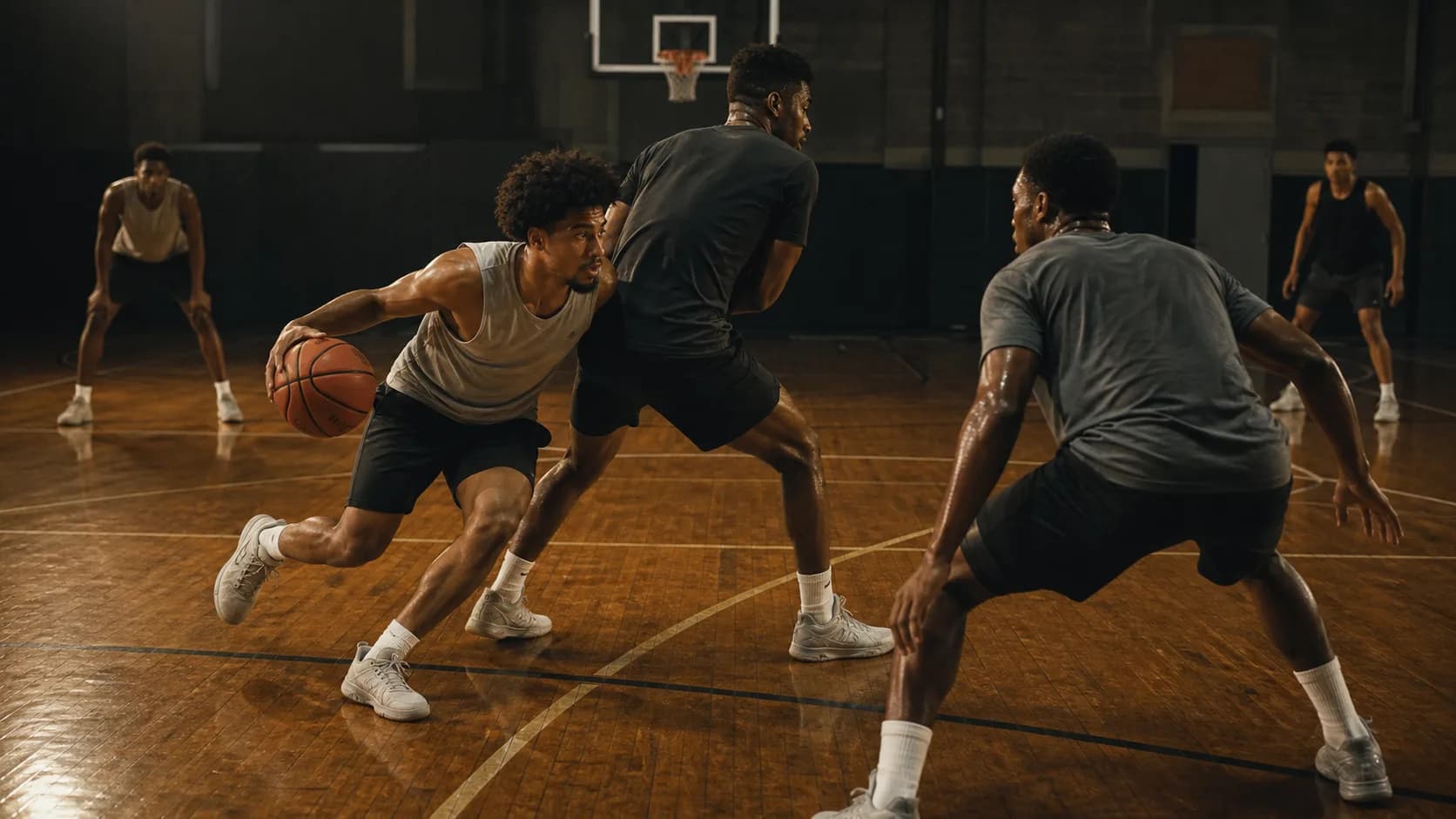
- ball
- defender
- offense
- the read
ICE is the coverage most casual viewers never notice, because nothing dramatic happens. There is no trap, no switch, just a defender quietly steering the ball-handler away from the middle and toward the sideline, where the offense has fewer options and the defense has already stacked its help. Beating it starts with understanding exactly what it takes away and what it must, by design, leave open.
This is the counter to a coverage we define in full in our pick-and-roll coverages breakdown. ICE is also the enforcement arm of the modern no-middle rule, so beating ICE is really about beating a defense that has committed to keeping you out of the paint through the middle.
What is ICE coverage?
ICE is a side pick-and-roll coverage where the defense refuses the screen entirely. The on-ball defender jumps to the high side of the ball, parallel to the sideline, and forces the dribble down toward the baseline instead of letting the ball-handler use the pick. The screener's defender shows at the level of the screen to wall off any path back to the middle. Everything is designed to make the ball-handler go one direction, the sideline, where the defense has pre-loaded its help.
The name comes from the verbal call teams use to signal it, and you will also hear it called blue or down depending on the staff. The intent is identical everywhere: no middle, force baseline, make the offense predictable.
How do you beat ICE coverage?
Beat ICE by attacking the middle it is trying to protect, or by punishing the weak side it leaves thin. There are four reliable counters, and the right one depends on how aggressively the defense sells out to the sideline.
| Counter | How it works | When to use it |
|---|---|---|
| Reject the screen | Refuse the pick and drive middle before you get turned | On-ball defender over-commits to the high side early |
| Snake dribble | Get pushed to the sideline, then cut back to the middle | The screener's defender shows too far out |
| Re-screen | Screener flips the angle to the other side | The first ICE turned you away cleanly |
| Weak-side skip / short roll | Swing to the weak side or hit the short-roll man | Help has loaded hard to the strong side |
The unifying logic: ICE commits the defense to one side of the floor. Anything that gets the ball back to the middle, or over to the neglected weak side, beats it.
A worked example
Side pick-and-roll on the right wing. The defense calls ICE. The on-ball defender jumps to the high side and forces the ball-handler toward the baseline, and the screener's defender shows at the level of the screen to seal the middle.
Read one, the reject. If the ball-handler feels the on-ball defender cheat early to the high side, he rejects the screen entirely, crossing over and attacking the middle before the defender can turn him. The pick was never used, and now the ball-handler is downhill into the space the defense abandoned to set up ICE.
Read two, the snake. If ICE turns him to the sideline cleanly, the ball-handler takes two dribbles baseline, then snakes back across the screener's defender into the middle. As the show defender slides to wall the baseline, the ball-handler cuts into the pocket he leaves and rises into a mid-range pull-up, or keeps going downhill if the lane opens.
Read three, the weak-side punish. If the help has loaded hard to the strong side to swallow the baseline drive, the weak side is thin. The ball-handler hits the short-roll screener, who swings a skip pass to the open weak-side corner, because a defender who slid over to help cannot recover to that closeout. Knowing which of these a given ball-handler and big prefer is a scouting read, and exploiting the matchup is what tells you whether that show defender is beatable on the snake.
The screener's role against ICE
The screener has real power against ICE, because he sets the angle the coverage depends on. His first weapon is the re-screen: if the first screen gets ICEd, he sprints to flip the angle to the other side, forcing the defense to reset its high-side positioning and often catching the show defender out of place. His second weapon is the short roll into the gap: as the show defender steps up to wall the middle, the screener rolls opposite into the space behind him and catches in the open floor, exactly as he would against a hedge.
A screener who sets a flat, wide angle also makes ICE harder, because it gives the ball-handler a real threat of going middle, which is precisely what ICE is built to deny. The tighter and more predictable the angle, the easier the ball is to ICE.
When ICE works against you
ICE wins when the ball-handler accepts the sideline without a counter, dribbles into the loaded help, and picks up his dribble in the corner. It also wins against a one-directional ball-handler who is dangerous going middle but harmless going baseline, because ICE simply removes his strong hand. The counters are decisiveness and balance: reject or snake back to the middle before help sets, keep the weak side involved, and be a threat in both directions so the defense cannot safely funnel you one way.
Facing a team that ICEs your side ball screens? Ask HoopBrief for a breakdown of how a specific defense runs ICE, where its help loads, and which counter, the reject, the snake, or the weak-side skip, gives your personnel the cleanest look.