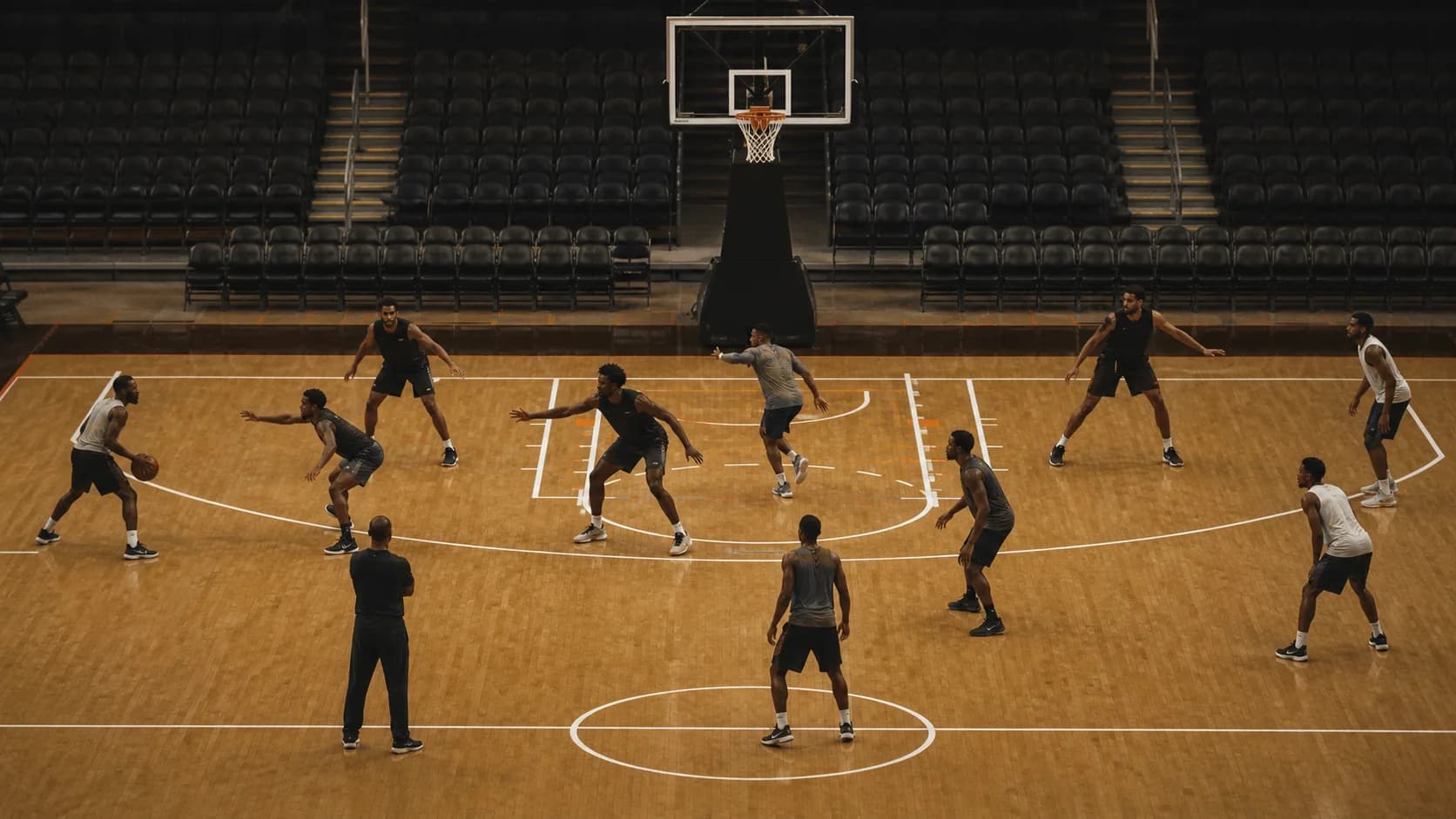
A scouting report is not installed when it is written. It is installed when players recognize the action at speed and make the right decision without waiting for the bench. The bridge from report to execution is a practice plan built around a few observable behaviors, not a longer meeting.
FIBA's practice-planning guidance starts with a goal, available resources, and a clear path through the session. Apply that discipline to opponent prep. The report supplies possibilities. Your practice plan selects what matters, sequences the teaching, and creates enough realistic decisions to make the response automatic.
Step 1: Cut the Report to Three Priorities
Choose exactly three items:
1. Primary defensive rule: the action you expect most often. 2. First counter: what the opponent does when that action is removed. 3. Offensive opportunity: the normal part of your offense that can attack its defense.
Example:
- Keep middle pick-and-roll on the sideline.
- When the guard rejects, the on-ball defender wins the race to the paint and the big shows early.
- On offense, involve their weakest communicator in a second action.
The rest of the report is not deleted. It remains a staff reference. But it should not compete with the opening plan for practice time or player attention.
Step 2: Convert Information Into Behavior
"They reject ball screens" is information. "Top foot above the screener, call the coverage before contact, sprint below the reject" is behavior.
For each priority, write three columns:
| See | Say | Do |
|---|---|---|
| What cue starts the decision? | What is the one-word call? | What footwork or rotation follows? |
If an item cannot be expressed as something players see, say, and do, it is not ready for practice. This test also exposes vague recommendations in the original report.
Step 3: Script the Scout Team
Do not tell five reserve players to "run their offense." Give them a four-line script:
- Alignment: where all five players begin.
- Trigger: the pass, entry, or cut that starts the action.
- First read: what the opponent wants if your team makes no adjustment.
- Counter: what the scout team does if your defense follows the new rule.
Run the action from both sides and with two personnel groups. The scout team does not need perfect imitation. It needs to recreate the geometry and decision chain that your starters will face.
The 90-Minute Opponent-Prep Practice
Minutes 0-10: movement prep with game cues
Warm up through the footwork the plan requires. If you are ICEing side ball screens, include hip turns, lateral retreat steps, and low-man closeout angles. Practice begins when players enter the gym, not when the first shell drill starts.
Minutes 10-22: five-on-zero recognition
Place the scout team in the opponent's alignment. Walk the defense through the first action and counter. Freeze at the decision point and make each player name the cue, call, and responsibility.
Keep this block short. Walkthrough establishes a map. It does not create the timing needed to use the map.
Minutes 22-38: guided advantage drill
Add a constrained offense and a live defense. The offense must begin with the scouted action but may choose its first counter. The defense wins the rep by recognizing and executing the rule, not merely by forcing a miss.
Score recognition separately from outcome:
- 1 point for the call before screen contact.
- 1 point for correct positioning at the decision.
- 1 point for finishing the possession with a rebound or turnover.
A contested make after correct execution is still useful work. An offensive miss after a blown coverage is not a defensive win.
Minutes 38-55: offensive opportunity
Run the action that attacks the opponent's weakest response. Use your own terminology and normal spacing. The goal is not to install a new offense for one game. It is to reach a familiar action against the matchup most likely to break.
Require a second-side decision so the offense does not become a memorized first pass. The opponent will adjust, and your players need to see the next advantage.
Minutes 55-70: live five-on-five with constraints
Give the scout team bonus points for the opponent's preferred outcomes. For example, a paint touch off a screen reject is worth three, a normal basket is worth two, and a late-clock bailout is worth one. The scoring system makes the defense protect the priority without constant coach interruption.
Switch lineups every three possessions. A game plan that only works with the starting five is not installed.
Minutes 70-82: special situations
Rehearse four predictable moments:
- The opponent's first after-timeout action.
- Its most common baseline inbound.
- Your response to pressure after a made basket.
- The late-clock coverage and rebound assignment.
Each situation gets two clean repetitions, then one live repetition where the scout team can counter.
Minutes 82-90: the six-possession test
No teaching between possessions. Run six live trips and grade the three priorities. Players should make the call, solve the first action, and handle the counter without a reset.
End by asking three players to state the plan in their own words. If the answers are long or different, the message is not yet clear.
The Day-Before Version
If the team practiced hard earlier in the week, keep the final prep shorter:
- 8 minutes recognition walkthrough.
- 10 minutes guided action and counter.
- 8 minutes offensive opportunity.
- 8 minutes special situations.
- 6 live possessions.
Reduce contact and volume, not decision quality.
What to Measure in the Game
Use one metric per priority. Track paint touches from the primary action, clean catches by the counter player, and advantages created through your target matchup. These are more diagnostic than the score because they tell you whether the plan is working even when shot variance is noisy.
Start with a first-draft read from the free Scout. Validate it, select three priorities, and build the practice around decisions your players can see, say, and do.