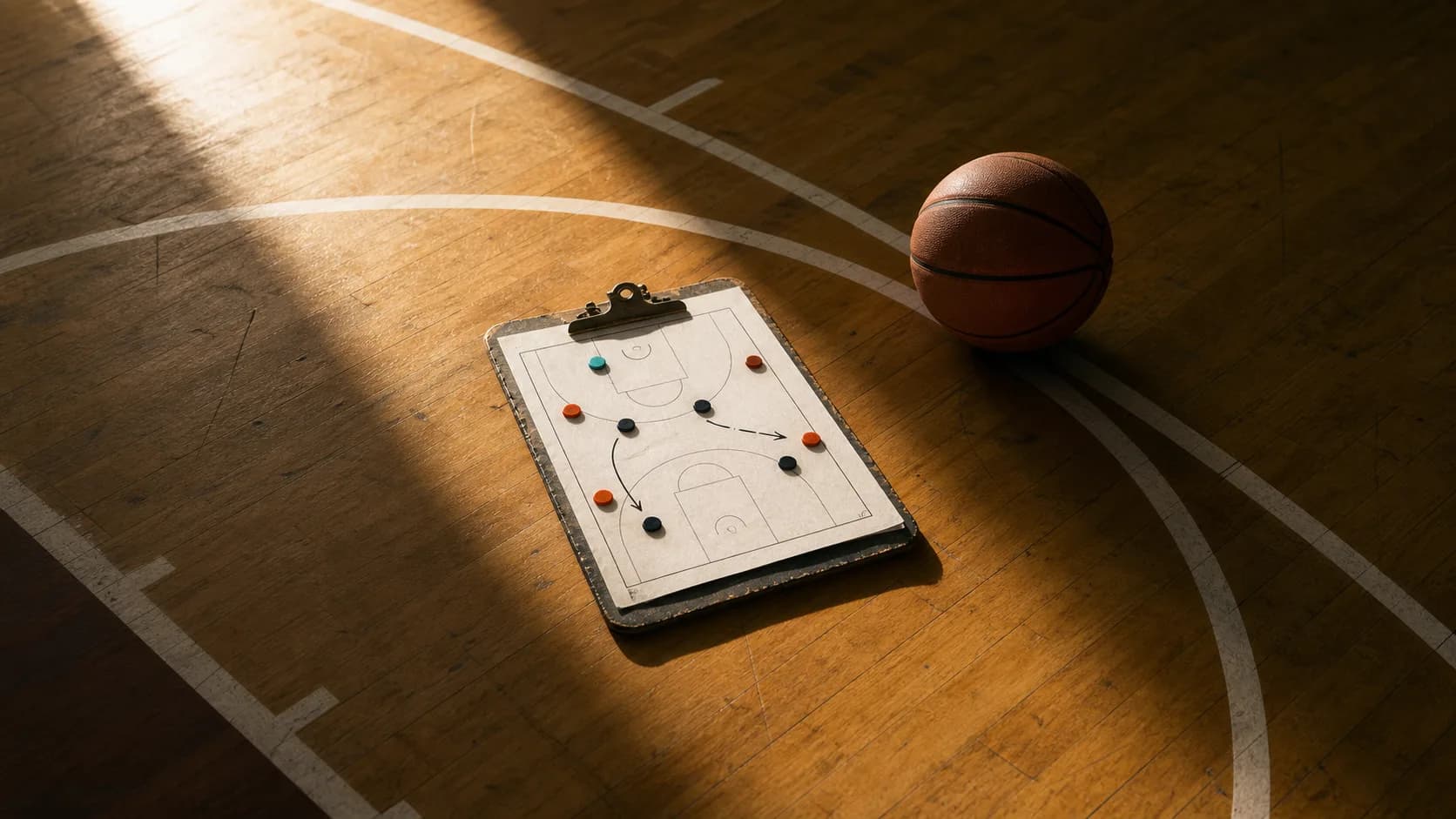
Most scouting advice is written for coaching staffs with editors and analytics departments. If you are a player, a co-coach, or a small staff, you need something leaner: a repeatable checklist that turns an hour of film into a usable game plan. This piece is that checklist, built for people who do not have a video coordinator. If you want the full report-building process, pair it with how to build a scouting report.
What is the fastest way to scout an opponent before a game?
The fastest reliable method is two recent games run against a five-question checklist. Do not try to chart everything. Instead, answer: what are their two most-run sets, who are their primary and secondary scorers, how do they guard the pick and roll, where do they turn the ball over, and who cannot shoot. Those five answers cover roughly 80 percent of what changes how you play them, and a single motivated player can gather them in under an hour.
Two games matter because one game is noise. If a team runs a specific after-timeout set once, that is a data point. If they run it in both games you watch, it is a tendency worth preparing for. Watch their most recent game plus one against a team stylistically similar to yours, and you will separate what they always do from what they did once. For a deeper method on the tendency side, see how to break down opponent tendencies.
What is the first thing you should write down?
Before any detail, answer four questions in four sentences: how do they want to score, how do they want to defend, what is their pace, and who takes the last shot. That identity paragraph is the frame every later note hangs off.
Do it first because it tells you what to look for. A team that runs and hunts threes needs a transition and closeout plan. A team that grinds clock and posts up needs a physicality and help plan. Name the identity and the rest of the scout organizes itself. If you cannot write the paragraph yet, keep watching until you can.
Who should you actually spend your time on?
Rank the rotation by how much each player can hurt you, then scout them proportionally. Your top three threats get real attention: the go-to scoring move, the situations they get the ball, and the clearest weakness you can attack. Everyone else gets one line.
The common mistake is spreading attention evenly across a roster, which buries the two or three players who decide the game. For each top threat, name one micro-behavior, a tell under pressure, a hand that drops, a spot they always drift to. Those small reads are what let your players anticipate instead of react.
What should be on a pre-game scouting checklist?
A complete checklist fits on one page and covers four buckets: personnel, tendencies, sets, and matchups. Personnel answers who you must stop and who you can safely help off. Tendencies capture strong hands and coverage habits. Sets are their go-to plays and after-timeout looks. Matchups decide how your defenders line up. Keep every line short enough to remember at game speed.
Here is the checklist in table form. Fill one out per opponent.
| Bucket | What to answer | Why it matters |
|---|---|---|
| Personnel | Who are the top 2 scorers? Who cannot shoot? | Tells you who to load up on and who to help off |
| Tendencies | Strong hand? PnR coverage? Turnover triggers? | Lets you script your first counter |
| Sets | Two most-run plays and their tell | You recognize the action before it develops |
| Matchups | Your best defender vs their best scorer | Decides your defensive assignments |
| Situational | After-timeout and late-clock go-to | Wins the two or three swing possessions |
How to fill the personnel and matchup rows
For personnel, rank their scorers and mark the non-shooters. If their center cannot shoot outside the paint, that is the defender you use to build a wall in the lane. For matchups, decide your assignments before tip: if your best on-ball defender takes their primary creator, who has the secondary scorer, and who has the shooter you cannot leave. Getting this settled early prevents the scramble that leads to blown coverages, and it ties directly into how to exploit a matchup.
A worked example: scouting one opponent's guard
Say you are prepping for a team whose engine is a downhill lead guard. You watch two games and chart just their pick-and-roll possessions. You find three things: the guard drives right on roughly two of every three ball screens, they rarely pass out of the paint once they turn the corner, and their center only screens and rolls, never pops.
Your plan writes itself. First, force the guard left by shading your on-ball defender to their strong hand and going over the top of screens on the right side. Second, because they do not kick out of the paint, your help defender can commit harder at the rim without fear of the skip pass. Third, since the center only rolls, your big can sit in a deep drop and wall up the paint rather than worrying about a pick-and-pop. Three reads, all pulled from two games of one action. That is the entire value of scouting: turning their habits into your advantages before the ball is tipped.
Where do you attack them?
The checklist above is mostly defensive. Flip it and find two pressure points on the other end. The usual ones:
- A team that does not get back, attack in transition before their defense sets
- A big who cannot guard in space, drag him into ball-screens and make him move
- A guard who dribbles into trouble, pressure the ball and force early decisions
- A poor closeout team, move the ball side to side and make them chase
You do not need ten ways to attack. You need two your team can execute under pressure, and they should fit your personnel rather than look good on paper.
What if you only have an hour?
Triage in this order:
1. Watch one recent full game (35 minutes) 2. Write the identity paragraph (5 minutes) 3. Note the top two threats and one weakness each (10 minutes) 4. Pick two pressure points and one coverage rule (10 minutes)
That is not a complete scout, but it hits the things that decide games and it beats showing up cold.
How do you turn a scouting report into a game plan?
Compress the whole report into three or four rules the entire team can repeat from memory. A scouting document that lives on paper does nothing; a game plan that survives the fourth quarter is three sentences everyone knows. From the example above, the rules become: force the guard left, wall up the paint, and let the drop big sit. Post those where players see them before tip, and review them at every timeout.
The discipline of narrowing a full report to a few rules is exactly what separates prepared teams from teams that scouted but could not use it. If you want a scouting-grade breakdown of a specific opponent or player without spending your evening on film, pull a report with HoopBrief and get their tendencies, personnel notes, and go-to sets in one place.