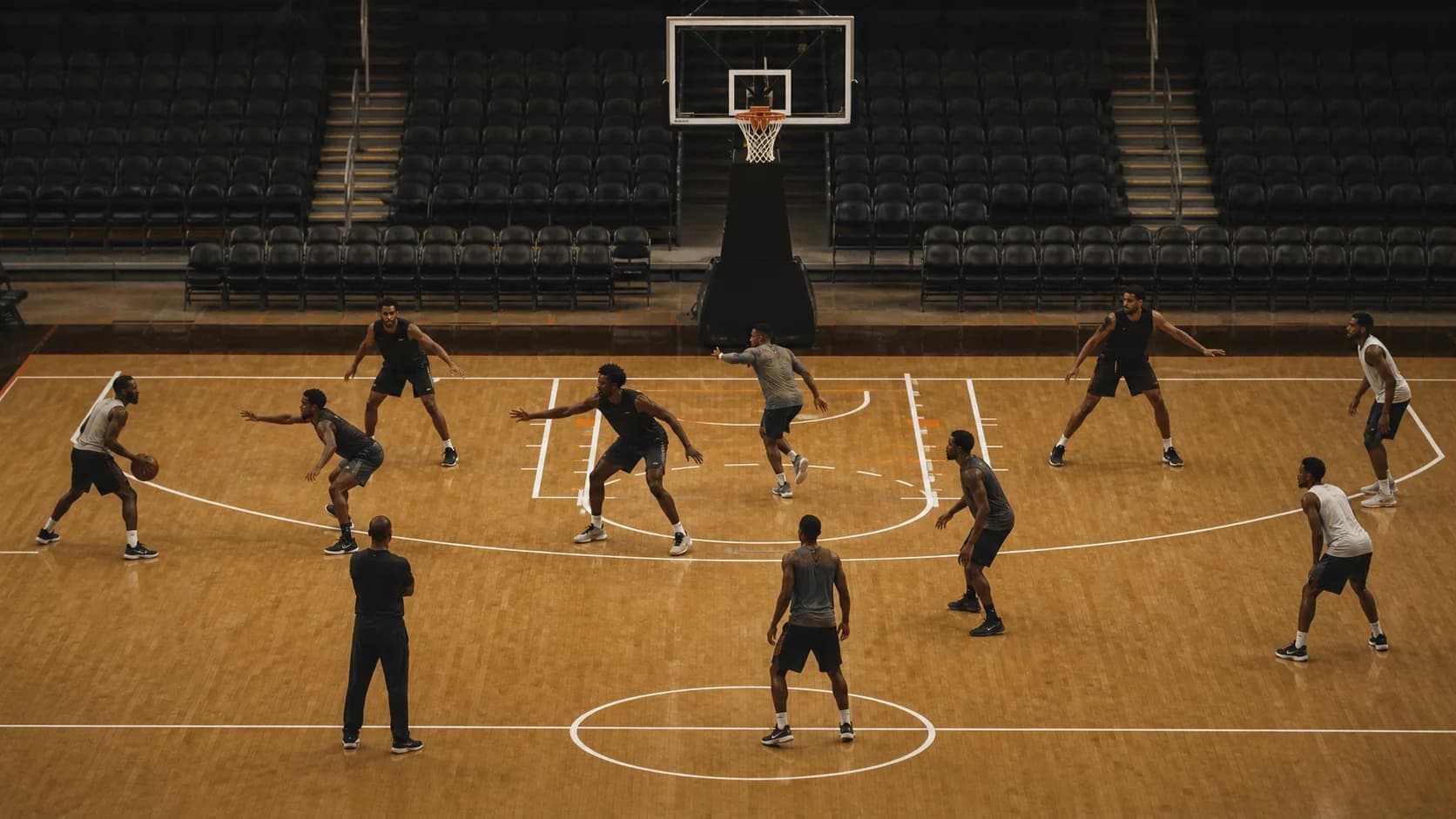
Free agency opens June 30 at 6:00 PM Eastern. The next 48 hours will produce the headlines that define half the league's 2026-27 season. Most coverage will tell you who's available and what they'll get paid. This piece tells you where each top free agent actually fits, based on scheme, lineup math, and what each team's roster needs.
The honest truth about free agency: the biggest contracts go to the best names, not the best fits. Every championship roster in the last decade was built on connectors, not headlines. This is the coaching-lens fit analysis for the 2026 class.
The 4-Lens Fit Framework
Every free agent gets evaluated through four fit lenses:
- Scheme fit: does the player's strength match what the team's coach already runs?
- Lineup math: does the player's usage rate fit the team's existing usage distribution?
- Defensive versatility: can the player switch on the modern NBA's required position range?
- Cultural fit: do the player's habits match the team's locker-room norms?
A free agent who hits 4/4 lenses is a championship-level signing. 3/4 is a strong starter. 2/4 is a calculated risk. 1/4 or 0/4 is a contract the team regrets within 18 months.
The 4 Free Agent Archetypes in 2026
Without naming specific players (most reporting in the 48 hours before moratorium is speculative), the four archetypes in this year's class:
Archetype 1: The Aging Star
A player coming off an All-NBA or near-All-NBA season at age 32-35, available because their previous team can't afford the max anymore. Most teams chase these names.
The fit question: does the team have a championship window NOW, or are they paying premium for a name to anchor a non-contender?
Best fit: a true contender adding the last piece. Worst fit: a rebuilding team using the signing to "speed up" their timeline (rarely works).
Archetype 2: The Connector
A 6'5"-6'9" wing or 6'10" big who shoots 35%+ from three, defends multiple positions, and doesn't need usage. Often signs for $15-25M/year, significantly below max.
The fit question: does the team have 1-2 stars who need their offense made more efficient?
Best fit: a one-or-two-star contender. Worst fit: a team that needs a primary creator and signs the connector hoping they'll grow into the role.
Archetype 3: The Bounce-Back
A player coming off a down year, injury, scheme mismatch, or coaching conflict, who can be signed below market. Risky.
The fit question: what specifically went wrong in the down year, and does the new team solve that?
Best fit: a team whose specific scheme matches the player's known strength. Worst fit: a team that's hoping vibes change.
Archetype 4: The Specialist
Elite at one thing (corner three, switch defense, rim protection, secondary playmaking). Signs in the mid-level exception range.
The fit question: does the team's playoff rotation have a specific hole this player fills?
Best fit: a contender with a roster gap. Worst fit: a team that signs the specialist as a 6th-man scorer instead of a tactical piece.
The Lineup Math That Drives Every Fit
Most fans evaluate free agency by adding the star's stat line to the team. Front offices evaluate by lineup math: what's the team's projected net rating with the new player on the floor?
The key inputs:
- Usage distribution. If the team's lead handler already uses 32%, adding a 30% usage free agent produces a usage crisis. Both stars produce worse efficiency than they would in isolation.
- Spacing math. Adding a non-shooter shrinks the floor; adding a stretch-five expands it. The PPP impact is measurable.
- Defensive switchability. A signing that turns the lineup from 3-switchable to 5-switchable adds 2-4 points of net rating.
- Closing-lineup fit. Does the player play in the final 6 minutes of a playoff game? If no, the contract is overpaid.
For the broader roster-construction framework, see how the Knicks built a championship roster (2024-2026).
Want NBA-staff-grade free agency fit analysis on every signing? Start a HoopBrief plan at $9.99/month, every free agent graded across the 12 lenses with team-fit projections updated daily through July.
The Signings That Will Look Smart in 3 Years
Three patterns historically produce the highest-ROI free-agency signings:
- Sub-max connectors who fit two-star rosters. The "$18M/year stretch-four with switchable defense" archetype routinely outperforms the $35M/year name signing on the same team.
- Below-market bounce-back signings with clear scheme match. Often produce All-NBA-adjacent seasons on $10-15M/year deals.
- The 9th rotation player who unlocks a 5-out lineup. Sounds boring; produces 2-3 points of playoff net rating swing.
The Signings That Will Look Bad in 3 Years
Three patterns that produce regret:
- Maxing the aging star to anchor a non-contender. The contract becomes immovable when the star ages.
- Duplicate signings, signing a 28% usage scorer when you already have a 32% usage scorer.
- Cultural mismatches, signing a player whose locker-room reputation conflicts with the team's norms.
What to Watch in the First 48 Hours
Three things that reveal more than the actual signings:
- Which contenders sign first. Teams that move fast usually had a plan; teams that wait are reacting to the market.
- Which executives offer max contracts. Pay attention to who pays the premium. The teams that consistently overpay for names (without scheme fit) compound the problem year over year.
- Which players take below-market deals to play for a specific coach. Highest signal in the entire free-agency window. Players who do this are usually telling you something about which coach they think wins championships.
Want a daily fit tracker through the entire 2026 free-agency window? HoopBrief subscriber reports drop a free-agency fit analysis every day from June 30 through July 15, with NBA-staff-grade lineup math on every signing.
Where to Go Next
Roster construction case study: how the Knicks built a championship roster (2024-2026).
Draft and offseason context: NBA Draft 2026 final mock + team fits, NBA Summer League 2026 preview.
Coaching framework: what coaches look for in matchup prep, how NBA coaches prepare for playoffs.
Hub: Playoff Prep Hub.