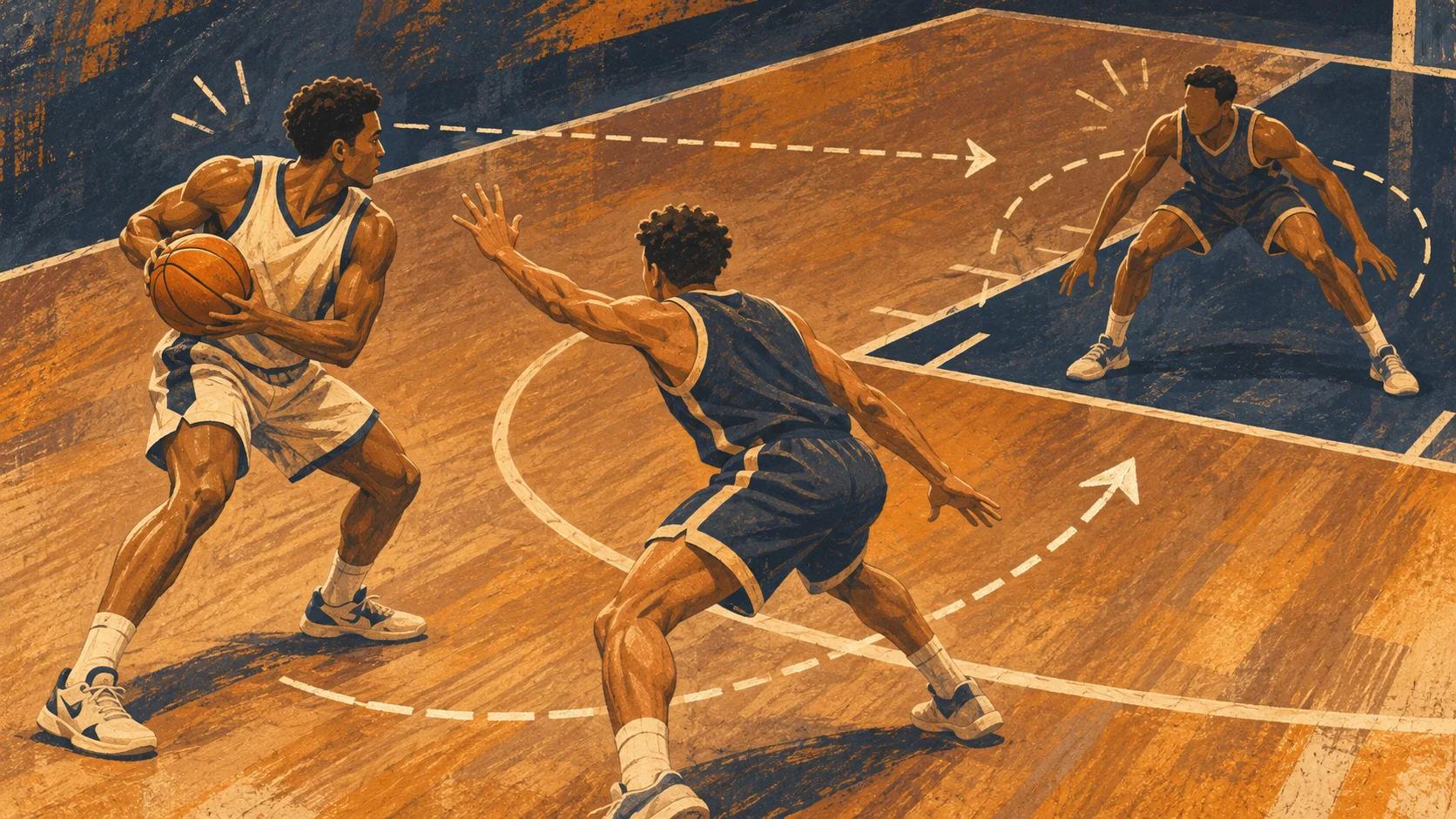
A closeout is the defender's recovery toward a player receiving the ball. The nearest defender determines the first opening. The next defender often determines whether that opening produces a useful shot, pass or drive. Study both before choosing a move to practice.
Use this question on your next NBA film session: If the receiver beats the closeout, who meets the next dribble? It turns a highlight into a sequence of decisions you can examine.
Freeze before the catch
Record where the receiver starts and how the pass travels. A long skip pass may give the defender time to recover. A quick reversal may arrive while the defender is still moving away. Neither situation should be reduced to the same instruction to “attack the closeout.”
Look at the receiver's balance. Are the feet ready to shoot? Does the pass arrive above the waist, low, or behind the player? A poor catch can erase an advantage that existed when the pass was released.
Then identify the nearest defender's direction, distance and momentum. A defender running past the receiver creates a different problem from one arriving under control. Describe what you see before naming the move you want to copy.
Find the next body in the lane
Move your attention to the paint. Which defender can reach a straight-line drive? Is that defender guarding a cutter, roller, corner player or another offensive threat? Where would the next pass go if help arrived?
Do not assume the baseline is open because the nearest defender's top foot points toward the middle. A teammate may occupy that lane. Another defender may be waiting below the ball. The drive must fit the whole possession, not just a one-on-one picture.
Use a simple study table:
| Pause point | Observation | Decision to investigate |
|---|---|---|
| Before catch | Defender recovering from help | Shoot or prepare to attack? |
| First dribble | Second defender's starting position | Continue, stop or move the ball? |
| Help commits | Teammate left by the helper | Is the pass available now? |
| Advantage changes | Rotation closes the first option | Can the next teammate act? |
These are questions, not a universal sequence. Some possessions require a quick shot. Others require a pass before the first dribble.
Predict before you watch the outcome
Pause on the catch and name one action you expect. Resume only far enough to see the first help movement. Pause again and predict the next pass or finish. This keeps the made shot from making every preceding choice look correct.
When your prediction differs from the player, inspect the missing information. You may have missed the clock, a teammate's cut or the defender's recovery angle. The NBA player's choice is evidence to study, not automatic proof that your first interpretation was wrong.
Write a reason rather than a verdict. “The receiver moved the ball before the helper recovered” is an explanation. “High IQ play” names a judgment without showing the cue.
Translate the read into a workout
Begin with a receiver, a closing defender and one helper. Define the allowed spacing with your coach. Let the helper stay attached or step toward the lane. The receiver identifies that movement and selects an action.
Grade the catch, recognition and execution separately. If the receiver sees the pass but cannot deliver it, practice the delivery. If the player never locates the helper, simplify the repetition until that cue is visible.
Add a second rotation only when the athlete can explain the first choice consistently. Avoid reproducing an NBA finishing attempt that exceeds the athlete's current control or conflicts with team instructions. The transferable skill is recognizing the next defender.
Prepare a targeted HoopBrief question
Run a supported NBA example through the free scout. Use its tendencies as questions to inspect, not proof that every closeout has the same answer. A useful Ask prompt is: “Explain how a wing can read the second defender after a closeout. Give one film-study checklist and one guided practice constraint.”
Add your role and the team's spacing when adapting the explanation. HoopBrief does not analyze your private workout footage merely because you describe a player. Its methodology explains the NBA grounding and limitations.
Review the current plans when you have a repeated study task the tool helps you complete. A report is useful when it changes what you observe and practice, not simply when it describes an impressive NBA player.
Should I always drive a hard closeout? No. The shot, clock, help and passing options matter. A hard closeout creates information to read, not a command to dribble.
How do I grade a good decision that ends in a miss? Record the decision evidence separately from shot execution. Repeated sound decisions and repeated execution problems require different work.
Basis for the teaching framework
The FIBA WABC Level 2 manual discusses coordinated team help behind ball screens. The worksheet and practice progression here are HoopBrief editorial exercises, not a claim that FIBA endorses this report or a universal coverage.