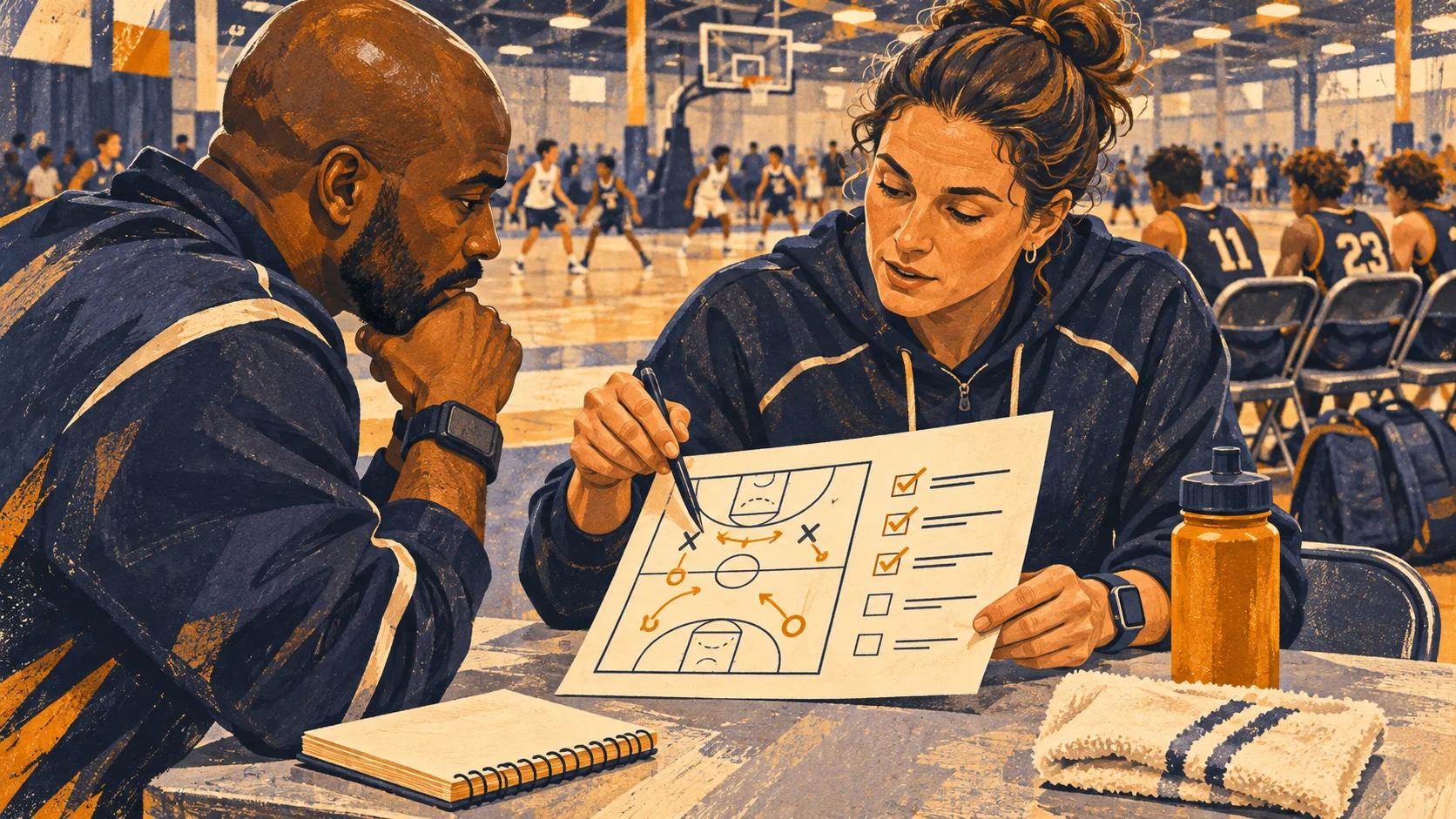
Between tournament games, a small staff needs a short handoff that players can use immediately. Start with verified opponent observations, three assignments and the questions still open. Do not let a long report consume the time needed to teach the plan.
The workflow below is for organizing preparation. It does not assume HoopBrief has a database of your AAU opponents or knows their current roster. Your staff supplies that evidence.
Give each note an owner and a timestamp
Record who watched the opponent, which game they watched and whether the rotation appeared complete. A secondhand remark and a directly observed possession should not look identical in the handoff.
Use role descriptions when a player's identity is uncertain. “Primary ball handler in the game we watched” is safer than attaching a name from an outdated roster. If the opponent changes uniforms or jersey numbers, verify identity before presenting individual instructions.
Keep the original notes separate from the final player-facing page. The staff may need the detail later, but the players need the current assignment.
Deliver one page in four blocks
| Block | Include | Leave for staff review |
|---|---|---|
| What we saw | A few repeated actions with clip or possession references | Unsupported season-wide claims |
| Our three jobs | Clear transition, half-court and rebounding responsibilities | Every possible counter |
| Early questions | Two things to learn in the opening possessions | Vague requests to watch everything |
| If the first plan fails | A staff-approved adjustment trigger | Unrehearsed coverage vocabulary |
A hypothetical assignment might be: “On the shot, identify a body before pursuing the rebound.” The actual assignment should match your coach's system and what your team can execute.
Run a brief staff readback
Ask the assistant to explain the plan aloud without reading the entire page. If the assignment needs several qualifiers to avoid confusion, simplify it. Then ask who will watch each early question.
Check for contradictory instructions. A defender cannot stay attached to a corner shooter and be the primary rim helper at the same moment unless the staff has defined the rotation that replaces them. A good handoff makes that replacement explicit.
Also check whether the opponent observation justifies the instruction. One successful press break does not establish that the opponent always uses the same alignment. Label the starting plan and name the cue that would make you change it.
Teach with a walk-through when space permits
Use the team's available preparation time and follow event rules. If a safe court or warm-up area is available, walk through the first action and the response. If it is not, use a simple sketch and ask players to describe their assignments.
The readback matters more than the page length. Ask one player where the first helper comes from and another who replaces that helper. A nod does not prove the assignment is understood.
Avoid introducing an unfamiliar scheme between games unless the coach decides the team can execute it. A smaller plan built on existing rules can be easier to communicate than a detailed new coverage.
Keep an adjustment log during the game
Write the trigger, the decision and the observed response. “Switched after two possessions with the same entry” is more useful than “went small.” Preserve the uncertainty when the score or opponent lineup changes at the same time.
After the game, carry forward only what still applies. A player who missed the earlier game may change the next matchup. A tournament opponent's fatigue or foul trouble can also make one sample unrepresentative.
The handoff for game two should not silently become a season-long scouting record. Keep the date and game context attached.
Where HoopBrief fits
Use HoopBrief Ask to organize your supplied observations: “These notes come from one AAU game. Produce a one-page handoff with observations, three assignments, two early questions and a staff review section. Mark every unverified inference.” Review the output before giving it to players.
Use the free NBA scout to evaluate the report format on supported players. Do not assume a local opponent is covered by the product's NBA data. Read the methodology and keep the staff's own evidence attached to the plan.
If saved reports and repeated follow-up questions would help your workflow, compare the current plans. Do not assume shared team workspaces or exports exist unless the current plan explicitly includes them. A saved report is useful only when the people using it can find and interpret the current version.
Close the loop after the weekend
Keep three notes: which assignment was understood, which observation was wrong, and which question the staff should investigate next. This builds a better preparation process without pretending every result was caused by the scout.
Can AI replace watching the opponent? No. It can help structure supplied notes, but a plausible description is not verified opponent evidence.
How much should players receive? Enough to act reliably within your team's system. Use readback and a brief rehearsal to decide whether the handoff is clear; a fixed page count alone does not prove that.