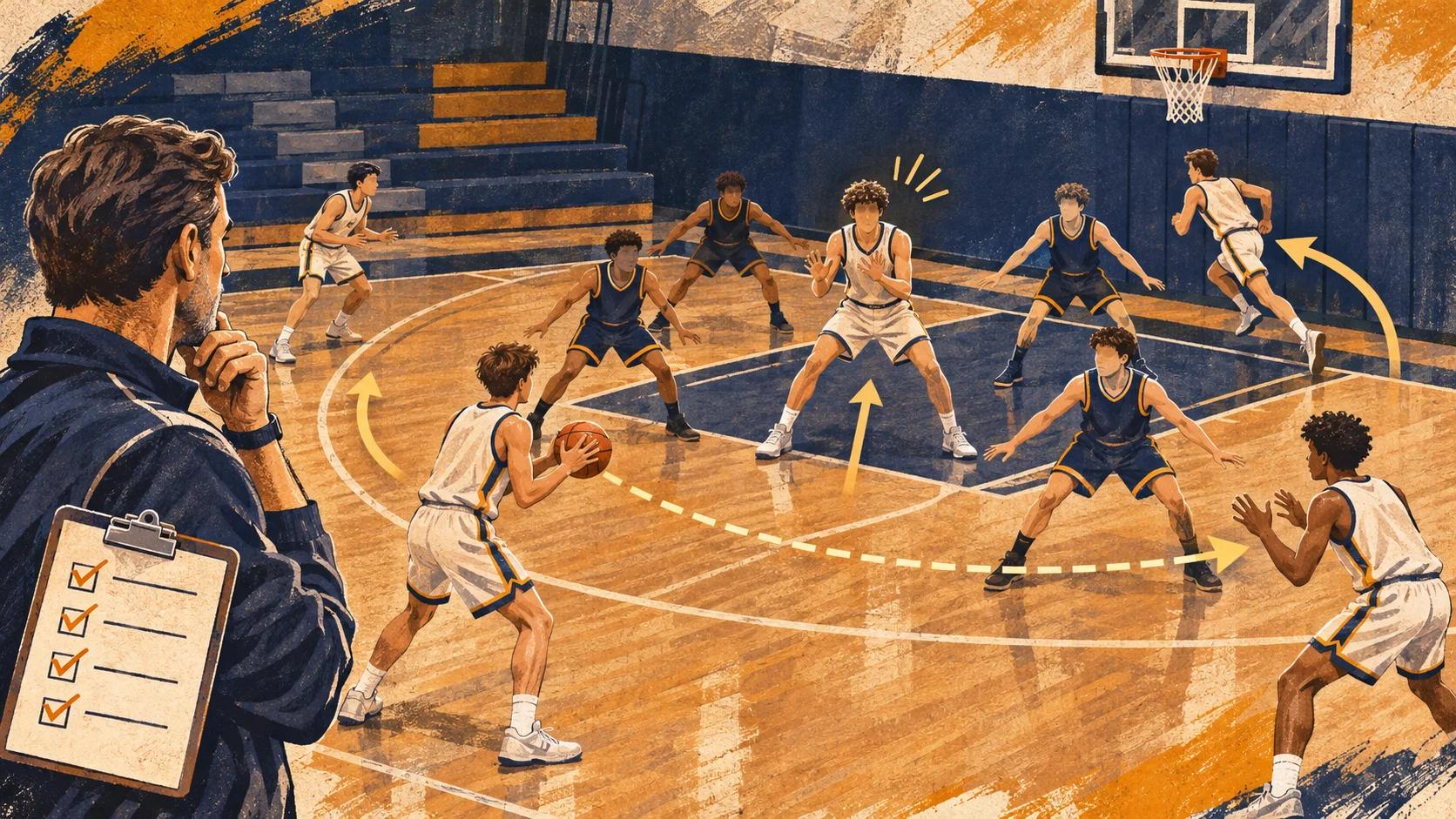
To scout an offense against a zone, track how it moves defenders before the shot. Record where it enters the ball, which player occupies the middle, how it uses the baseline and what happens after a reversal. The shot result is the final event, not the whole explanation.
This checklist helps a high-school staff organize observed possessions. It does not assume one zone alignment or one offensive response is best for every roster. Use your team's terminology and verify the opponent's actual actions.
Identify the defense you are watching
Before evaluating the offense, describe the zone's initial shape and how it changes when the ball moves. A nominal two-three alignment can shift its responsibilities by location. A matchup zone can follow cutters in ways that resemble individual assignments.
If the recording does not make the responsibilities clear, mark the uncertainty. Do not build an opponent tendency around a defensive label you have not verified. The offense may be responding to a different problem than you think.
Also record the available context: date, opponent, lineup and visible clock. Late-clock possessions and out-of-bounds plays may use different priorities from the normal half-court offense.
Log the entry and the first displacement
Write where the ball enters and which defender moves first. A wing pass may pull a top defender outward. A middle catch may turn a back-line defender toward the ball. The useful question is what space that movement creates.
Keep the possession intact through the next pass. If you stop at the first open catch, you may miss the defense recovering before the offense acts. Timing can explain why a promising alignment produces no advantage.
Use this sheet:
| Possession feature | Observation to record | Follow-up question |
|---|---|---|
| Entry | Ball location and receiving player | Which defender leaves the original spot? |
| Middle occupation | Catch, screen or movement through the gap | Does the defense collapse or pass the player on? |
| Baseline action | Short corner, cutter or screening activity | Who covers behind the first rotation? |
| Reversal | Number and speed of passes across the floor | Does the offense attack before recovery? |
| Shot and rebound | Location, contest and rebounding positions | Was the advantage preserved to the end? |
Do not infer a frequency from selected highlights. Count the possessions you can follow and state the limits of that sample.
Distinguish an open gap from a usable catch
A player standing between defenders may look available from the camera angle. The passer still needs a lane, and the receiver needs balance and awareness. A slow delivery can let the defenders close the gap.
Grade the entry pass separately from the next decision. A receiver who catches facing away from the basket may need a different practice task from one who catches ready but misses the next pass. “Use the middle” is too vague to identify either problem.
Look for movement that creates the catch, not just a static spot on a diagram. A cut after a reversal or a screen that delays a defender may be the actual source of the opening.
Build the defensive plan around responsibilities
If your team will play a zone, choose the opponent actions you need to rehearse. Define who addresses the middle catch, who takes the baseline threat and who rebounds when the ball reaches a corner.
Check the replacement rotation whenever a defender leaves an assignment. One player cannot protect two separated threats indefinitely. A staff-approved rotation should explain how teammates share that problem.
If your team will attack a zone, use the same observations to identify one decision to practice. Do not copy an entire opponent set without considering your players' passing, shooting and spacing.
Rehearse the possession, then review the cue
Walk through the entry and the first rotation before adding live choices. Ask the offense to choose between the middle catch and a reversal. Defenders explain the cue that determines their responsibility.
Then let the possession continue through a shot and rebound. A plan that looks sound until the shot goes up may still fail to assign the rebound. Keep that final responsibility in the review.
Record whether the players recognized the cue, communicated and executed. A made or missed shot alone cannot tell you which part of the repetition worked.
Turn notes into a focused HoopBrief task
Bring observations to HoopBrief Ask: “These notes come from our high-school opponent against a zone. Organize the entry, middle, baseline, reversal and rebounding actions. Separate what we saw from possible counters, and give us three responsibilities to review.”
Do not assume HoopBrief has your opponent's film or private statistics. Its NBA grounding can support an NBA teaching example, which you can try with the free scout. Read the methodology, then check the output against your own evidence and team system.
Compare the current plans only when the report workflow solves a recurring preparation task. The report should help the staff teach a clearer assignment; it cannot verify an observation the staff never made.
Is a middle catch always the best answer to a zone? No. Passing lanes, defenders, clock and personnel matter. The checklist helps you observe those conditions.
Can one game establish the opponent's zone-offense tendencies? It can provide examples and questions. Label the sample and keep broader frequency claims provisional until supported by more evidence.