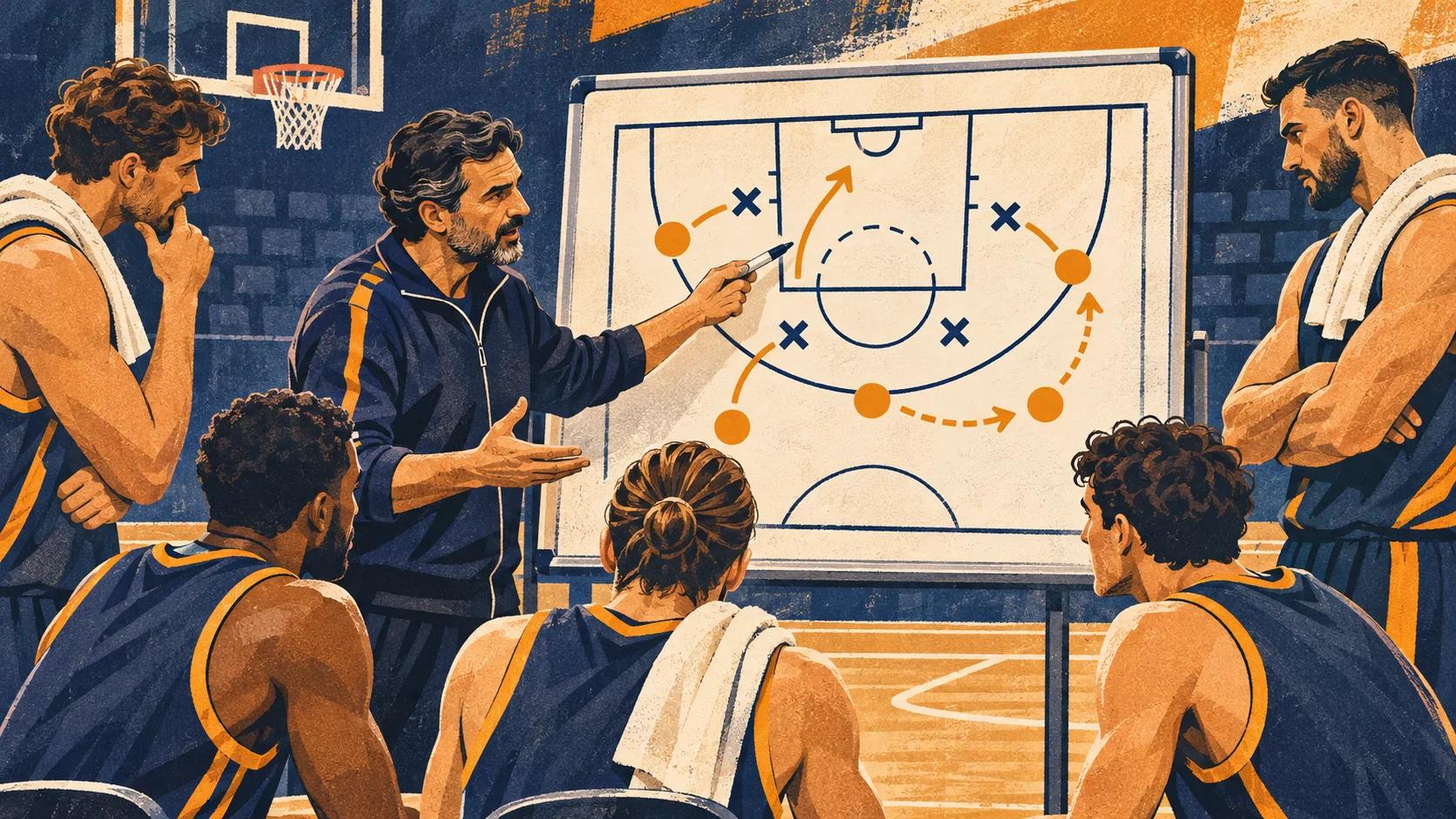
A coverage name is shorthand for a set of defensive jobs. It is useful only when the players agree on those jobs. In an international basketball setting, the same word may carry different details across coaches, languages and teams.
Start with the action you observed, then define the assignments. Ask where the on-ball defender goes, where the screener's defender meets the ball, and who protects the next pass. This guide explains common starting meanings; your staff's definitions take priority in practice.
Describe before you label
Watch the possession from before the screen. A defender recovering late can resemble a deliberate switch. A big retreating after a brief show can resemble a drop if you watch only the final frames. The label should summarize the sequence, not replace it.
Write a plain sentence first: “The big steps toward the ball above the screen, then returns to the roller while the guard recovers.” Your staff can then decide which term it uses for that response.
Keep the clip or possession reference beside the sentence. If another coach disagrees, you can review the same sequence rather than arguing from different memories.
Common coverage words and the questions they leave open
| Term | Common starting meaning | Assignment to clarify |
|---|---|---|
| Drop | Screener's defender stays below the screen to contain the lane | How high, and who contests the pull-up? |
| Switch | Defenders exchange the two offensive assignments | When does the exchange occur, and what happens on a slip? |
| Show or hedge | Screener's defender steps toward the ball before recovering | What triggers recovery, and who covers the roll temporarily? |
| Blitz or trap | Two defenders pressure the ball handler | Who handles the short roll and next pass? |
| Under | On-ball defender travels below the screen | What happens if the screener changes angle or re-screens? |
| ICE or down | Commonly used to deny a side screen and direct the ball away from it | What is the exact foot position and help plan in this system? |
These descriptions are not a complete defensive playbook. Staffs can use different names or alter the details by location, personnel and clock. Never assume the word alone gives a teammate every required instruction.
Define the help behind the coverage
A ball-screen scout is incomplete if it names only the first two defenders. Locate the low helper and the defender responsible for the next rotation. Explain which offensive player each defender leaves and who replaces them.
For example, pressure on the ball can create a receiving opportunity behind it. The short roller's catch forces the remaining defenders to make choices. A useful scout identifies those choices rather than stopping at “they blitz.”
Use role labels that survive a lineup change: on-ball defender, screener's defender, low helper and next rotating defender. Add individual names only after verifying the identities and assignments in the evidence you have.
Build a shared glossary for your team
Create three columns: staff term, plain-language job, and a clip demonstrating the job. Ask players to explain the job without repeating the term. If they cannot, add a walk-through or simplify the wording.
For a multilingual group, agree on the short call used on court and teach the longer explanation off court. The goal is reliable communication under pressure, not a perfect translation of every coaching phrase.
Keep different coverage variations separate. If the same word sometimes means a brief show and sometimes means sustained pressure, name the trigger that distinguishes them. Otherwise players may execute different plans while believing they made the same call.
Check the next action
An offense can reject, slip, re-screen or move the ball before the expected contact. Your glossary should include the response to those changes if they are relevant to your team's system.
Ask the staff to identify one failure condition for each coverage: an open roll, a mismatch the roster cannot handle, or a pass that bypasses pressure. Then define the adjustment cue. That makes the glossary useful during a game instead of merely descriptive.
Do not claim a current European opponent uses a coverage consistently from a single example. Attach dates, available games and uncertainty to any tendency statement.
Use HoopBrief to clarify, then verify
A useful HoopBrief Ask prompt is: “Our staff uses show to mean the big briefly meets the ball and returns to the roller. Explain the other three defenders' responsibilities as questions we must settle. Do not assume a particular opponent's system.”
Evaluate the format first with a supported player pairing in the free NBA scout. HoopBrief's NBA data does not establish a European club's current terminology or coverage frequency. Read the methodology and test any explanation against your staff's film and instructions.
If recurring report preparation is useful, compare the current plans. The value is a clearer assignment and a better follow-up question, not a guarantee that a label will solve the possession.
Are hedge and show always the same? No. Coaches may use them differently. Define the defender's route, duration and recovery trigger.
Can I copy a professional team's calls? You can study the concepts, but adapt them to your roster and coaching system. A call without shared assignments is incomplete communication.
Basis for the teaching framework
The FIBA WABC Level 2 manual discusses coordinated team help behind ball screens. The worksheet and practice progression here are HoopBrief editorial exercises, not a claim that FIBA endorses this report or a universal coverage.