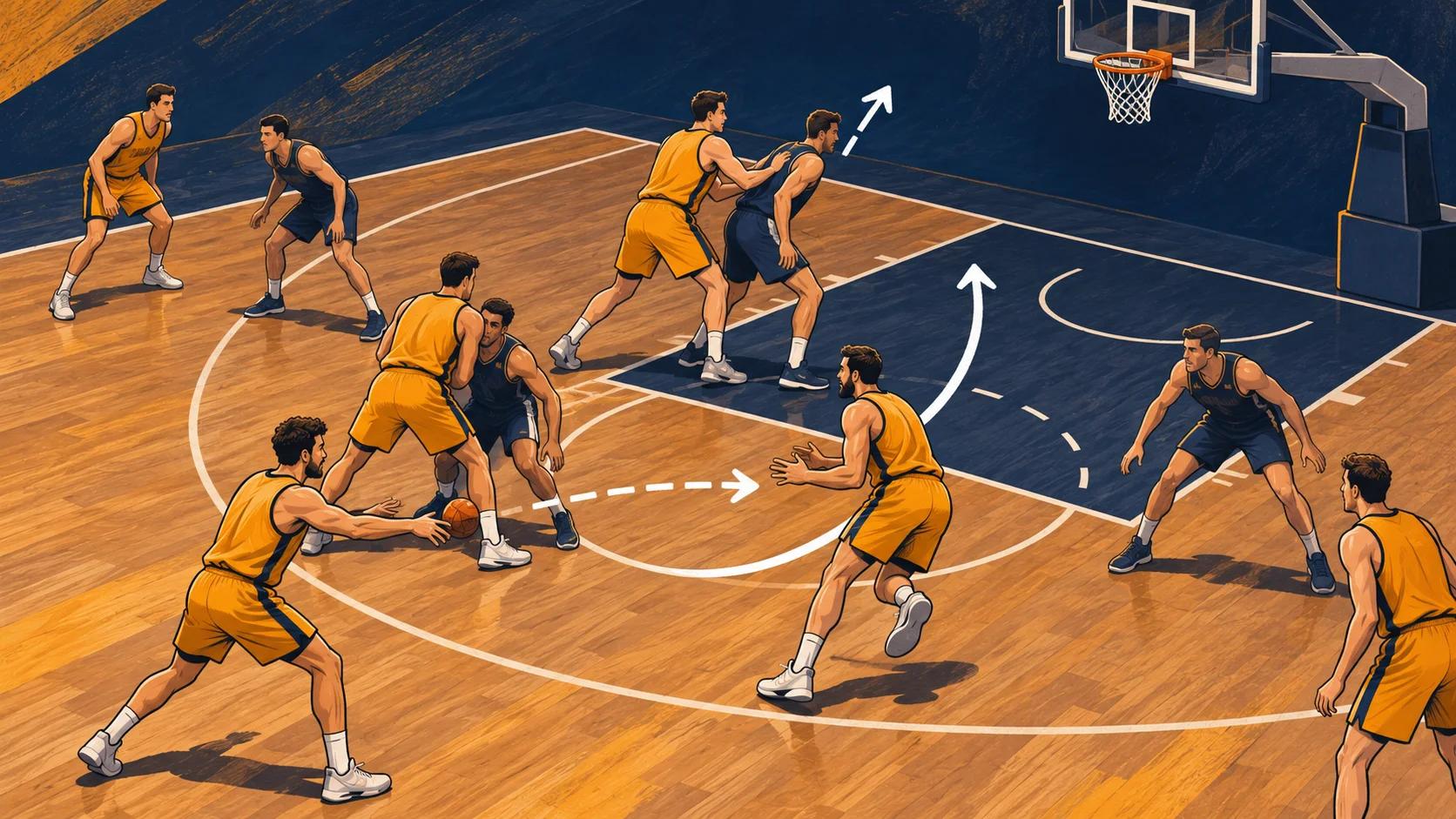
A Spain pick and roll adds a back screen to a ball screen. One offensive player screens the ball handler's defender, then rolls toward the basket. A third offensive player screens the roller's defender from behind and often moves back toward the perimeter. The defense must account for the ball, roll and perimeter release in a short sequence.
Use the name as a starting point. Your scout should explain who sets the back screen, when it arrives, and where that player goes next. Without those details, “watch Spain” is an incomplete assignment.
Identify the action from the start
Watch the possession before the ball screen arrives. The back screener may begin near the baseline, at the elbow, or higher on the floor. Track that player rather than following only the ball. A defender who sees the setup early can communicate before the big is screened.
Record the order of events: initial screen, roll, back screen, release. Some teams alter the timing or slip an expected screen. Do not label a slip as an execution mistake simply because it differs from the first clip you saw.
This is a useful study subject for European basketball, but the action also appears elsewhere. This guide does not claim that any particular current European team runs it at a measured frequency.
Fill in an assignment sheet
| Question | What to record | Why it changes the decision |
|---|---|---|
| Who handles the ball? | Driving direction and passing windows observed | The coverage must contain the first threat |
| Who rolls? | Roll path and contact timing | A fast slip can arrive before the back screen |
| Who back screens? | Starting spot, angle, next destination | The defender needs a recovery plan |
| Where are the other two players? | Corner or lifted spacing | Help may expose a second pass |
| What happens after the first denial? | Re-screen, reversal, or isolation | The scout needs a second action |
Write observations separately from proposed responses. “The back screener lifted to the top on these three clips” is an observation. “We should exchange assignments” is a proposal to review with your staff.
Compare coverages by their responsibilities
A switching solution needs a clear exchange between the defenders involved. It also needs an answer for a slip, a size mismatch, and a shooter leaving the screen early. “Switch everything” is too vague unless your players know which exchange happens first.
A non-switching solution still needs early communication. The back screener's defender may help the big recognize and avoid contact, then recover. The big and on-ball defender retain their own ball-screen responsibilities. Those responsibilities depend on your team's system; do not import an isolated instruction that contradicts it.
For each option, write one sentence for each defender. If one player receives two simultaneous jobs that cannot both be completed, revise the plan before practice.
Rehearse the counter, not just the opening
Start with a guided repetition at a speed where everyone can recognize the back screen. Then let the offense choose whether the back screener releases early or holds the screen. Add a slip only after the defense can communicate the base sequence.
Stop the repetition when an assignment is unclear. Ask the defender to identify the cue they saw and the teammate they expected to respond. That discussion distinguishes a missed call from a coverage that has no answer.
Judge the possession before the shot result. A contested miss can hide a missed roller; an open shot can be missed even after the offense wins the possession. Grade the assignments, then the execution.
Turn film notes into a HoopBrief question
A useful prompt names the observed action and your available coverage: “We defend ball screens with the big below the screen. On these clips, the third player back screens the big and lifts to the top. Explain the responsibilities we need to clarify, and give us a practice progression.”
Use HoopBrief Ask for that focused explanation when your plan provides access. Use the free NBA scout to evaluate the product with a supported NBA example first. HoopBrief's NBA statistical grounding does not verify a European opponent's playbook. Supply your own film observations, read the methodology, and check the response with your staff.
A report earns its place in preparation when it helps you communicate a specific assignment. Compare the current plans only after you can identify the recurring task it would help you complete.
Quick review
Is Spain pick and roll a separate offense? It is an action within an offense. Its value depends on timing, personnel, spacing and the subsequent reads.
Should we always switch the back screen? No universal coverage fits every roster. Decide the assignments, test the slips and releases, and use the system your staff can teach reliably.
Can an AI report confirm what a European opponent runs? Only evidence from that opponent can establish the tendency. Use AI to organize observations and questions; do not treat a plausible explanation as verified opponent data.
Basis for the teaching framework
The FIBA WABC Level 2 manual discusses coordinated team help behind ball screens. The worksheet and practice progression here are HoopBrief editorial exercises, not a claim that FIBA endorses this report or a universal coverage.