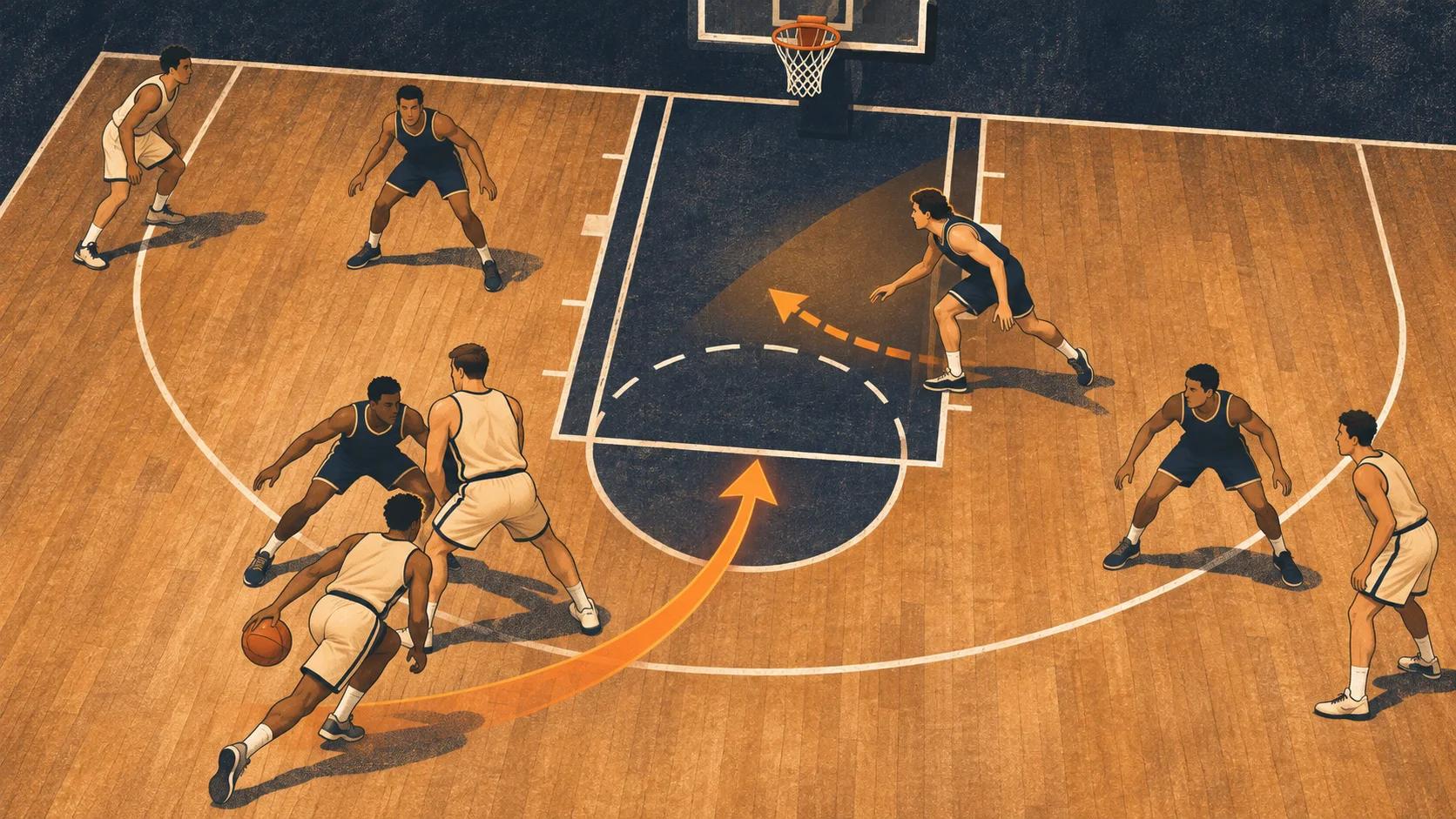
The low defender is the teammate of the on-ball defender positioned near the baseline on the help side. When a guard turns the corner in a pick and roll, that defender often has to choose between stopping the roll and staying connected to a perimeter player. Study that choice before you study whether the shot went in.
This worksheet gives you a repeatable question for your next film session: Who takes away the roll, and what pass does that leave? It is a teaching framework, not a claim that every defense follows the same rotation.
Freeze the possession before the screen arrives
Write down the ball location, screen angle, and weak-side spacing. A corner shooter and a lifted wing create different passing windows. If the corner is empty, the nearest helper may start from a different position. Do not copy a read from an NBA possession without checking your team's spacing.
Identify three defenders: the guard's defender, the screener's defender, and the lowest helper away from the ball. Describe their positions in ordinary words. For example: “The big is below the screen, the guard trails, and the weak-side corner defender has one foot in the paint.” That is more useful than writing “bad defense.”
Make a prediction before pressing play
Pause when the ball handler's shoulder clears the screen. Choose one prediction:
- The low defender steps toward the roller, leaving a pass behind the help.
- The low defender stays home, leaving the roller for the big and the guard.
- A higher defender rotates down, changing who owns the next pass.
Now resume the clip. Record the actual first movement. Your prediction can be wrong even when the offense scores. The purpose is to improve recognition, not to justify the final result.
Use this five-column worksheet
| Possession | Coverage seen | Low defender's first move | Pass available | Your next read |
|---|---|---|---|---|
| Practice example | Big stays below screen | Corner helper tags roll | Pass toward vacated corner | Check whether wing rotates down |
| Your clip 1 | ||||
| Your clip 2 | ||||
| Your clip 3 |
The practice row is hypothetical. Do not enter a coverage label until you can explain the defenders' actions. A late switch can resemble a failed drop for a few frames. Watching the possession from the start often resolves that ambiguity.
Separate the pass from the execution
A corner pass is not automatically correct because the low defender helped. The ball handler still needs an angle, balance, and enough time to deliver it. A defender at the nail may close the lane. A pass floated across the court may let the defense recover.
Grade the decision and the delivery separately. “Saw the corner, threw late” produces a specific practice task. “Turnover” alone does not. On the next possession, look for an earlier pass or a change in pace that holds the helper for an extra beat.
Turn the observation into a practice constraint
Use a small-sided possession with your coach. Give the low defender two options: tag the roll or stay attached to the corner. The guard must call the first movement aloud, then make the read. Start slowly enough that recognition remains accurate. Add a rotating wing only after the first choice becomes clear.
Measure what you can observe: correct identification, pass timing, and whether the receiver catches ready to act. A made shot is useful feedback, but it does not replace those three checks. Adapt the drill to your team's rules and available space.
Use HoopBrief to prepare your questions
Start with the free scout for a supported NBA player. Use the result to choose one tendency to investigate, then test it against the possessions you can actually watch. Ask a focused follow-up in HoopBrief: “Explain the low defender's responsibilities against a high pick and roll, and give me three things to check on film.”
HoopBrief's NBA data can support an NBA study example. It does not establish what your high-school opponent or European club will do. For those teams, enter your own observations and treat any proposed coverage as a hypothesis until you verify it. See the methodology for the product's grounding and limitations.
When the free example helps you form a better question, compare the current plans against how often you need saved reports and follow-up analysis. Buy for a repeatable preparation task, not for a promise that an AI report will win a game.
Questions to answer after the session
Do I always pass to the corner when the low defender helps? No. Check the passing lane and the next rotation. Help creates a potential advantage, not a guaranteed pass.
Can I use NBA film to prepare for high school basketball? Yes, as a teaching example. Your team's spacing, skill, rules, and coaching instructions determine whether the same read transfers.
How do I know I improved? Repeat the worksheet on unfamiliar possessions. Compare how accurately you identify the first helper and how clearly you explain the next rotation before seeing the outcome.
Basis for the teaching framework
The FIBA WABC Level 2 manual discusses coordinated team help behind ball screens. The worksheet and practice progression here are HoopBrief editorial exercises, not a claim that FIBA endorses this report or a universal coverage.