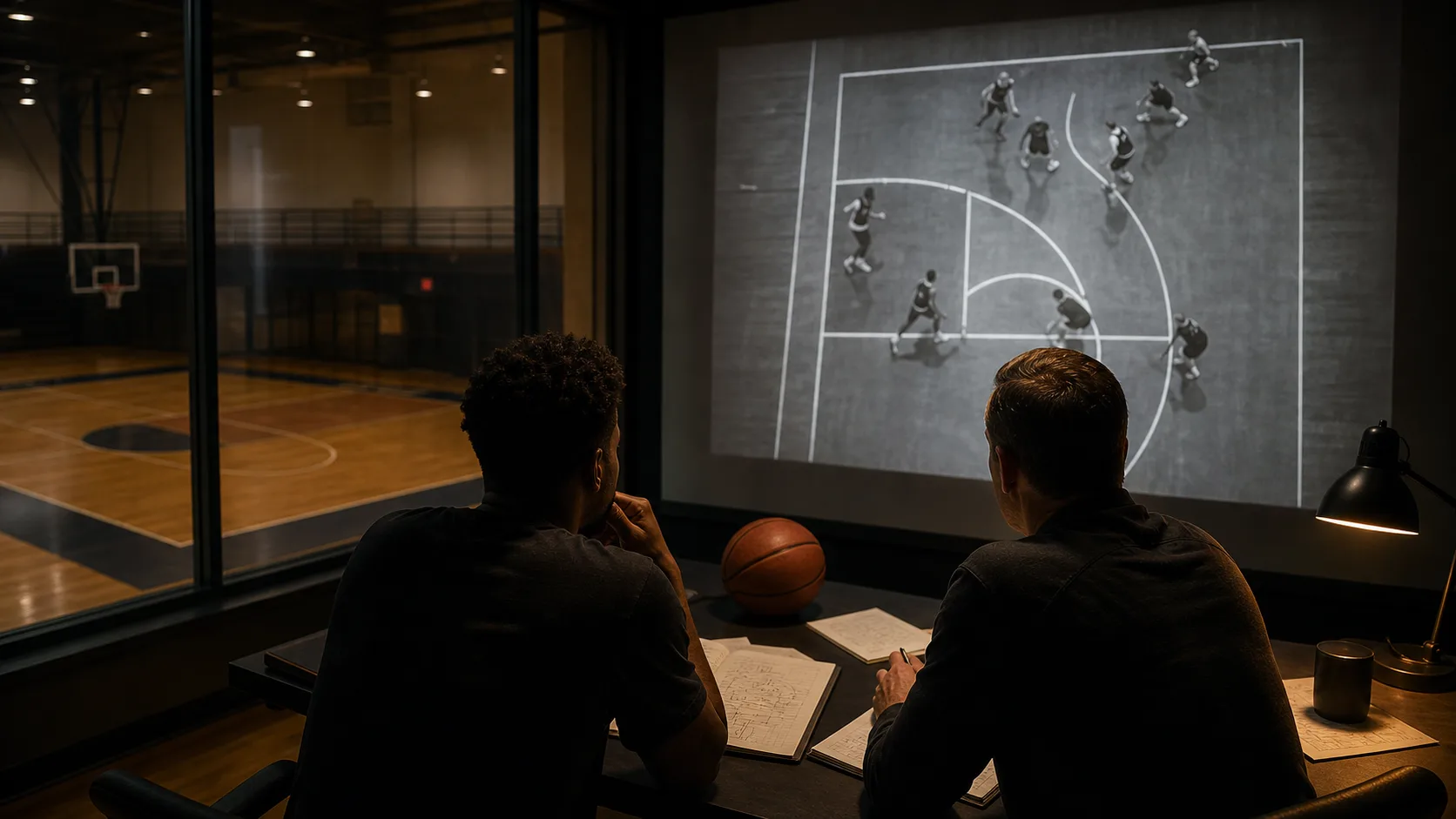
That is the argument for watching it differently than a fan does. By December, every team's coverage is contaminated by 25 games of opponents attacking it and 25 games of counter-adjustment. On October 20 you are looking at what a staff decided in September, unedited.
Here is what each game answers.
Celtics at Pistons, 3:00 pm ET
The question: how do you build a defense around two forwards who both want the same help responsibilities?
Boston traded Jaylen Brown to Philadelphia in July and paired Jayson Tatum with Paul George. Offensively that fit is easy to imagine. Defensively it is the more interesting problem, and it is the one that will show up first.
Watch the low-man responsibility. When Detroit runs a side ball screen, the weak-side forward has to decide between staying attached to a corner shooter and dropping to the rim. Boston's scheme under its recent staffs has leaned on aggressive nail help with hard closeouts back out. George at this stage of his career is a smart positional defender rather than a recovery athlete, and if Boston asks him to make the same closeout it asked of a younger wing, that is a scheme choice with a visible cost.
Detroit, meanwhile, earned the East's other top record last season by being genuinely difficult to screen. Watch how many of their ball screens result in a switch versus a fight over. The number tells you whether they think their personnel advantage is size or speed.
The three possessions to rewind: Boston's first defensive possession against a Detroit side ball screen. Boston's first after-timeout offensive set. Any Detroit possession where they attack Tatum and George on consecutive actions, which is how a staff tests whether the pairing has a seam.
76ers at Knicks, 7:00 pm ET
The question: what does a champion's defense look like when everyone has 82 games of tape on it?
New York raises its 2025-26 championship banner and then plays a Philadelphia team that added LeBron James and Jaylen Brown. It is the marquee game and it is also, from a coaching standpoint, the most instructive.
Championship defenses face a specific problem in the following season: their coverage rules are now the most-studied document in the league. Every staff spent the summer building attacks against them. So the interesting thing is not whether New York's defense is good, it is whether it is the *same*. If the Knicks open in the same coverages that won them a title, that is a statement of confidence. If they have added a wrinkle, a different ball-screen default or a new late-clock switch rule, that is a staff that knows it has been solved and got ahead of it.
Philadelphia's side is a spacing question. LeBron James and Jaylen Brown are both most dangerous with a live dribble and a driving lane. The tension in that roster is who occupies the strong-side corner and whether the floor gets crowded in exactly the area both players want. Count how many possessions end with a drive into a two-man wall. That number is the season's central question for them, and it will be visible in the first quarter.
The three possessions to rewind: New York's first defensive possession against a James-initiated ball screen. Philadelphia's first possession with James and Brown on the floor together in a half-court set. New York's first late-clock possession, which is where a champion's hierarchy shows up unmistakably.
Thunder at Spurs, 9:30 pm ET
The question: what did each staff learn from an eight-game Western Conference Finals?
This is the best coaching film of the three, and it is not close. These teams played eight games against each other last spring. Both staffs have a complete book on the other, and both spent the summer building answers to what happened.
Series rematches early the next season are the highest-signal games in basketball. A regular-season opener between two teams with no history is guesswork. This one is a direct read on which adjustments each staff decided were permanent.
Watch the Wembanyama coverage specifically. Oklahoma City spent a series learning what happens when they put Shai Gilgeous-Alexander into ball screens involving Victor Wembanyama as the drop defender. Whatever they run on the first three of those possessions is the summer's conclusion. If it looks like what they ran in Game 8, they think the answer was execution. If it looks different, they think the answer was scheme.
San Antonio's version of the same test is how they defend Gilgeous-Alexander in the last six seconds of a clock. He is the hardest late-clock cover in the league, and there are only about four legitimate approaches. Which one San Antonio opens with tells you what they believe.
The three possessions to rewind: the first SGA ball screen with Wembanyama as the screener's defender. The first Spurs possession where Wembanyama touches the ball above the free-throw line. Any possession in the last six seconds of a shot clock for either team.
How to actually watch this
The temptation on opening night is to watch all three games as a fan and retain an impression. Impressions are dominated by whether shots went in, which is the least stable and least transferable thing on the floor.
A better method, and it takes about 20 minutes per game rather than two and a half hours:
Pick one question per game before tipoff. The three above are fine. Any single specific question beats general attention.
Watch the first five possessions of each type. First five ball screens. First five post touches. First five after-timeout sets. Defaults live at the beginning, before a game's flow starts producing exceptions.
Write down the rule, not the result. "They ICE side ball screens and send the low man from the corner" is durable knowledge. "They got a stop" is not.
Check it again in January. The gap between the October rule and the January rule is the most useful thing you can learn about a coaching staff, because it tells you what they are willing to abandon.
This is the same method that works on your own opponents, and the reason it works is that ten deliberately chosen possessions beat a hundred watched passively. The constraint on most coaching staffs is not access to film, it is the hours between the film existing and a decision coming out of it.
That gap is the specific thing HoopBrief closes. Ask a matchup question and you get a decision-ready brief in roughly five seconds, built from NBA play-by-play and tracking data across 12 coaching lenses. No film to upload, no analyst to hire.