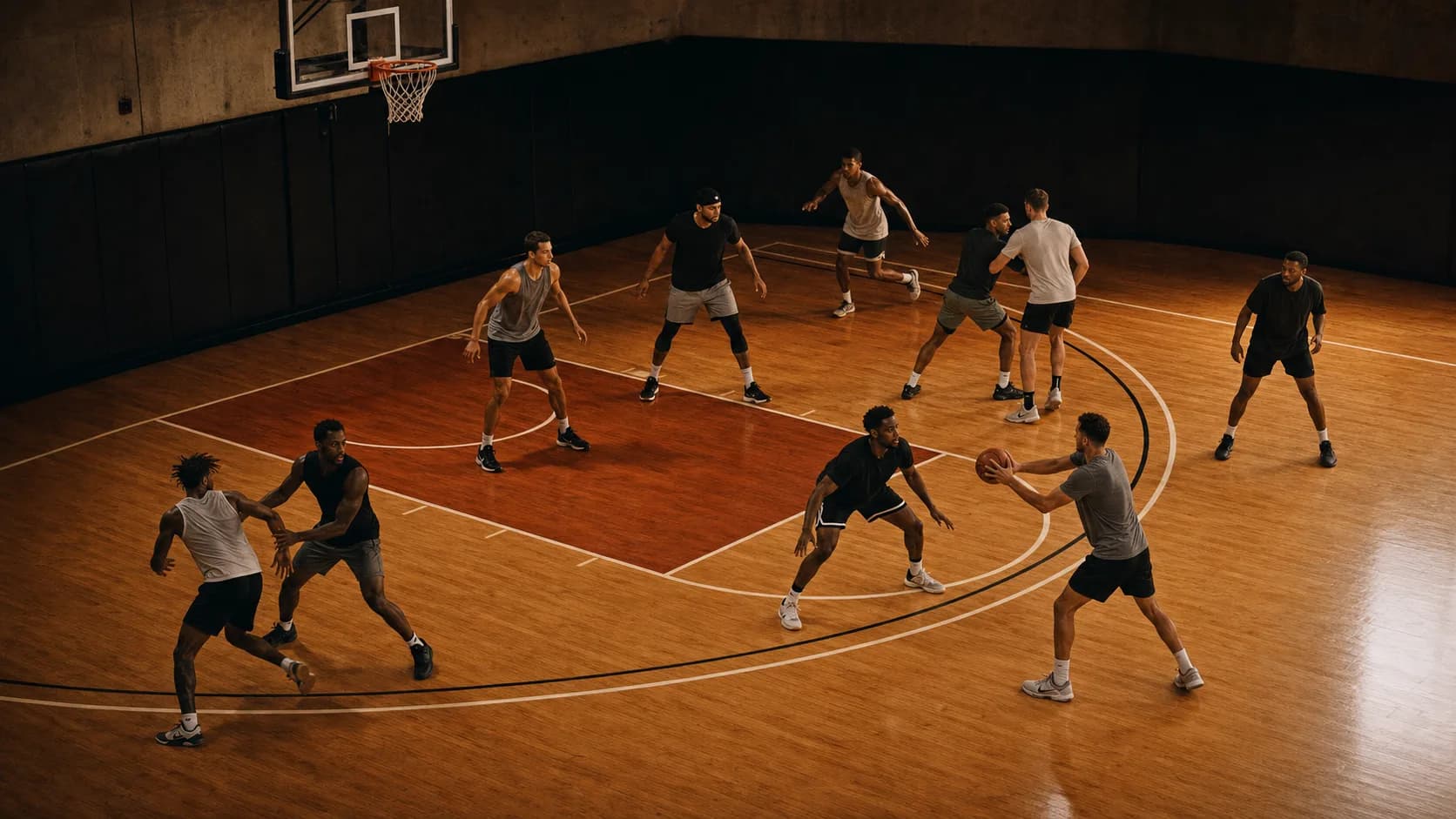
Man-to-man should be the base defense for most teams, and a zone should be the change-up. Man-to-man teaches every player to guard, holds each player accountable for a matchup and adapts to any offense. A zone earns a bigger role in three situations: your players are big but not quick, you need to protect players in foul trouble, or the opponent cannot shoot from outside. For players under 12, the answer is simpler. The USA Basketball and NBA youth guidelines recommend no zone defense at all before that age.
| Your situation | Base defense | Change-up | Why |
|---|---|---|---|
| Quick, competitive, average size | Man-to-man | 2-3 zone after timeouts | Pressure plays to your strength |
| Big but slow | 2-3 zone | Man-to-man late in games | Protects the paint without chasing |
| Thin bench or foul trouble | Zone | Man-to-man in the fourth quarter | Fewer fouls on the ball |
| Opponent shoots under 30% from three | Packed man-to-man or zone | None needed | Their threes are worth under 0.90 points |
| Opponent has one great scorer | Man-to-man with help rules | Box-and-one | Put your best defender on them |
| Players under 12 | Man-to-man only | None | Youth guidelines recommend no zone |
The math that decides it
Every defense concedes something. A zone usually concedes outside shots to protect the paint. Whether that is a good trade depends on how well the opponent shoots.
| Opponent's three-point % | Points per three attempt | Trade for a zone |
|---|---|---|
| 28% | 0.84 | Good. Let them shoot. |
| 32% | 0.96 | Roughly even |
| 36% | 1.08 | Poor unless you close out hard |
| 40% | 1.20 | Bad. Guard the arc. |
Compare those numbers with what you give up at the rim. A high school layup or post shot often goes in more than half the time, which is worth more than a point per shot. So against a team that shoots 28% from three, a zone that turns layups into threes is winning you possessions. Against a team that shoots 38%, it is losing them. Our guide to points per possession explains the math behind these numbers.
Why man-to-man is the default
Man-to-man is harder to learn and easier to live with. Every player guards someone, so you can see who is getting beaten and fix it. It adapts to any offense without a new rule. And it builds habits that last: closeouts, help position, talking on screens. Those are the same habits a zone relies on, so a team that plays man-to-man well usually plays a better zone too.
It is also why the youth guidelines lean so hard toward it. USA Basketball and the NBA recommend player-to-player defense only, with no zones, before age 12, so young players learn to guard a player on and off the ball instead of standing in an area. If you coach a younger team, the decision is already made.
When a zone is the right call
A zone is not a shortcut. Played well, it is a real defense with its own rules, and USA Basketball's principles of the 2-3 zone start with the same fundamentals as man-to-man: talk, see the ball and your area, and close out under control. It is the right call when:
- Your players are tall but not quick. A 2-3 keeps your bigs near the rim instead of chasing guards on the perimeter.
- You are thin or in foul trouble. Zones put fewer players in one-on-one situations on the ball, so they tend to draw fewer fouls.
- The opponent cannot shoot. See the table above. If they shoot under 30% from three, make them prove it.
- You need a change of rhythm. Two or three possessions of zone after a timeout can stall an offense that has found its rhythm against your man-to-man.
What 2026-27 changes
Physical play is a point of emphasis. NFHS lists hand checking, displacement and push-offs as illegal contact for 2026-27, and post play gets special attention, including two hands on an opponent's back and forearm displacement. That makes aggressive on-ball man-to-man riskier if your players guard with their hands. Teach walls, not reaches, and see our guide to defending without fouling. For a team that cannot guard without its hands yet, it is also an argument for more zone early in the season.
The shot clock. NFHS counted 32 states using a shot clock in some form in 2025-26, and Alabama, Illinois, Oklahoma and Florida add a 35-second clock this season. Without a clock, an offense can hold the ball against a zone and wait for a mistake. With one, the zone only has to hold for 35 seconds, which makes a well-drilled zone more valuable in late-game situations.
Most good teams play both
The practical answer for most high school teams is one base defense, played well, and one change-up, installed by the second week of practice. A common split:
- Base: man-to-man with clear help rules (who helps on drives, who rotates, who boxes out).
- Change-up: a 2-3 or 1-3-1 zone used after timeouts, against poor-shooting teams, or when a key player has three fouls.
- Special: a box-and-one for the rare opponent with one great scorer.
Choose the defense the same way you choose your offense, from your roster. Our guide to choosing a basketball offense uses the same three roster questions from the other side of the ball.
Decide game by game with a scout
The base defense is a preseason decision. The change-up is a weekly one, and it depends on the opponent: can they shoot, who is their best scorer, and do they attack the rim? Our guide to scouting a team with no film shows how to answer those questions from three box scores.
HoopBrief turns that into a plan. Use Game Prep: type the opponent and what you know about them, such as "they shoot a lot of threes but not well, and their point guard drives left", and get a structured, scouting-style plan for which defense to play and how to guard their best players. For NBA players, HoopBrief's free How to Guard reports show how shot profiles turn into defensive rules. HoopBrief does not host or tag film. It gives you the first draft in seconds.
| Starter, $9.99 a month | Pro, $99 a month | |
|---|---|---|
| Game Prep for your next opponent | Included | Included |
| Questions | Unlimited | Unlimited |
| Positioning IQ cues | Not included | Included |
| Practice plans and player install sheets | Not included | Included |
| Coaching lenses | 5 | All 12 |
A free account gets three answers a month to try it on your next opponent. Coaches who plan defense week to week usually choose Pro for Positioning IQ cues, practice plans and install sheets. See plans and get started, or run the free matchup scout first.