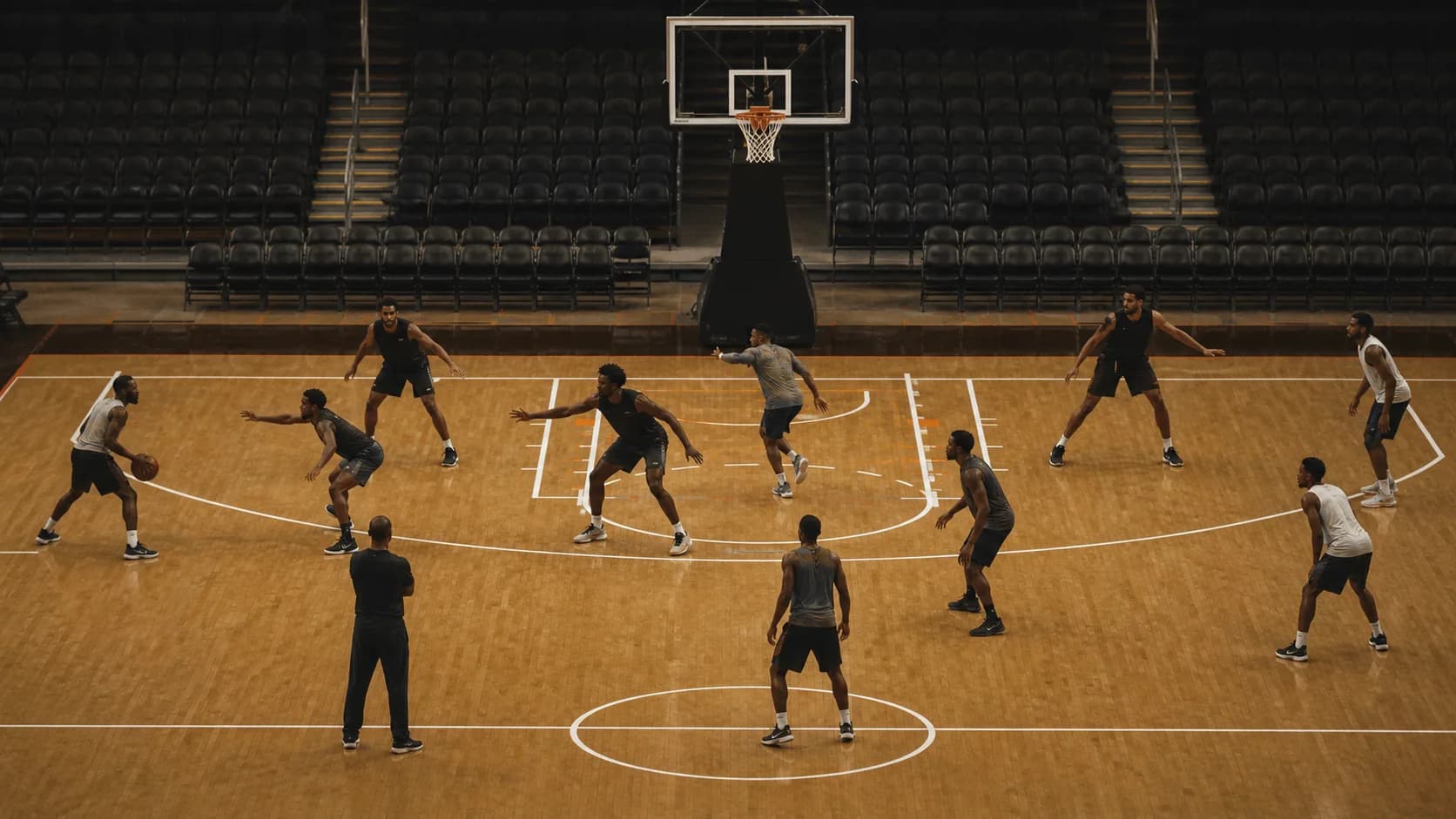
This is one of the most common situations in coaching and one of the least written about. Holiday tournaments, first-round playoff draws, out-of-conference nonleague games, and AAU pool play all routinely put you against a team you have never seen. Video platforms do not help here, because the entire premise of a video platform is that footage exists. What follows is the workflow that does help.
Start with the box scores, not with the film hunt
Spend ten minutes searching and then stop. Check MaxPreps, your state association's results page, the opponent's own athletics site, and the local paper. Then check whether any of their games streamed on the NFHS Network, because a single streamed game converts this whole exercise back into a normal scout and is worth ten minutes of searching to find.
If you come up empty on video, commit to the data. Five box scores is the target. Three is workable. One is a rumor.
Now compute two numbers per game. Possessions is approximately field goal attempts, minus offensive rebounds, plus turnovers, plus 0.44 times free throw attempts. Points divided by possessions gives you points per possession, and doing the same for their opponents gives you their defensive number. The Basketball-Reference glossary has the exact formulas if you want to be precise, but precision is not the point. The point is to learn, before you ever see them, whether you are facing a 78-possession sprint or a 58-possession grind, and whether they win with offense or defense.
Read the stat line as a set of tendencies
Raw totals lie. Ratios do not. Here is the translation table I use.
| What you see in the box score | What it usually means | What you do about it |
|---|---|---|
| High three-point attempt rate, low free throw rate | Perimeter spacing team, jump-shooting identity | Run them off the line, close out short and high |
| High free throw rate, low three-point rate | Downhill driving team, seeks contact | Build a wall, load the paint, take the charge |
| Opponents post high turnover totals against them | They press, trap, or run a scrambling defense | Rehearse press break, add a safety guard |
| High offensive rebound totals | They crash multiple bodies | Decide now: nobody to the offensive glass |
| One player over 35 percent of team scoring | Hierarchy team | Load, deny, and make someone else beat you |
| Four players between 10 and 15 points | System team | Guard the scheme, not the man |
| Big minute gap between starters and bench | Thin rotation | Attack early, foul-hunt, push tempo late |
| Low team turnover total with a senior-heavy roster | Disciplined execution team | Do not gamble, guard straight up |
Two more reads worth pulling. Look at whether their point total varies wildly game to game. A team that scores 71, 44, 68, 39, and 66 is streak-shooting and vulnerable to a defense that takes away the first look. A team that scores between 58 and 64 every night is running a system, and beating them requires a plan rather than a hot half.
Then find their common opponent with you. If you both played the same team, that game is the most valuable box score in the set, because it gives you a calibrated reference rather than an abstract number.
Read the roster shape
Pull the roster with heights, grades, and numbers. This takes four minutes and produces disproportionate insight.
Count the bodies over 6 feet 3 inches. Two bigs and three guards with no true wing usually means a team that cannot switch one through five, which makes your best action a guard-big screen that forces a decision. Five interchangeable wings means the opposite, and screening will not create the advantage you want, so hunt in transition and off cuts instead.
Then look at class year. A roster with six seniors executes under pressure and rarely beats itself. A roster with six sophomores is talented and fragile, and pressure is a legitimate strategy rather than a gimmick. Cross-reference the roster with the scoring list: if the leading scorer is listed at 5 feet 10 inches, you are preparing for a guard-driven offense; if he is 6 feet 7 inches, your post defense plan is the whole game plan.
Numbers matter too. Get the jersey number of the leading scorer and the leading three-point shooter in front of every player before tipoff, because "number 12 does not get a clean catch" is a coachable instruction and "their shooter" is not.
Ask around, but ask correctly
The coaching network is the most underused scouting asset in the sport, and most coaches waste it by asking a general question. "What can you tell me about Central?" gets you "they are pretty good, big kid inside." Useless.
Ask four specific questions instead:
1. What do they run out of a timeout, and what do they run to start the second half? 2. What defense do they open in, and do they change it after a made basket? 3. Who is the one player you cannot leave open, and where does he get his shots? 4. What do they do when they are down six with three minutes left?
Those four answers give you their special-situation package, their base defense, their priority cover, and their endgame. Every one of those is worth more than a general impression. Text three coaches, expect two replies, and you will have a scout.
Also ask your own players. High school and AAU players know each other from summer ball, camps, and social media in a way coaches do not. Somebody on your bench has probably guarded their best player in June.
Write three assumptions and a kill switch for each
This is the step that separates a scout from a pile of notes. Take everything above and reduce it to no more than three written assumptions. Three, not eight, because your team cannot execute eight new ideas on two days of prep.
An example set:
- Assumption one. They are a spacing team that wants threes. Kill switch: if they take fewer than four threes in the first quarter, they are attacking the paint instead, so we drop our bigs and stop closing out so hard.
- Assumption two. Number 12 is their only reliable shooter. Kill switch: if a second player makes two threes, we stop helping off the weak side entirely.
- Assumption three. They press after made baskets. Kill switch: if they do not press in the first four minutes, we stop sending our safety guard back and we run in transition.
The kill switch is the whole point. You are going to be wrong about something, because you are working from partial information. Deciding the counter in advance, in the calm of a Wednesday office, is dramatically better than inventing one in a timeout with 6,000 decibels of gym around you.
The first-four-minutes live scouting template
Delegate this. A head coach cannot coach and scout at the same time, and pretending otherwise is how staffs end up with neither. Hand one assistant a single printed page with six items and nothing else:
| Item | What to record | Why it matters |
|---|---|---|
| Opening defense | Man, 2-3, 1-3-1, press | Determines your first offensive call |
| First two half-court sets | Rough diagram or name | Reveals their base action |
| Primary initiator | Jersey number | Tells you who to pressure |
| Screening side | Right, left, or middle | Sets your ICE or drop instruction |
| Screener behavior | Pops or rolls | Decides your big's coverage |
| Transition discipline | Do they get back or crash | Decides whether you push |
Six items, four minutes, one page. At the first dead ball after the four-minute mark, the assistant reports and you confirm or kill each of your three assumptions. Then you deliver exactly one adjustment to the team. One. A team that receives three adjustments in the first timeout executes zero of them.
By halftime you have effectively watched a half of film in real time, and your second-half plan is a normal scouting plan built on observed behavior instead of inference. The rest of the game is coaching, not scouting.
What not to do
Do not try to build a full possession-by-possession game plan from box scores. You will produce a document that feels rigorous and is mostly fiction. Box scores tell you who, how fast, and what kind of shots. They do not tell you scheme, and pretending otherwise creates a false confidence that is worse than admitting uncertainty.
Do not over-prepare your players. Give them three things about the opponent, maximum, and spend the rest of practice on your own execution. Against an unknown opponent, your own habits are the only variable you control.
Do not skip the self-scout. When you know little about the opponent, the highest-value preparation is knowing exactly what you do well and running more of it. Unknown opponents are a good argument for playing your own game harder, not for reinventing it.
Where a stats-first tool actually helps
This is the situation where a scouting tool that requires no upload is genuinely more useful than a video platform, because there is nothing to upload. If you can ask a question about personnel and get a structured report on tendencies, matchups, and coverage recommendations without any footage in the system, you have compressed most of the 90 minutes above into a few minutes.
That is the honest use case, and it is narrow: it does not replace watching film when film exists, and it does not know the specific sets a local high school runs. What it does is give you the archetype-level read fast, which is exactly the layer you are missing when the tape does not exist. Ask HoopBrief about the matchup you are facing, then layer in the box-score reads and the coaching-network intel above.
If your broader problem is that you have no scouting budget at all, the companion piece is budget basketball scouting stacks for 2026, which builds three full setups at $0, under $500, and under $2,000 a year.