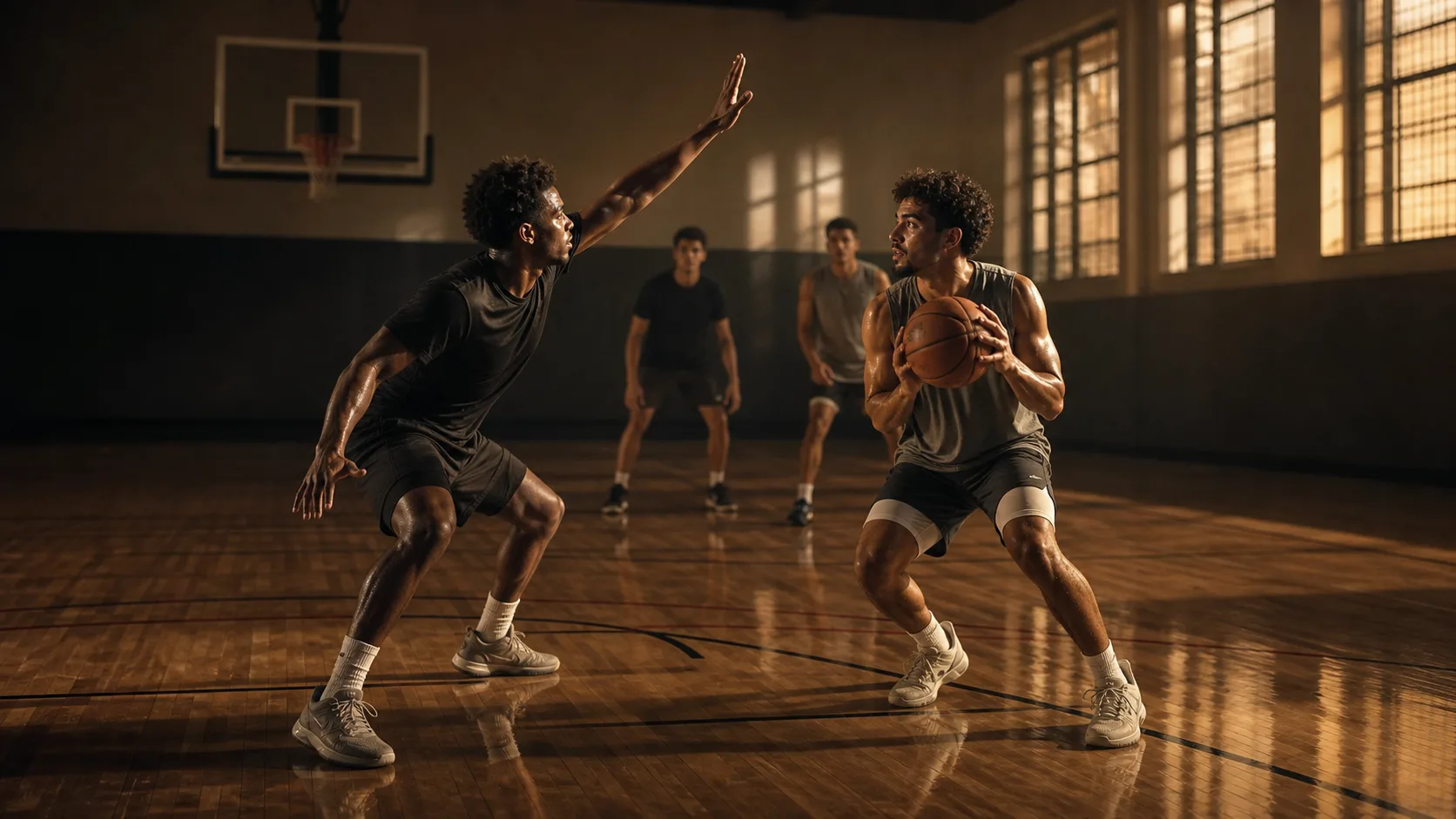
Guarding a shooter is different from guarding a scorer. A slasher hurts you with the ball in his hands; a knockdown shooter hurts you when he does not have it, running you through a maze of pin-downs and flares until you are a half-step late and he is rising into a rhythm three. If you wait to react until he catches, you have already lost. The work happens off the ball, in the two seconds before the pass. Here is how to do that work.
How do you guard a really good shooter?
You guard his feet and his path, not the ball. An elite shooter needs two things: separation and rhythm. Deny both. Get into him physically, take away his path to his spots, and make every catch a hard, off-balance one. Your mindset flips from a normal defender: you would rather give up a contested drive than a clean set-feet three, because for this player the three is the money shot and the drive is the concession.
That means playing him differently from everyone else on the floor. You do not sag, you do not help off him one pass away, and you never lose sight of him to watch the ball. Your eyes stay on his waist, your body stays attached, and you treat every screen as a threat to your positioning. The tendencies that tell you which spots he loves are the same ones covered in how to exploit a matchup in basketball, read from the defensive side.
Top-lock: keeping him off his spots
Top-locking is your first weapon against a movement shooter. When he tries to use a pin-down or a flare to get to his spot, you jump to the high side, between him and the screen, and deny the path to the shot. Instead of letting him curl into a rhythm catch, you force him to give it up and cut backdoor, where a help defender is waiting to bump him.
The key is knowing when to top-lock. You do it when he is heading toward his favorite shooting spot, usually a wing or the top, and when there is a helper behind you to protect the backdoor. If there is no backdoor help, top-locking is a gamble, because a good shooter will simply slip behind you for a layup. Used right, it takes the shooter's first option completely off the table and forces the offense into its second or third read. Pair this with the movement-screen reads in how to guard a shooter coming off screens.
A worked example: chasing over a floppy action
Picture a floppy set: the shooter starts under the rim and can choose either a left or right pin-down. He breaks right off a double screen. Here is the sequence that keeps him quiet.
As he plants to come off, you are already on his back hip, inside arm on his outside hip, low and moving. You do not go under the double, because under gives him a clean catch-and-shoot pocket. You chase over the top, slipping through the sliver of space between him and the screeners, taking the contact on your body without stopping your feet. If the screen catches you, your screener's defender is in a gap and bumps the cutter, a brief show that stalls the shooter for the half-beat you need to recover to his hip.
Now he catches on the right wing, but he catches it moving, with your hand in his airspace, off balance. You close out the last step short and high, chest to his shooting shoulder, chopping your feet. The clean rhythm three he wanted is gone. His options are a contested fadeaway, a drive into your set feet and the loaded help, or a pass back out to reset. You made an elite shooter take a hard shot or give it up, which is the whole objective. This kind of connected chase-and-recover is built on the fundamentals in how to improve your basketball defense.
Closing out short and living with the drive
When the shooter does catch, the closeout decides everything. Against this player you close out to take away the shot first, which means arriving short and high rather than long and flat. Fly at him and you invite the shot fake, the side-step, and the blow-by. Arrive under control and you can contest the three and still slide with a drive.
Here is the priority order that should govern your closeouts against a knockdown shooter.
| Situation | Your first job | Acceptable outcome |
|---|---|---|
| Catches with feet set | Contest the three, high hand | Force a drive into help |
| Catches on the move | Close short, stay attached | A contested off-balance shot |
| Catches in the corner | Take away baseline, high hand | Force middle into your help |
| Shot-fakes you | Stay down, slide, wall up | A contested pull-up two |
The through-line is simple: you always take the three away first and live with the two. Every closeout is short, high, and under control, because against this player the worst thing you can give up is a clean, balanced catch-and-shoot look. Everything else is a win. Sharpen the anticipation behind these reads in how to read a defense in basketball.
Want the shot chart and off-ball tendencies of the exact shooter you are prepping for, his favorite spots, his go-to actions, and how he likes to relocate? Ask HoopBrief and get the matchup mapped out.