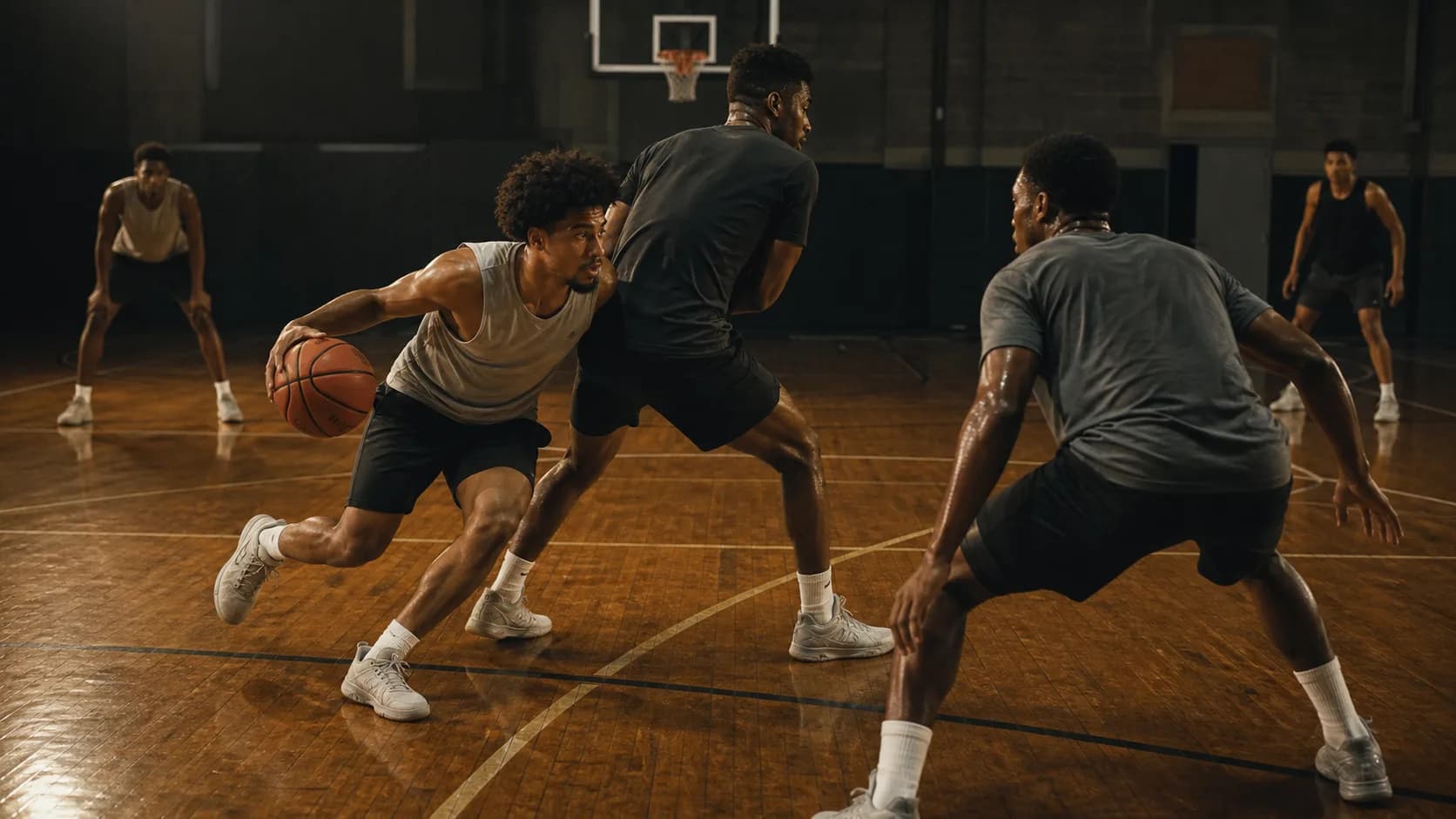
A ball-dominant lead guard is the hardest cover in basketball because the ball is always in his hands and the whole offense runs through his decisions. He controls tempo, he picks his spots, and he has counters for every coverage. You cannot erase him. What you can do is build a plan that taxes him on every possession, so that by the fourth quarter he is tired, frustrated, and making rushed reads. That plan has three layers: pressure, coverage, and gaps.
How do you defend a high-usage point guard?
You raise the cost of every decision. Firm on-ball pressure speeds up his reads and shortens the clock he has to survey the floor. A coverage tailored to his weakness takes away his first option. And gap help off his teammates clutters the lanes so that even when he beats his man, he sees a crowd. No single layer stops him, but stacked together they turn easy possessions into hard ones.
The mindset is patience over hero-ball. Your on-ball defender is not trying to strip him or block his shot; he is trying to be a nuisance who never lets the guard get comfortable, while trusting the four defenders behind him to do their jobs. That trust and communication is the backbone of team defense, and it starts with everyone reading the same picture, which is exactly the skill in how to read a defense in basketball.
Pressure or sag: reading his best weapon
Your first decision is how tight to play him, and it comes down to whether he is a better shooter or a better driver. Pressure the pull-up shooter to deny him the air space to rise, and stay disciplined against his change of pace. Sag off the downhill speed guard to keep a cushion and dare him to shoot. Getting this backward is fatal: crowd a burner and he blows by you, sag off a shot-maker and he rains pull-ups.
Here is the read in one place.
| His primary weapon | Play him | The line you walk |
|---|---|---|
| Pull-up and step-back threes | Pressure, hand in airspace | Do not overcommit and get driven |
| Downhill speed and finishing | Sag a cushion, stay in front | Do not concede the rhythm three |
| Elite at both | Pick your poison by spot | Force his second-best option |
| Passing over scoring | Contain and wall off the paint | Do not let him split two defenders |
The point is that pressure is not a personality, it is a tool. You dial it up or down based on what this specific guard does best, and you build the rest of your coverage around taking that away. That tendency read is the same lens described in how to exploit a matchup in basketball.
Choosing the pick-and-roll coverage
Everything a lead guard does eventually runs through a ball screen, so your pick-and-roll coverage is the heart of the plan. Drop keeps your big back to protect the rim and concedes the mid-range pull-up, so it fits a guard who would rather drive than shoot. Blitz and hedge get the ball out of his hands fast, so they fit an elite shot-maker you cannot let operate in space. Switching neutralizes the screen but risks a mismatch he will hunt.
Whatever you pick, the on-ball defender must be physical and give great effort every rep, and the screener's defender must communicate early and loud so the back line knows the plan. The moment you blitz, the other three defenders play behind the ball in a rotation, tagging the roller and stunting at shooters, because a blitz turns the possession into a temporary 4-on-3. Get the full coverage tree and its counters in pick-and-roll coverages explained.
A worked example: gapping the pick-and-roll
Say your opponent's star runs a middle ball screen and he is an elite pull-up shooter but a merely good passer. You choose to hedge, sending your big out to briefly wall him off at the level of the screen so he cannot rise into the pull-up. That show buys a beat, but it also means the roller is momentarily open, so now the gaps decide the possession.
The weak-side defenders are sitting in the gaps, one pass away, in the space between their man and the ball. As the guard picks up his dribble to escape the hedge, the low man tags the roller so he cannot catch on the move, and the nail defender stunts at the guard's chest to stall any split. The guard's picture is ugly: a big in his face, a tagged roller, and help clogging the middle. His best read is now a kick to a spot-up teammate, which is exactly the outcome you wanted. The ball is out of his hands, and a lesser scorer has to make the play. Then everyone closes out and the defense resets, having survived the most dangerous action on the floor. The discipline to hold those gaps and recover is built in how to improve your basketball defense.
That is the whole philosophy against a ball-dominant lead guard: you do not need to stop him, you need to make him give it up. Want the coverage map for the exact star guard on your schedule, his pull-up tendencies, his favorite screen spots, and where he goes when you take the paint away? Ask HoopBrief for a possession-level breakdown.